 KnowThis
Key Takeaways
Key Takeaways
- 1A resume is short and selective — it includes only the experience relevant to one specific job, and typically stays under two pages regardless of career length.
- 2A CV is comprehensive and cumulative — it grows over an entire career and includes items a resume would never list, like publications, conference presentations, or grants.
- 3Which one to use depends on the field and region, not personal preference: academia, research, medicine, and many international job markets expect a CV; most other roles in general industry expect a resume.
The concept
Once purpose is separated from length, the practical rule becomes simple: match the document type the field and the specific posting expect, not the one you're more familiar with.
What is the core functional difference between a resume and a CV in U.S. usage?
Worked examples
Example 1: A marketing professional applying for an industry role (baseline case)
A marketing manager with eight years of experience applies to a corporate marketing director role. They submit a two-page resume that highlights only their most relevant campaigns, results, and leadership experience — older or unrelated roles from early in their career are summarized in one line or omitted. This is the expected format for the role and industry.
Example 2: A researcher applying for a university faculty position (edge case / variation)
Why would submitting a short, resume-style summary instead of a full CV hurt a candidate applying for an academic faculty position?
Example 3: Applying to jobs in two different countries (real-world / applied case)
A software engineer applies to a company in the United States and, separately, to a company in a country where "CV" is the standard term for a short application document. For the U.S. role, they submit a two-page American-style resume. For the international role, they submit a similarly short document but label it "CV" because that's the term the posting uses and the expected length in that market — not a comprehensive academic-style document. The content strategy is nearly identical; only the label and local convention differ.
A job posting outside North America asks for a 'CV' and specifies a two-page limit. What should the candidate submit?
How it works (visual)
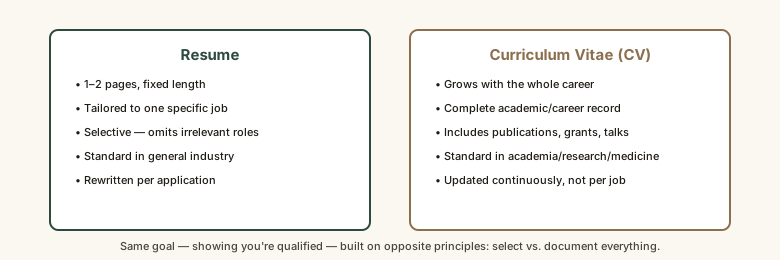
The two columns rarely overlap in practice — a role expecting one format almost never expects the other, which is why matching the field's convention matters more than personal preference.
Common mistakes
Common Mistakes
Submitting a full academic-style CV to a general industry job posting.
→ Condense to a tailored one-to-two-page resume — industry recruiters expect brevity and relevance, not a complete record.
Trimming a genuine academic CV down to resume length for a faculty or research application.
→ Keep it comprehensive — academic hiring committees specifically expect the complete publication and activity record.
Assuming the word used in a job posting always signals document length, regardless of region.
→ Check the posting's actual instructions (page limit, required sections) — regional usage of the word 'CV' varies.
Common misconception
“Resume and CV are just two different words for the exact same document.”
In U.S. and Canadian usage, they're functionally different documents — different length, different purpose, different expected content. A resume selects and tailors; a CV documents comprehensively. Outside North America, "CV" often does simply mean what Americans call a resume, which is where the confusion usually comes from — it's a regional naming difference layered on top of a real functional difference, not purely one or the other.
What to do next
What to do next
- Check the job posting's field: general industry roles almost always expect a resume; academic, research, and medical roles almost always expect a CV.
- If the posting specifies a page limit, follow it regardless of which word ('resume' or 'CV') the posting uses.
- For a resume, cut anything not relevant to the specific job — for a CV, keep the full record complete and up to date.
- Read How to Quantify Achievements on a Resume next to strengthen the content once you've picked the right format.