 KnowThis
Key Takeaways
Key Takeaways
- 1Parkinson's Law observes that work tends to expand to consume whatever time is allotted to it, regardless of the task's actual minimum required effort.
- 2A loose deadline provides no signal for when to stop, so effort keeps getting added — extra polish, extra checking, extra revising — well past the point of diminishing returns.
- 3Deliberately setting a tighter, artificial deadline (shorter than the true one) is the most direct practical countermeasure, forcing a stopping point that a generous deadline doesn't provide.
The concept
Once the mechanism is framed as "no forced stopping point" rather than "the task genuinely needed that long," the fix becomes obvious: create a stopping point deliberately, rather than waiting for the loose deadline to eventually arrive.
According to Parkinson's Law, why does a task given a week to complete often end up taking most of that week, even if it could genuinely be finished in an afternoon?
Worked examples
Example 1: A report given a generous deadline (baseline case)
Example 2: The same report given an artificial 2-hour deadline (edge case / variation)
A writer sets themselves a tight, self-imposed 2-hour deadline for a report that would otherwise be given a full week, and finishes at similar quality. What does this suggest about the extra time in the original week-long deadline?
Example 3: Structuring project deadlines across a team (real-world / applied case)
A manager notices that every project given a two-month deadline takes close to two months, regardless of its actual scope, while similar-sized projects given tighter deadlines finish faster without a drop in quality. Rather than assigning every project the loosest deadline that seems safe, they start setting deadlines closer to a realistic estimate of required effort, with some built-in slack for genuine uncertainty rather than open-ended extra time. This produces more predictable delivery timelines without the quiet expansion Parkinson's Law predicts under looser deadlines.
Why might setting project deadlines closer to a realistic effort estimate — with modest slack for uncertainty — produce more predictable outcomes than giving every project the loosest deadline that seems safe?
How it works (visual)
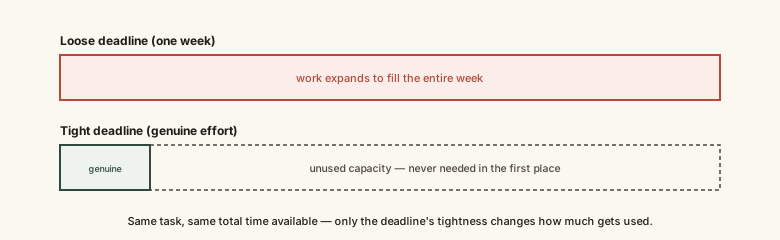
The gap between the two bars isn't wasted time in a literal sense — it's time that got absorbed by marginal effort simply because nothing signaled the task was already effectively done.
Common mistakes
Common Mistakes
Assuming a task that took a long time genuinely required that much time.
→ Check by testing a tighter self-imposed deadline on similar future tasks — a similar-quality result in less time is evidence the extra time was expansion, not necessity.
Applying artificial deadlines indiscriminately without checking whether the task could actually suffer from too little time.
→ Set artificial deadlines close to a realistic estimate of genuine effort with some slack for uncertainty, not at an arbitrarily aggressive minimum.
Treating every deadline extension request as evidence more time is genuinely needed.
→ Consider whether the original deadline was already loose enough to have invited expansion — sometimes the fix is a tighter, clearer deadline next time, not simply more time now.
Common misconception
“Giving a task more time always produces a better result.”
Past a certain point, additional time mostly produces diminishing returns — small, often unnecessary refinements rather than meaningful quality gains. Parkinson's Law describes exactly this pattern: extra time doesn't sit unused, it gets absorbed into additional effort regardless of whether that effort meaningfully improves the outcome. More time and better results are related, but not directly proportional past the point where real requirements are already met.
What to do next
What to do next
- For your next task, set a self-imposed deadline noticeably tighter than the actual due date, and see how much of the 'extra' time was genuinely necessary.
- When a task keeps expanding without clear improvement, ask whether you've already passed the point of diminishing returns.
- When setting deadlines for others, aim close to a realistic effort estimate with modest slack, rather than defaulting to the loosest 'safe' timeline.
- Read What Time Blocking Actually Is next to see how assigning a fixed calendar slot reinforces the same stopping-point effect.