 KnowThis
Key Takeaways
Key Takeaways
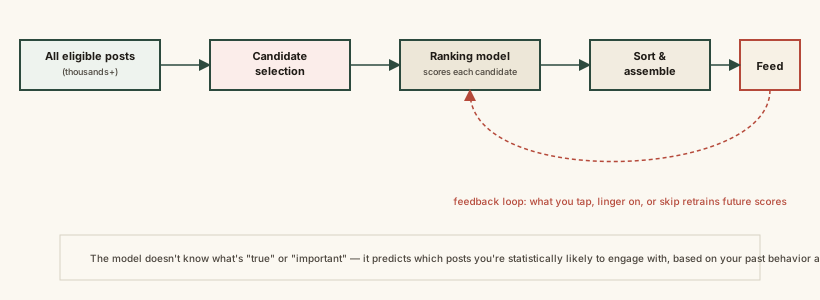
- 1A feed's order comes from a ranking model scoring a narrowed-down pool of candidate posts against predicted engagement — not strict chronological order, and not a human editor's pick.
- 2The model doesn't judge truth, importance, or quality — it predicts what you're statistically likely to react to, based on your own past behavior and similar users' behavior.
- 3Your reactions to what you're shown feed back into the same model, which is why two people with different habits on the same platform see very different feeds even for the same topic.
The concept
Once a feed is understood as a prediction, not a neutral timeline, patterns that used to feel arbitrary — why certain posts blow up, why two people's feeds diverge so sharply — start making mechanical sense.
Two friends follow all the same accounts on a social platform, but their feeds look completely different. What best explains this?
Worked examples
Example 1: Liking posts about one topic changes what shows up next (baseline case)
Someone notices their feed shifted toward a new topic shortly after they engaged with a few posts about it. What caused the shift?
Example 2: A widely shared post that turns out to be misleading (edge case / variation)
Why can a misleading post sometimes get ranked and shown very widely by a feed algorithm?
Example 3: Understanding why a switch to chronological order changes the experience (real-world / applied case)
Some platforms offer a setting to switch from the default ranked feed to a strictly chronological one. Choosing chronological order effectively removes the ranking model's scoring and sorting step entirely, showing posts purely in the order they were posted from accounts a person follows. The tradeoff becomes visible immediately: chronological feeds show far less content overall (since there's no candidate-narrowing step optimizing for relevance) and can surface far more low-engagement or off-topic posts, but they also stop reinforcing the feedback loop that narrows a person's exposure toward whatever they've engaged with most.
Someone switches their feed setting from the default ranked view to a chronological view. What actually changed under the hood?
How it works (visual)
Common mistakes
Common Mistakes
Assuming a social media feed shows posts in the order they were made.
→ Most default feeds are ranked by predicted engagement, not posting time — a strictly chronological feed is usually a separate, optional setting where available.
Believing the algorithm knows or cares whether content is true.
→ Base ranking models optimize for predicted engagement, not accuracy — factual verification, where it exists, is typically a separate system layered on top.
Thinking your feed is identical to what other people following the same accounts see.
→ Ranking is personalized per account based on individual engagement history, so identical follow lists can still produce very different feeds.
Assuming the feed is a fixed, unchanging list rather than a live prediction.
→ The ranking updates continuously as new engagement data comes in — the same post can rank differently for the same person at different times.
Common misconception
“Social media feeds are just a neutral, chronological list of what people you follow have posted.”
Most default feeds run every eligible post through a ranking model that predicts engagement and sorts accordingly — the order is a personalized prediction, not a neutral timestamp sort. This isn't inherently deceptive; it's a deliberate design choice to surface what a model estimates you'll find worth your time. But it does mean the feed reflects a statistical guess about your preferences, filtered through what the platform can measure, not an unfiltered record of everything posted.
What to do next
What to do next
- If a platform offers a chronological feed option and you want less algorithmic filtering, try switching to it and compare what you see.
- Remember that liking or lingering on a type of content will likely shift future recommendations toward more of it — that's the feedback loop, not a coincidence.
- Be more skeptical of content that provoked a strong emotional reaction and spread quickly — that pattern is exactly what engagement-based ranking tends to amplify, regardless of accuracy.
- Read How Push Notifications Work next to see the related mechanism that pulls you back to check a feed in the first place.