 KnowThis
Key Takeaways
Key Takeaways
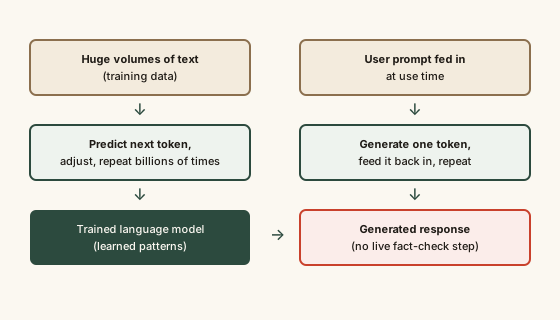
- 1A large language model generates text by repeatedly predicting the single most statistically likely next token, given everything written so far.
- 2It learns these patterns by processing huge volumes of text during training — it doesn't look up facts in a live database when answering.
- 3Because it's predicting plausible-sounding text rather than retrieving verified facts, it can produce confident, fluent answers that are still factually wrong.
The concept
This is also why a phrase like "the AI thought about it" is misleading in a literal sense — there's no separate reasoning step happening outside the token-by-token prediction process, even though the output can read as if there were.
Why can an LLM state an incorrect fact fluently and confidently, in the same tone as a correct one?
Worked examples
Example 1: Finishing a common phrase (baseline case)
Example 2: A confident wrong answer (edge case / variation)
Example 3: A long, multi-step answer (real-world / applied case)
An LLM produces a well-organized, multi-step answer with clear structure. What does this indicate about how it was generated?
How it works (visual)
Common mistakes
Common Mistakes
Assuming an LLM is searching the internet or a database in real time to answer.
→ Understand it's generating text from patterns learned during training, unless it's explicitly connected to a separate search or retrieval tool.
Trusting a confident, fluent tone as a sign of factual accuracy.
→ Verify specific facts, dates, and figures against a real source independently, especially for anything consequential.
Believing the model 'understands' or 'thinks' in the human sense.
→ Treat it as a powerful statistical pattern-completion system — useful, but mechanistically distinct from human reasoning or comprehension.
Common misconception
“An AI chatbot looks up the answer, the same way a search engine does.”
It generates its answer token by token from patterns learned during training, with no live lookup step in the core mechanism. Some AI products add a separate retrieval or search tool on top of the model specifically to address this gap, but that's an added component, not how the base language model works. This distinction is exactly why fluent-sounding wrong answers happen and why independently verifying important facts still matters.
What to do next
What to do next
- Treat an LLM's answer as a fluent first draft, not a verified fact — check anything consequential against a real, independent source.
- Watch for confident, specific-sounding claims about obscure or recent topics — these are exactly where unverified errors are most likely.
- If accuracy matters, prefer AI tools that explicitly cite retrieved sources over ones that answer purely from trained patterns.
- Remember that apparent 'reasoning' or 'structure' in an answer is a byproduct of pattern learning, not a guarantee the underlying logic was checked.