 KnowThis
Key Takeaways
Key Takeaways
- 1"AI" is an umbrella term, not one technology — it covers everything from a simple recommendation algorithm to a large language model, all of which perform tasks normally requiring human judgment.
- 2Most AI in use today is built through machine learning: a system is shown huge amounts of example data and adjusts itself to recognize patterns, rather than following hand-written rules for every case.
- 3AI systems don't "understand" the way people do — they identify statistical patterns in data, which is why they can be both extremely capable and confidently wrong at the same time.
The concept
Because it's a category rather than a single technology, the honest way to evaluate any AI claim is to ask what specific approach is being used underneath — not whether something is "AI-powered," but what it was trained on and what it's actually optimizing for.
A company advertises a new app as "powered by AI." What does that phrase alone actually tell you about how the app works?
Worked examples
Example 1: Email spam filtering (baseline case)
Example 2: A chess engine vs. a chatbot (edge case / variation)
Example 3: A medical image classifier (real-world / applied case)
Why can an AI medical image classifier perform worse for some patient groups than others, even if it's highly accurate overall?
How it works (visual)
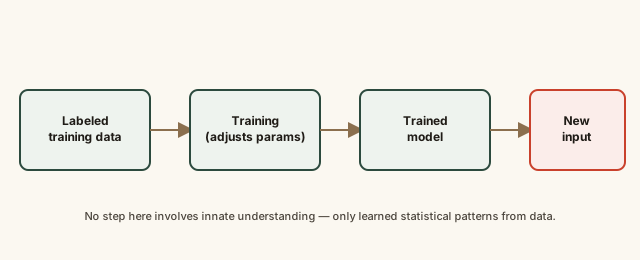
Every step in this pipeline is a place where things can go wrong — biased or incomplete training data produces a biased or incomplete model, no matter how sophisticated the underlying technique is.
Common mistakes
Common Mistakes
Treating "AI-powered" as a meaningful quality signal on its own.
→ Ask what specific method is used and what data it was trained on — the label alone tells you almost nothing about reliability.
Assuming AI output is verified fact because it sounds fluent and confident.
→ Treat AI output as a draft or a starting point, especially for factual claims — fluency and accuracy are not the same thing.
Assuming all AI systems work the same way under the hood.
→ Recognize that "AI" spans very different techniques (search, statistical pattern-matching, rule-based systems) with different strengths and failure modes.
Common misconception
“AI systems understand and reason about the world the way people do.”
Most AI systems in use today identify statistical patterns in data rather than reasoning from understanding — they can produce genuinely useful, sophisticated-looking output while having no actual model of truth, causation, or meaning behind it, which is exactly why confidently-stated AI output still needs independent verification for anything that matters.
What to do next
What to do next
- When a product claims to be "AI-powered," ask what specific technique it uses and what data trained it before trusting the claim.
- Treat AI-generated factual claims as a draft to verify, not a finished, checked answer.
- For anything high-stakes (medical, legal, financial), use AI output as an aid alongside a qualified professional, not a replacement for one.
- When evaluating an AI tool, look for disclosed information about its training data and known limitations, not just its stated capabilities.