 KnowThis
Key Takeaways
Key Takeaways
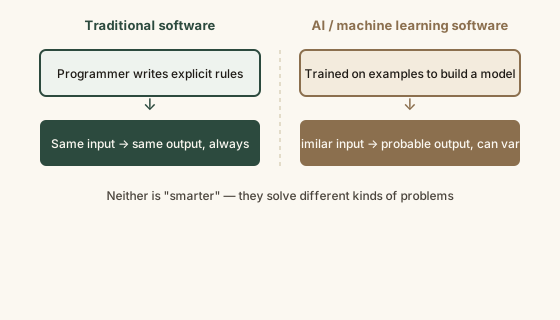
- 1Traditional software follows rules a programmer explicitly wrote — the same input always produces the same output.
- 2AI software is built by training a model on data, so it produces probabilistic, pattern-based output that can vary even for similar inputs.
- 3This is why AI can handle situations no programmer anticipated, but also why AI failures are harder to predict, reproduce, and debug than a normal software bug.
The concept
Neither approach is universally better — a bank's interest calculation should be traditional, deterministic software with a provably correct answer every time, while a system that has to handle messy, unpredictable real-world input (a photo, a sentence, a voice recording) is exactly where AI's pattern-matching becomes useful.
A calculator app and an AI photo-recognition app are both given the same input twice in a row. What's the honest expectation for each?
Worked examples
Example 1: Tax software (baseline case)
Example 2: A spam filter vs. a rule-based email sorter (edge case / variation)
Example 3: A self-checkout scale error (real-world / applied case)
A self-checkout's weight sensor and its camera-based produce-recognition feature both make a mistake on the same day. Which is more likely to be a straightforward, fixable 'bug'?
How it works (visual)
Common mistakes
Common Mistakes
Assuming any software labeled "smart" or "AI-powered" is actually using machine learning.
→ Plenty of software marketed as "smart" is still traditional rule-based code — the label alone doesn't tell you the underlying mechanism.
Expecting AI output to be exactly reproducible the way a calculator's is.
→ Build in tolerance for variation and verification steps when using AI output for anything that needs a single correct answer.
Treating an AI system's mistake the same way you'd treat a normal software bug.
→ Ask whether the failure is a genuine coding bug or an expected limitation of the model's training — the fix looks very different for each.
Common misconception
“AI software is just a more advanced version of regular programming.”
It's not an advancement of the same approach — it's a fundamentally different one. Traditional software is explicit instructions a human wrote; AI software is a statistical model shaped by exposure to data, with no human-readable line that dictates a specific decision. That distinction, not raw sophistication, is what actually separates the two.
What to do next
What to do next
- Before trusting a system's output for something important, ask whether it's rule-based (deterministic) or trained (probabilistic) — they warrant different levels of independent verification.
- Don't assume a wrong AI answer is a fixable one-line bug — it may reflect a genuine gap in the training data.
- For tasks that need a single, auditable correct answer (taxes, medical dosing, legal deadlines), prefer traditional deterministic software or professional review over AI output alone.
- When evaluating a product's "AI" claim, ask specifically what's rule-based vs. trained — the marketing term alone doesn't tell you.