 KnowThis
Key Takeaways
Key Takeaways
- 1A voice assistant doesn't understand meaning directly from sound — it first converts the sound wave into text through statistical pattern matching, a separate step from figuring out what to do with that text.
- 2Turning text into an action is itself a matching step: the transcribed words are compared against a limited set of recognized intents, not interpreted with open-ended comprehension.
- 3The system 'always listening' for a wake word and the system that processes your full request afterward are two different stages doing two very different amounts of work.
The concept
Once you separate "converting sound to text" from "matching text to a known action," a lot of frustrating voice assistant behavior — misheard words, requests outside its recognized commands getting a generic "I don't understand that" response — stops looking like the system failing to understand you personally and starts looking like a two-stage pattern-matching pipeline hitting its limits at one specific stage.
When a voice assistant processes a spoken request, does it interpret the meaning of the sound directly, or does something else happen first?
Worked examples
Example 1: "Set a timer for 10 minutes" (baseline case)
Why does a clearly spoken, common request like 'set a timer for 10 minutes' usually work reliably?
Example 2: Background noise and a genuinely ambiguous phrase (edge case / variation)
When a voice assistant carries out the wrong action after apparently mishearing a request, where in the pipeline did the error most likely originate?
Example 3: A compound request with two actions (real-world / applied case)
A request like "turn off the lights and lock the front door" requires the intent-matching step to recognize two separate, known intents within a single utterance rather than just one, and to extract the correct target device for each. This works when both sub-requests individually match well-established patterns the system has been built to recognize; it can fail, or only partially succeed, if the phrasing for either half falls outside the range of patterns the intent-matching step was designed to handle — for instance, an unusual way of referring to a specific smart device that wasn't part of its recognized vocabulary for that command. This illustrates that even multi-step or more complex-sounding requests are still handled by the same two-stage pattern-matching pipeline, just applied to more than one recognized intent in sequence.
Why might a voice assistant successfully turn off the lights but fail to lock the front door, when both commands were spoken together in one request?
How it works (visual)
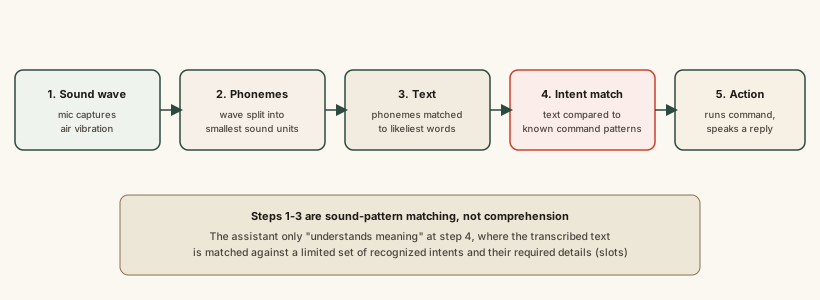
The callout beneath the pipeline marks the honest boundary: steps one through three are sound-pattern matching with no interpretation of meaning at all. "Understanding" in any real sense only happens at step four, and even then it's a comparison against a limited, predefined set of recognized intents — not open-ended comprehension.
Common mistakes
Common Mistakes
Assuming a voice assistant understands the meaning of what you say, rather than matching sound patterns and then text patterns.
→ Picture the two-stage pipeline: sound-to-text pattern matching first, then text-to-intent pattern matching second. Neither step involves open-ended comprehension of meaning.
Blaming a misheard request entirely on the assistant 'not listening properly,' regardless of the actual cause.
→ Consider that background noise or an ambiguous-sounding phrase at the sound-to-text step is a very common root cause, separate from whether the request afterward matched a known command.
Assuming the assistant is constantly and fully processing everything it hears.
→ Remember only a small wake-word-detection component runs continuously; the much heavier transcription and intent-matching steps only activate after that specific trigger phrase is detected.
Common misconception
“Voice assistants understand the meaning of what you say, not just the sound of it.”
A voice assistant's pipeline has two separate pattern-matching stages, and neither involves open-ended understanding of meaning. First, a sound wave is converted to text by matching phoneme patterns to the statistically likeliest words. Second, that text is compared against a limited, predefined set of recognized command patterns (intents) to decide what action to take. Requests phrased in ways that don't closely match either stage's trained patterns — an unusual accent, an unfamiliar way of phrasing a command — commonly fail, which is a direct sign the system is doing pattern matching rather than genuinely comprehending intent the way a person listening would.
What to do next
What to do next
- If a voice assistant repeatedly mishears you, try rephrasing with simpler, more common wording rather than repeating the exact same phrase louder — a different phrasing may match its recognized patterns better.
- When a compound request partially fails, try splitting it into separate single requests to identify which specific part isn't matching a recognized pattern.
- Remember that only wake-word detection runs continuously in the background — full processing of your request only begins after that trigger is detected.
- Read What a Chatbot Is Actually Doing next to see the same 'pattern matching, not comprehension' idea applied to a text-based system instead of a speech-based one.