Language change is a constant, universal process driven by how each new generation of speakers acquires and reshapes what it hears — through sound change, semantic shift, grammaticalization, and borrowing — not a sign of decline from some earlier 'correct' form.
Reading time
— 5 min
Updated
— Aug 16, 2026
Fact-reviewed
— Aug 16, 2026
Key Takeaways
Key Takeaways
1Every living language is changing right now, through ordinary processes like sound change, borrowing, and shifting word meanings — only dead languages stop changing.
2Change happens gradually across generations, because each new generation of speakers learns a language slightly differently from the last and passes those small differences on.
3Language change isn't decline from a purer earlier form — every language spoken today is equally many generations removed from its ancestors, and 'incorrect' usage is often just change still in progress.
The concept
Languages change because each generation of speakers learns from the generation before it, but never learns it perfectly identically — small differences in pronunciation, word choice, and grammar creep in, get passed on to the next generation, and accumulate over decades and centuries into changes big enough to notice, and eventually big enough to make old texts hard to read without training.
With sound change, semantic shift, grammaticalization, and borrowing as the main mechanisms, it becomes much easier to see specific historical examples as instances of a general, ongoing process rather than isolated oddities.
Quick check
What best describes why languages change over time?
Worked examples
Example 1: The Great Vowel Shift — sound change reshaping English (baseline case)
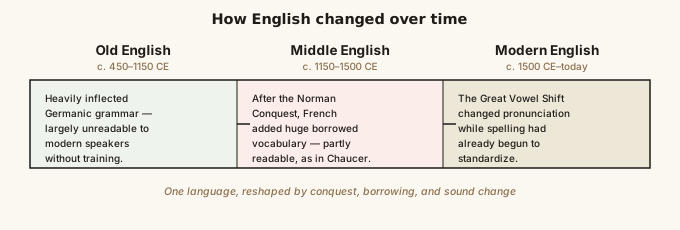
Between roughly the 15th and 18th centuries, the pronunciation of English long vowels shifted dramatically — the vowel in words like "bite" and "mice" moved from sounding closer to "beet" and "meese" to the diphthong sound used today, and similar systematic shifts affected several other vowel sounds. English spelling, however, had already started to standardize before the shift finished, which is a major reason modern English spelling looks so disconnected from modern pronunciation — the spelling is, in effect, a fossil of an earlier stage of the spoken language.
Example 2: Semantic shift — words that flipped or drifted meaning (variation)
"Awful" once meant "inspiring awe or wonder" — full of awe — and only later narrowed to mean "very bad." "Silly" traces back to an Old English word meaning "blessed" or "happy," which drifted through "innocent" and "pitiable" before landing on "foolish." These aren't errors that crept into the language — they're the same gradual reinterpretation process that produces sound change, just applied to meaning instead of pronunciation, and every word in every language has some version of this history if you trace it back far enough.
Example 3: Creoles — language evolution compressed into one generation (real-world / applied case)
When enslaved and colonized populations from different language backgrounds were brought into contact with European colonial languages, simplified pidgins often formed first as limited trade or plantation-communication tools. In several documented cases — Haitian Creole (French-lexified) and Tok Pisin, now a national language of Papua New Guinea (English-lexified), among others — children born into these communities acquired the pidgin as a first language and, in doing so, expanded it into a full, stable grammar within a generation, turning it into a creole with native speakers, its own consistent rules, and the capacity to express anything any other natural language can. It's one of the few places in linguistics where the normally centuries-long process of language formation has been observed and documented happening within living memory.
Quick check
A group of adults who share no common language develops a simplified way to communicate for trade purposes, with no native speakers of it yet. What is this called?
How it works (visual)
English across three historical stages
Each stage on this timeline was, to the people living through it, simply "how English is spoken" — the labels and boundaries are something historical linguists apply afterward to describe an unbroken chain of gradual change.
Common mistakes
Common Mistakes
✕
Treating new usage, slang, or grammar shifts as 'incorrect' or a sign of decline.
→ Recognize it as language change in progress — the same kind of process that produced every feature of the 'correct' language people compare it against.
✕
Assuming English spelling should logically match pronunciation.
→ English spelling standardized before sound changes like the Great Vowel Shift finished — the mismatch is a historical fossil, not a design flaw or an error to correct.
✕
Assuming borrowed words 'don't really' belong to a language.
→ Borrowing is one of the primary normal mechanisms of language change — most languages, including English, have enormous layers of borrowed vocabulary fully integrated into everyday use.
Common misconception
“Language change is decay or corruption from an earlier, more correct form of the language.”
There is no earlier "correct" form to decay from — every language spoken today is exactly as many generations removed from its common ancestor as every other language in the same family, and change has been continuous the entire way. Old English speakers would find modern English just as "corrupted" as some modern speakers find today's slang, and Old English itself was already a changed descendant of an earlier Germanic language. What looks like decline is almost always ordinary sound change, semantic shift, or grammaticalization, observed from the perspective of a speaker who happens to be used to an earlier stage of the same ongoing process.
Quick check
An older relative complains that 'kids today' are ruining English with new slang and grammar shortcuts. What does linguistics say about this complaint?
What to do next
What to do next
Next time someone says a usage 'isn't proper English,' consider whether it might just be language change still in progress.
Notice slang or new phrasing your generation uses that older speakers don't — that's language change happening in real time around you.
Look up the etymology of a common word you use daily and see how differently it meant a few centuries ago.
Read the entry on language families to see where accumulated change eventually leads — enough divergence, over enough centuries, produces entirely new branches and languages.
FAQ
FAQ
Related terms
Related terms
Sound change
A systematic shift in how a language's speakers pronounce certain sounds over generations — such as the Great Vowel Shift, which changed English long-vowel pronunciation between roughly the 15th and 18th centuries.
Semantic shift
A change in a word's meaning over time — 'nice' once meant 'foolish' or 'ignorant' in Middle English, and 'awful' once meant 'awe-inspiring' rather than 'bad.'
Grammaticalization
The process by which a full word or phrase gradually turns into a grammatical marker — for example, the phrase 'going to' becoming the future-tense marker 'gonna' in casual speech.
Pidgin
A simplified contact language that develops between groups without a shared language, typically for limited purposes like trade, and has no native speakers of its own.
Creole
A stable, fully-fledged natural language that develops when a pidgin (or similar contact situation) is learned as a first language by children of the next generation, who expand it into a complete grammar.
An older relative complains that 'kids today' are ruining English with new slang and grammar shortcuts. What does linguistics say about this complaint?
This entry was researched from public sources and drafted with AI-assisted tools, then edited — errors are still possible. Spot one, or want a topic covered? Read our disclaimer.
 KnowThis