Rankings of the world's most spoken languages change depending on whether you count only native (first-language) speakers or total speakers including everyone who uses the language as a second language — and the top of either list spans language families from Indo-European to Sino-Tibetan to Niger-Congo to Austronesian, not just one region.
Reading time
— 5 min
Updated
— Aug 16, 2026
Fact-reviewed
— Aug 16, 2026
Key Takeaways
Key Takeaways
1The ranking of “most spoken languages” depends entirely on whether you count only native (L1) speakers or total speakers including everyone who uses it as a second language — the order changes depending on which count you use.
2The top of the list spans language families far beyond Indo-European: Mandarin belongs to Sino-Tibetan, Swahili to Niger-Congo, Indonesian to Austronesian, and Tamil or Telugu to Dravidian.
3Speaker count alone doesn't determine a language's global reach — institutional status, trade use, and digital presence matter just as much, which is why smaller-population languages can still carry outsized influence.
The concept
There are two honest ways to answer "what's the most spoken language in the world?" — count only native speakers (people who grew up speaking it at home), or count total speakers, adding in everyone who learned it as a second language. By native speakers, Mandarin Chinese has long led, with well over 900 million people worldwide, according to Ethnologue's tracking. By total speakers, English typically comes out ahead, with well over a billion additional people using it as a second language for work, travel, or study — more than any other language accumulates through second-language use.
With native-versus-total speakers and the macrolanguage question in mind, the actual shape of the global top ten starts to make more sense as a set of trade-offs rather than a single fixed fact.
Quick check
Why do different sources sometimes rank English and Mandarin Chinese in a different order for 'most spoken language'?
Worked examples
Example 1: English as a global lingua franca (baseline case)
English has around 380 million native speakers, a total that alone wouldn't top the list — Mandarin and Hindi both have more. What pushes English to the top of the total-speaker count is second-language use: it's an official or co-official language in dozens of countries across five continents, the primary language of international air traffic control, and the most common shared working language in international business, science publishing, and diplomacy. That reach is a product of historical spread (the British Empire, then the economic and cultural influence of the United States) rather than of English being structurally "easier" than other languages — a claim linguists don't support.
Example 2: Hindi, Arabic, and the counting problem (variation)
Hindi has well over 300 million native speakers concentrated mainly in India, and climbs significantly higher on a total-speaker count once Hindi is used as India's most widely spoken second language across states where it isn't the primary home language. Arabic tells a similar counting story from a different angle: as a macrolanguage entry it ranks among the largest groupings in the world, but that figure combines Modern Standard Arabic — used in news broadcasting, formal writing, and religious contexts across the Arab world — with distinct regional spoken varieties that aren't all mutually intelligible. Both cases show that "how many speakers" depends heavily on where the line between "one language" and "several related ones" gets drawn.
Example 3: Swahili and Indonesian — reach without a huge native base (real-world / applied case)
Swahili, a Niger-Congo language, has a comparatively modest number of native speakers, but tens of millions more across Kenya, Tanzania, Uganda, and the Democratic Republic of the Congo speak it as a second language, and it's an official language of the African Union — reach built almost entirely on lingua franca status rather than native-speaker headcount. Indonesian tells a similar story: Indonesia is home to more than 700 local languages, and Indonesian (an Austronesian language, standardized from Malay) functions as the shared national and educational language across an archipelago where most people's home language is something else entirely. Both cases are useful evidence against ranking languages by native speakers alone — real-world global reach often runs through second-language adoption, not birth.
Quick check
Which language family does Mandarin Chinese belong to?
How it works (visual)
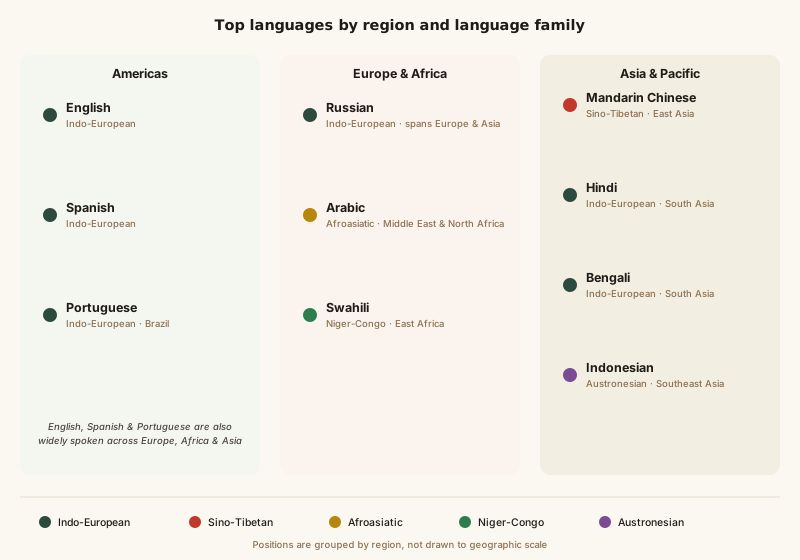
Top languages by speaker count and language family
Laid out this way, it's clear the largest languages by speaker count aren't clustered in one part of the world or one family — they're scattered across every populated continent, which is exactly why total reach can't be reduced to a single simple explanation.
Common mistakes
Common Mistakes
✕
Assuming 'most spoken' automatically means 'official language of the most countries.'
→ These are different metrics — a language can have huge speaker numbers concentrated in one or two countries (like Bengali) or modest numbers spread officially across dozens (like French or English).
✕
Treating 'Chinese' as a single, uniform language with one speaker count.
→ Chinese is a macrolanguage grouping Mandarin, Cantonese, Wu, and other varieties that aren't all mutually intelligible in speech — check whether a source means Mandarin specifically or the whole grouping.
✕
Comparing rankings from different sources without checking whether they count native speakers or total speakers.
→ Always check the methodology first — a ranking that swaps English and Mandarin, or moves French up several places, is almost always a native-vs-total counting difference, not a data disagreement.
Common misconception
“The number of speakers is the only thing that determines a language's global importance or reach.”
Raw speaker count is one factor among several. Institutional status matters — French, with a comparatively modest native-speaker base, is an official working language of the United Nations, the European Union, and dozens of international organizations, largely a legacy of past diplomatic influence and its continued use across Francophone Africa. Digital and economic presence matters too — a language's share of internet content, scientific publishing, or international trade can outweigh its raw population. Portuguese and Bengali have broadly comparable native-speaker counts, but very different global institutional footprints. Speaker count is a real signal, but treating it as the only one misses how language reach actually gets built and sustained.
Quick check
French has a comparatively modest number of native speakers worldwide, yet it's an official working language of the UN, the EU, and the African Union. What does this best illustrate?
What to do next
What to do next
Next time you see a 'most spoken languages' ranking, check whether it's counting native speakers or total speakers before trusting the order.
Notice how many of the largest languages by speaker count are official in multiple countries rather than just one — that's usually where second-language reach comes from.
When you hear 'Chinese' or 'Arabic' used as a single language name, remember both are macrolanguage groupings covering several distinct varieties.
Read the entry on language families to see which family your own most-spoken local language belongs to, and how many other languages share that ancestry.
FAQ
FAQ
Related terms
Related terms
Native speaker (L1)
Someone who acquired a language as a child, typically at home, as their first language — as opposed to learning it later as a second or additional language.
Second-language speaker (L2)
Someone who learned a language after their first language, often through school, work, or migration, and uses it fluently alongside another native language.
Lingua franca
A language adopted as a common means of communication between speakers whose native languages differ — often used in trade, diplomacy, or regional administration regardless of how many people speak it natively.
Macrolanguage
A single entry, used by catalogues like Ethnologue, that groups several closely related language varieties together for counting purposes — 'Arabic' and 'Chinese' are both counted this way, which affects where they land in speaker-count rankings.
This entry was researched from public sources and drafted with AI-assisted tools, then edited — errors are still possible. Spot one, or want a topic covered? Read our disclaimer.
 KnowThis