 KnowThis
Key Takeaways
Key Takeaways
- 1Insects make up roughly 80% of all described animal species — more than 1 million known species, with estimates of undiscovered species running far higher.
- 2An insect's hard exoskeleton supports and protects its body but doesn't grow with it, forcing the animal to periodically molt (shed and regrow it) to increase in size.
- 3Insects and arachnids are not the same group: insects have 6 legs and 3 body segments; arachnids like spiders and scorpions have 8 legs and 2 body segments, and are not insects at all.
The concept
That exoskeleton-and-molting design is the foundation of the insect body plan, and it produces some genuinely strange growth mechanics compared to how vertebrates grow.
Unlike a human, an insect's hard outer exoskeleton doesn't stretch or grow gradually as the animal gets bigger. How does an insect actually increase in size?
Worked examples
Example 1: A monarch butterfly's complete metamorphosis, stage by stage (baseline case)
Example 2: Why a dragonfly nymph looks nothing like popular "baby insect" assumptions (edge case / variation)
A dragonfly nymph lives underwater and looks very different from the flying adult it will become, yet dragonflies undergo 'incomplete' rather than 'complete' metamorphosis. What distinguishes incomplete metamorphosis?
Example 3: Why bee pollination is worth billions to agriculture (real-world / applied case)
Bees and other insect pollinators transfer pollen between flowers as they forage for nectar, enabling many food crops — including apples, almonds, blueberries, and squash — to produce fruit and seed at all. This isn't a minor side benefit; a large share of global food crop production by volume depends at least partly on animal pollination, the majority of it performed by insects, according to research summarized by institutions including the Smithsonian. Commercial beekeepers transport managed honeybee hives to farms specifically to provide this pollination service during bloom season, a direct, economically significant application of basic insect biology — without adequate pollinator activity, yields for many crops drop sharply, which is part of why declining wild pollinator populations are an active conservation concern.
How it works (visual)
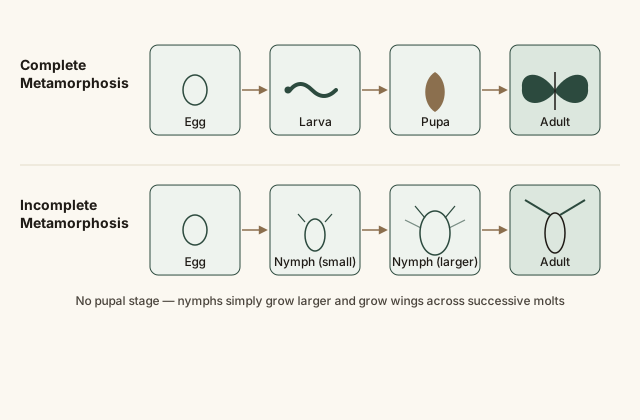
The key visual difference is the missing pupal box in the bottom row — incomplete metamorphosis goes straight from a series of nymph stages to an adult, while complete metamorphosis inserts a dramatic, mostly immobile reorganization stage (the pupa) between larva and adult. That extra stage in complete metamorphosis is why a caterpillar and the butterfly it becomes can look, eat, and behave in ways that share almost nothing in common — the pupal stage allows for a much more radical rebuild than incomplete metamorphosis's more gradual, stage-by-stage change permits.
Common mistakes
Common Mistakes
Calling spiders, ticks, and scorpions 'insects.'
→ They're arachnids, a separate class with 8 legs and 2 body segments, versus an insect's 6 legs and 3 body segments. Both are arthropods, but arachnids are not insects.
Assuming all insects go through a caterpillar-and-cocoon-style transformation.
→ Only insects with complete metamorphosis (butterflies, beetles, flies, bees) have a larval and pupal stage. Insects with incomplete metamorphosis (grasshoppers, dragonflies, true bugs) skip the pupa entirely.
Thinking centipedes and millipedes are insects because they're small and have many legs.
→ They're myriapods, another separate arthropod class, with far more than 6 legs and a body plan built from many repeating segments — insects always have exactly 6 legs.
Common misconception
“All insects and small crawling creatures are basically the same kind of pest and can be lumped together.”
Insects, arachnids, and myriapods are distinct classes within the arthropod phylum, defined by clearly different body plans — leg count and body segmentation are the fastest reliable check. Insects have 6 legs and 3 body segments (head, thorax, abdomen). Arachnids — spiders, scorpions, ticks, mites — have 8 legs and just 2 body segments, and notably, no antennae, which every insect has. Centipedes and millipedes (myriapods) have many more legs across many repeating body segments. These are not interchangeable pest categories: a pesticide or treatment effective against insects may do little against spider mites (arachnids), and treating them the same is a common, practical mistake in both pest control and casual conversation.
A spider has 8 legs, 2 body segments, and no antennae. Based on this, how should it be classified?
What to do next
What to do next
- Next time you spot a small crawling creature, count its legs before naming it — 6 means insect, 8 means arachnid, many more means myriapod.
- Watch for a molted exoskeleton (a papery, insect-shaped shell) on a plant or windowsill — it's a real, physical leftover from a molting event, not a dead insect.
- If you see a caterpillar and a butterfly of the same species side by side, note how radically different they are — a direct visual result of complete metamorphosis's pupal rebuild stage.
- Read the related entry on Symbiosis & Animal Relationships to see how insect pollinators and flowering plants have shaped each other's evolution.