 KnowThis
Key Takeaways
Key Takeaways
- 1The ocean is divided into depth zones based mainly on light penetration — only the top ~200 meters (the photic zone) gets enough sunlight for photosynthesis, even though average ocean depth is roughly 3,700 meters.
- 2Phytoplankton, not seaweed or coral, form the energy base of nearly the entire ocean food web and, per NOAA, produce roughly half of the oxygen in Earth's atmosphere.
- 3Some deep-sea ecosystems near hydrothermal vents run entirely on chemosynthesis, proving sunlight isn't the only possible energy source for a functioning food web.
The concept
That light-driven zoning explains most of what lives where — but the deep-sea vent ecosystems are the clearest proof that the rule ("no light means no food web") has a genuine, well-documented exception.
Which factor most directly determines the boundary of the ocean's photic zone, where most marine photosynthesis happens?
Worked examples
Example 1: A coral reef food web built entirely on sunlight (baseline case)
Example 2: Hydrothermal vent ecosystems that run without sunlight at all (edge case / variation)
Giant tube worms living near deep-sea hydrothermal vents thrive in total darkness with no access to photosynthesis-based food. How do they get their energy?
Example 3: Why coral bleaching is a direct, measurable warning sign (real-world / applied case)
When ocean water gets unusually warm, corals under heat stress expel the symbiotic algae living in their tissue — the event known as coral bleaching, named for the stark white color left behind once the pigmented algae are gone. Because that algae supplies the majority of a coral's energy through photosynthesis, a bleached coral is effectively starving; if warm conditions persist long enough, the coral can die outright rather than recover once temperatures drop. NOAA and marine researchers use bleaching events as a direct, measurable indicator of ocean heat stress, tracking reefs worldwide through coral bleaching alert systems tied to sea surface temperature data. This is a real-world, applied consequence of the same mutualistic, sunlight-dependent relationship described in Example 1 — when the underlying energy relationship breaks down, the visible result is immediate and dramatic.
How it works (visual)
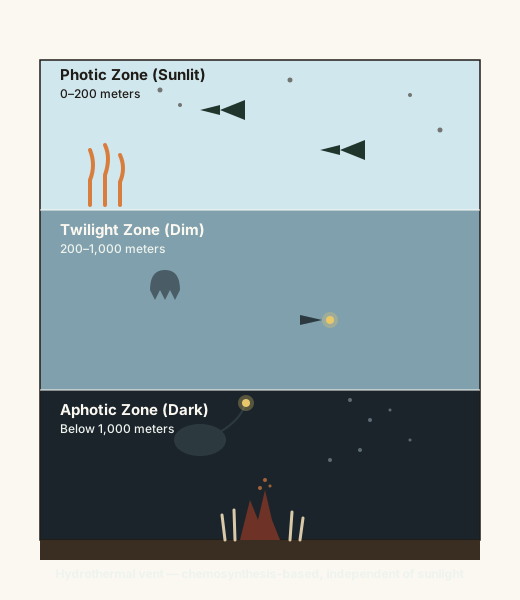
The diagram's shrinking light gradient from top to bottom is the organizing principle for almost everything living in each band — abundant, photosynthesis-fueled life crowds the thin photic zone at the top, sparser, adapted life occupies the twilight and aphotic zones below, and the hydrothermal vent callout at the bottom shows the one clear exception where an entirely separate, sunlight-independent food web thrives despite the total darkness surrounding it.
Common mistakes
Common Mistakes
Assuming coral is a plant because it looks stationary and branch-like.
→ Coral is an animal (a colony of tiny polyps related to jellyfish and sea anemones) — its greenish-brown coloring and much of its energy actually come from photosynthetic algae living inside its tissue, not from the coral itself photosynthesizing.
Thinking seaweed or large plants are the base of most ocean food webs, the way land plants are on land.
→ Microscopic phytoplankton, not seaweed, form the energy base of the large majority of the ocean's food webs and produce roughly half of Earth's atmospheric oxygen, per NOAA.
Assuming all deep-sea life ultimately depends on sunlight reaching the surface somewhere.
→ Hydrothermal vent ecosystems are a documented exception — chemosynthetic bacteria there produce energy from chemical reactions, not sunlight, supporting an independent food web in total darkness.
Common misconception
“The deep ocean is basically a lifeless void because there's no sunlight down there for anything to survive on.”
The deep ocean, while sparser than the sunlit surface, hosts substantial life adapted specifically to darkness, cold, and extreme pressure — bioluminescent fish, giant squid, and enormous numbers of small invertebrates that feed on organic debris ("marine snow") drifting down from above. More strikingly, hydrothermal vent ecosystems, first discovered in 1977, prove that an entire independent food web can exist with zero connection to sunlight at all, built instead on chemosynthetic bacteria converting chemical energy from vent minerals. Far from a lifeless void, NOAA and marine research institutions consider the deep ocean one of the least-explored, most biologically surprising environments on Earth — researchers regularly discover new species there.
Why is 'the deep ocean is basically empty of life since there's no sunlight' an inaccurate view?
What to do next
What to do next
- Next time you see a coral reef in a photo or video, remember it's an animal-algae partnership, not a plant, and that its color comes largely from that living algae.
- Look up a photo of a hydrothermal vent tube worm community to see a genuinely sunlight-independent ecosystem in action.
- Check NOAA's coral bleaching alert resources if you're curious about current reef heat-stress conditions in a specific region.
- Read the related entry on Ecosystems & Food Chains to see how the ocean's phytoplankton-based food web compares to a land-based one.