 KnowThis
Key Takeaways
Key Takeaways
- 1Photosynthesis converts carbon dioxide, water, and light energy into glucose and oxygen — the balanced equation is 6CO₂ + 6H₂O + light → C₆H₁₂O₆ + 6O₂.
- 2Most of a plant's dry mass comes from carbon dioxide pulled from the air, not from the soil — a fact first demonstrated experimentally in the 1600s and confirmed by modern chemistry.
- 3Photosynthesis happens in two linked stages — light-dependent reactions that split water and release oxygen, and the Calvin cycle that uses that energy to build sugar from CO₂.
The concept
That balance of gases going in and out is precise enough to write as a chemical equation, and running real numbers through it is the fastest way to see exactly what photosynthesis is trading for what.
In the balanced photosynthesis equation 6CO₂ + 6H₂O + light → C₆H₁₂O₆ + 6O₂, where does the oxygen that's released actually come from?
Worked examples
Example 1: Reading the balanced equation with real quantities (baseline case)
Example 2: How cacti photosynthesize without losing all their water (edge case / variation)
Why do cacti and other desert plants often open their stomata at night instead of during the day?
Example 3: Why greenhouse growers pump in extra CO₂ (real-world / applied case)
Commercial greenhouse operators often raise carbon dioxide levels inside their greenhouses to two or three times the normal atmospheric concentration (roughly 420 parts per million outdoors) because CO₂ availability is frequently the limiting factor on photosynthesis rate when light and water are already abundant. With more CO₂ available, the Calvin cycle can fix carbon faster, directly increasing glucose production and, in turn, plant growth and crop yield — a practical, economically motivated confirmation that photosynthesis really is a chemical reaction with measurable inputs and outputs, not just a vague biological process. The same principle explains why rising atmospheric CO₂ has measurable, complex effects on plant growth rates globally, an active area of climate and agricultural research.
How it works (visual)
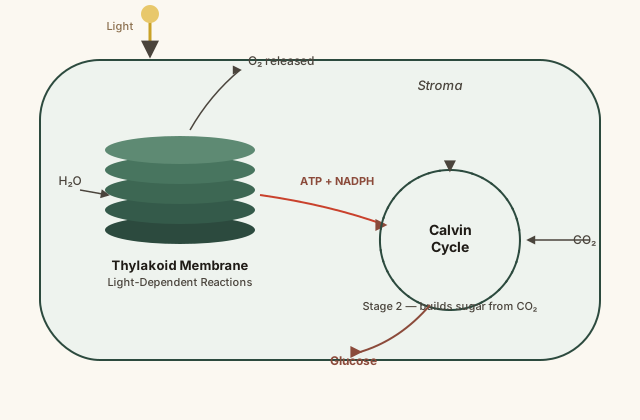
Follow the arrows: light strikes the thylakoid membranes first, splitting water and releasing oxygen straight out of the leaf while generating ATP and NADPH. Those two energy carriers then flow into the stroma, where the Calvin cycle uses their stored energy to grab carbon dioxide molecules from the air and stitch them into glucose. The two stages are chemically dependent on each other — the Calvin cycle can't run without ATP and NADPH from the light reactions, which is why photosynthesis, despite the Calvin cycle itself not directly requiring light, still stops almost immediately in darkness once the supply of stored ATP and NADPH runs out.
Common mistakes
Common Mistakes
Thinking photosynthesis is the only thing plants do with gases, and that plants never 'breathe' in the way animals do.
→ Plants also respire around the clock, consuming oxygen and releasing CO₂ to generate usable energy from glucose — photosynthesis and respiration are separate, simultaneous processes, with photosynthesis simply producing far more oxygen than respiration consumes during daylight.
Assuming photosynthesis only happens in leaves.
→ It happens in any plant tissue containing chlorophyll and exposed to light — green stems and unripe green fruit can photosynthesize too, just typically at a much lower rate than leaves.
Believing plants get most of their physical mass and 'food' from the soil.
→ The large majority of a plant's dry mass comes from carbon captured out of the air as CO₂ during photosynthesis. Soil mainly supplies water and a small set of minerals, not bulk mass.
Common misconception
“Plants grow mostly by absorbing mass and food from the soil, the way a sponge absorbs water.”
This was directly tested nearly 400 years ago by Belgian scientist Jan Baptist van Helmont, who grew a willow tree in a weighed pot of soil for five years, watering it but adding nothing else. The tree gained about 74 kilograms, while the soil lost less than 100 grams. Van Helmont wrongly concluded the extra mass came entirely from water, but modern chemistry completes the picture: the overwhelming majority of a plant's dry mass is built from carbon dioxide pulled out of the air and fixed into glucose through photosynthesis, not from soil. Soil mainly supplies water absorbed through roots and a relatively small quantity of minerals like nitrogen and phosphorus — critical for plant health, but not the bulk material a plant is made of.
A large tree gains hundreds of kilograms of mass over its lifetime while the soil around it barely loses any weight. Where does most of that mass actually come from?
What to do next
What to do next
- Next time you see a houseplant leaning toward a window, connect it to photosynthesis — the plant is maximizing light exposure to its chlorophyll-containing leaves.
- Look at the underside of a leaf with a magnifying glass if you have one; the stomata pores (invisible to the naked eye) are where the plant's CO₂ intake and oxygen release actually happen.
- Notice succulents and cacti opening their care instructions around watering at specific times — that indirectly reflects their CAM photosynthesis water-conservation strategy.
- Read the related entry on Ecosystems & Food Chains to see how the glucose plants produce becomes the energy base for nearly every food chain on Earth.