Famous Man-Made Landmarks and the Geography That Shaped Them
Famous man-made landmarks were built by engineering solutions specifically tailored to their local geography — mountain terrain, desert aridity, or river access — and studying them reveals how much geography still shapes human construction.
Reading time
— 5 min
Updated
— Aug 16, 2026
Fact-reviewed
— Aug 16, 2026
Key Takeaways
Key Takeaways
1Man-made landmarks are engineering answers to local geography — Machu Picchu's terracing manages steep mountain slopes, Petra's carved channels manage desert flash floods, and the Great Wall follows mountain ridgelines for defensive visibility.
2The Great Wall of China is not visible to the naked eye from space, despite its enormous length — a persistent myth confirmed false by multiple astronauts and NASA, because its width (a few meters) is far too narrow relative to the distance involved.
3Some ancient construction techniques, like Machu Picchu's mortar-free dry-stone walls, were specifically engineered to survive local hazards — in that case, earthquakes — that a rigid mortared structure would not.
The concept
A man-made landmark is a large human-built structure famous enough to define its region — the Great Wall of China, the Pyramids of Giza, the Eiffel Tower, Machu Picchu, Petra. What makes many of these landmarks remarkable isn't just their size, but how precisely they were engineered to fit their specific location: a mountain citadel built to handle steep slopes and earthquakes, a desert city built to capture and store scarce water, a wall built along ridgelines to see approaching threats from a distance. The geography came first; the engineering had to answer it.
Engineering solving for local geography is easiest to see clearly by looking at how differently two landmarks, built for completely different environments, solved completely different problems.
Quick check
Machu Picchu's buildings use dry-stone construction — precisely fitted stone blocks with no mortar. What geographic hazard does this technique specifically help address?
Worked examples
Example 1: The Great Wall following mountain ridgelines (baseline case)
The Great Wall of China isn't a single structure but a network of walls, fortifications, and natural barriers built and rebuilt across multiple dynasties over roughly two thousand years, with the best-preserved sections dating to the Ming Dynasty (1368–1644). Rather than running in a straight line, it deliberately follows mountain ridgelines and other high terrain wherever possible — a choice that gave defenders elevated sightlines to spot approaching forces from a distance, while also making the wall itself harder to approach and scale. The full network, including all branches and sections identified in a 2012 Chinese government survey, totals roughly 21,196 kilometers, though only a fraction of that is a single continuous, tourist-visited wall.
Example 2: Petra's water engineering in a desert canyon (edge case / variation)
Petra sits in a narrow desert canyon in modern-day Jordan, a location with almost no reliable year-round surface water — seemingly a poor site for a major city. The Nabataeans solved this with an engineered water system: dams positioned to catch rare, sudden flash floods, cisterns to store the captured water, and a network of ceramic pipes and channels to distribute it through the city. This let Petra thrive as a major trading hub from roughly the 4th century BCE onward, in a location its natural geography alone would never have supported — a genuine edge case where the landmark's most important engineering achievement (water management) is largely invisible, buried underground, while the famous rock-cut facades get the attention above ground.
Quick check
Petra was built in a narrow desert canyon with almost no reliable natural water source, yet supported a thriving trading city for centuries. What made this possible?
Example 3: The Eiffel Tower's height in context (real-world / applied case)
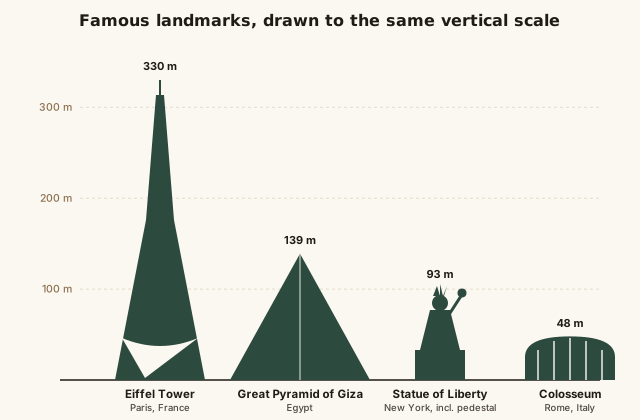
The Eiffel Tower, completed in 1889 for the World's Fair, stands 330 meters tall including its antennas — a height that made it the tallest man-made structure in the world for over 40 years after its completion. Comparing it to a familiar reference point makes the scale easier to grasp: at roughly 330 meters, the tower is close to 3.5 times taller than the Statue of Liberty (about 93 meters including its pedestal), and roughly as tall as a stack of more than three American football fields laid end to end vertically. Wrought-iron lattice construction, an engineering choice driven by the need to minimize wind resistance at that height, is what made a structure this tall achievable with 19th-century materials in the first place.
How it works (visual)
Height comparison: famous man-made landmarks side by side
Lined up on one scale, the size gap between these landmarks becomes obvious in a way a list of numbers doesn't convey — the Eiffel Tower is more than twice as tall as the Great Pyramid, itself the only surviving structure from the ancient world's original Seven Wonders list. Each height reflects the materials and engineering available at the time it was built: stacked stone blocks for the pyramid roughly 4,500 years ago, versus a wrought-iron lattice frame in the industrial age for the tower.
Common mistakes
Common Mistakes
✕
Assuming the Great Wall of China is one single, continuous wall built at one time.
→ It's a network of walls and fortifications built and rebuilt across multiple dynasties over roughly two thousand years, with most surviving visible sections dating to the Ming Dynasty specifically.
✕
Believing the Great Wall of China is visible to the naked eye from space.
→ It isn't — multiple astronauts and NASA have confirmed this; the wall averages only a few meters wide, far too narrow to be seen without aid from orbit despite its great length.
✕
Assuming ancient landmarks were built with primitive, unsophisticated engineering.
→ Sites like Machu Picchu (earthquake-resilient dry-stone construction) and Petra (desert water-capture systems) reflect precise, deliberate engineering solutions to real local hazards, not crude guesswork.
Common misconception
“The Great Wall of China is visible from space with the naked eye.”
This is one of the most persistent myths in geography, and it's false. The wall's length is enormous, but its average width is only a few meters — far too narrow to be distinguishable from low Earth orbit without magnification, according to multiple astronauts who have specifically looked for it, as well as NASA's own statements on the subject. Many other, much wider human-made features — cities at night, large airports, some highways — are actually easier to spot from orbit than the wall itself, precisely because visibility from space depends on a feature's width and contrast, not simply its total length.
Quick check
Astronauts have specifically looked for the Great Wall of China from low Earth orbit. What have they generally reported?
Try it yourself
How many 'unit heights' stack to match a landmark's height
Number of stacked units to match that height3.55
What to do next
What to do next
Try the calculator above comparing the Great Pyramid's height (about 139m) to a landmark near you to build an intuitive sense of scale.
Next time someone repeats the 'Great Wall visible from space' claim, mention that astronauts and NASA have specifically confirmed it isn't — the wall is simply too narrow.
Look up which man-made landmarks near you are on the UNESCO World Heritage List, and check which of the ten official selection criteria they were inscribed under.
Read the related entry on UNESCO World Heritage Sites (Overview) to see how landmarks like these earn formal international recognition.
FAQ
FAQ
Related terms
Related terms
Amphitheater
A large, typically oval or circular open-air venue with tiered seating built around a central performance area, as with Rome's Colosseum.
Terracing
A method of building level, stepped platforms into a slope to prevent erosion and create usable flat land, used extensively at Machu Picchu.
Dry-stone construction
A building technique that fits stones together precisely without mortar, allowing structures to flex slightly during earthquakes rather than crack.
Rock-cut architecture
Structures carved directly into an existing rock face rather than built from separately quarried and stacked materials, as with Petra's facades.
Citadel
A fortified complex, typically built on high or defensible ground, used for the protection of a city or as a center of political or religious authority.
The Grand Canyon and the Great Barrier Reef are both famous natural wonders, but they formed through fundamentally different processes. What's the key difference?
This entry was researched from public sources and drafted with AI-assisted tools, then edited — errors are still possible. Spot one, or want a topic covered? Read our disclaimer.
 KnowThis