 KnowThis
Key Takeaways
Key Takeaways
- 1Nepal's flag is the only national flag on Earth that isn't a rectangle or square — it's two stacked triangular pennants, representing the Himalayas and Nepal's two major religions.
- 2Some flag symbolism is deliberate and documented, like Mozambique's AK-47 rifle representing defense and vigilance — but not every color or shape carries deep meaning; some are practical or historical accidents.
- 3Flags spread in visually related 'families' — the Nordic cross design appears on five countries' flags, and the pan-African colors (red, black, green) appear on many African nations' flags, tracing back to specific 20th-century political movements.
The concept
Once you know that flags travel in families and that meaning isn't always deliberate, the real question becomes how to tell a genuinely symbolic design choice from a practical or inherited one — and a few specific flags make that distinction unusually clear.
The Nordic cross pattern (an off-center cross) appears on the flags of Denmark, Sweden, Norway, Finland, and Iceland. What best explains this shared design?
Worked examples
Example 1: The U.S. flag's stars and stripes (baseline case)
Example 2: Nepal's non-rectangular flag (edge case / variation)
What makes Nepal's national flag unique among all of the world's sovereign countries?
Example 3: Mozambique's flag and its AK-47 rifle (real-world / applied case)
Mozambique's flag, adopted after independence from Portugal in 1975 and refined in 1983, is the only national flag in the world to feature a modern firearm: an AK-47 assault rifle, crossed with a hoe, layered beneath an open book and topped with a star. Each element is officially documented — the rifle represents defense and vigilance, tracing directly to Mozambique's armed independence struggle against Portuguese colonial rule; the hoe represents agriculture and the peasantry; the book represents education; and the star represents international solidarity and the ruling party's socialist orientation at the time of design. Unlike more ambiguous or debated flag symbolism elsewhere, Mozambique's design is a clear, government-documented case where every charge on the flag maps to a specific, named historical and political meaning.
How it works (visual)
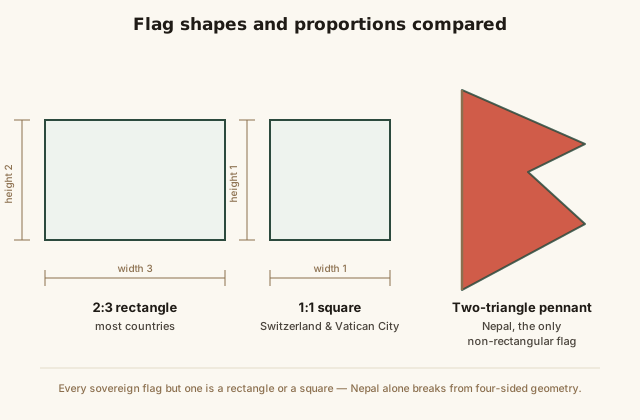
The comparison makes clear just how standardized flag shape is worldwide — the overwhelming majority of countries use a simple rectangle, typically at a 2:3 or 1:2 ratio, with only two exceptions breaking from a rectangle to a square, and exactly one breaking from four-sided geometry altogether. That level of near-universal conformity is itself a signal: flag shape, unlike flag color or symbolism, is almost never used to make a political statement — it's treated as a practical, internationally interoperable format.
Common mistakes
Common Mistakes
Assuming every color on every flag carries specific, deliberate, universally agreed-upon symbolism.
→ Some flag elements are practical or inherited choices — shared color families (like the pan-African red, black, and green) or simple historical continuity, not a fresh, deeply symbolic decision by each individual country.
Assuming all national flags are rectangles.
→ Nepal's flag is a double triangular pennant, and Switzerland and Vatican City use square flags — rectangular is the overwhelming norm, but not a universal rule.
Assuming flag symbolism never changes after a flag is first adopted.
→ Flags are actively redesigned for political reasons — Mozambique refined its flag in 1983, and many post-Soviet and post-colonial states redesigned their flags entirely after independence to remove imperial or colonial symbols.
Common misconception
“Every color and symbol on a national flag carries deep, deliberate, universally agreed-upon meaning.”
Some flag elements genuinely are richly, deliberately symbolic and well-documented — Mozambique's rifle, hoe, book, and star each have an official, government-recorded meaning. But plenty of flag features are practical or historical accidents rather than deep symbolism: many countries adopted a color scheme simply because it matched an existing regional flag family (the pan-African or Pan-Arab color sets, or the Nordic cross design), because a particular dye was cheap and available historically, or because a revolutionary movement's flag was adopted wholesale as the new national flag without a fresh design process. Treating every flag detail as loaded with intentional symbolism risks inventing meaning that was never actually assigned — the honest answer, for many specific colors and shapes, is simply "inherited from a related flag" or "that's what was available," not a deep coded message.
A viral post claims every stripe and color on every national flag has a specific, deeply intentional symbolic meaning that the country's founders carefully chose. Is this generally accurate?
Try it yourself
What to do next
What to do next
- Try the calculator above with your own country's official flag dimensions to see its simplest official ratio (many are 2:3 or 1:2, but check yours specifically).
- Look up your country's flag description in the CIA World Factbook to see whether its colors and symbols have officially documented meanings or are inherited from a broader design family.
- Next time you see a Nordic cross or pan-African color scheme on a flag you don't recognize, use it as a clue to the country's likely region before checking.
- Read the related entry on How Country Names Originated to see how flag symbolism and name origins often trace back to the same historical moment (independence, revolution, or colonial rule).