 KnowThis
Key Takeaways
Key Takeaways
- 1Countries disappear through three distinct mechanisms — dissolution into multiple new states, unification into one larger state, or absorption into an existing neighbor — and each leaves a different legal trail.
- 2A dissolved state's rights, treaties, and UN seat don't just vanish — they're reassigned through 'state succession,' sometimes to one 'continuator state' (like Russia after the USSR) and sometimes split among all successors equally.
- 3Roughly two dozen sovereign states have ceased to exist since 1945 alone, even as total UN membership grew from 51 founding members in 1945 to 193 today — new nations are being created faster than old ones disappear.
The concept
Distinguishing these mechanisms matters because they're often confused with something else entirely: a country simply renaming itself while remaining the exact same legal state. The next section walks through real cases that show how different — and how similar — these processes can look on a map.
In 1990, East Germany and West Germany became a single country again. What is the correct term for this kind of event?
Worked examples
Example 1: Czechoslovakia's 1993 "Velvet Divorce" (baseline case)
Example 2: The USSR's 1991 dissolution into 15 states (edge case / variation)
When the USSR dissolved in 1991 into 15 independent countries, why did Russia — and not, say, Ukraine or Kazakhstan — keep the USSR's permanent UN Security Council seat?
Example 3: Yugoslavia's violent, multi-stage breakup (real-world / applied case)
Yugoslavia shows that dissolution doesn't always happen in one clean event. The Socialist Federal Republic of Yugoslavia began breaking apart in 1991 when Slovenia and Croatia declared independence, followed by Bosnia and Herzegovina and North Macedonia. What remained — Serbia and Montenegro — continued for years as a rump state first called the Federal Republic of Yugoslavia, then renamed Serbia and Montenegro in 2003, before that union itself dissolved peacefully in 2006 when Montenegro voted for independence. Kosovo's later declaration of independence from Serbia in 2008 remains only partially recognized internationally. The full process, from 1991 to 2008, produced seven states from one — spread across nearly two decades, and involving war, referendums, renaming, and a second, separate dissolution along the way.
Which of these best describes how the former Yugoslavia turned into today's separate countries?
How it works (visual)
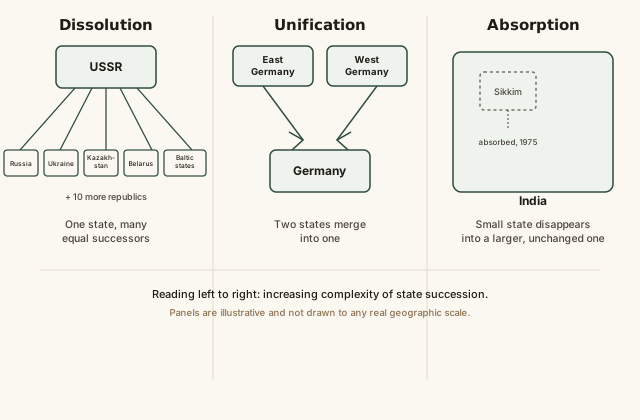
Reading the diagram left to right traces increasing complexity: dissolution (one state, many successors) is the pattern behind the USSR, Yugoslavia, and Czechoslovakia; unification (many states, one successor) is the pattern behind Germany and Yemen; absorption (one state disappears entirely into an unchanged neighbor) is the pattern behind cases like Tibet's incorporation into the People's Republic of China in the 1950s or Sikkim's 1975 merger into India. Only dissolution and unification typically involve every party voluntarily giving up separate statehood — absorption is the pattern most often disputed internationally.
Common mistakes
Common Mistakes
Assuming a country that changes its name (Burma to Myanmar, Ceylon to Sri Lanka, Zaire to the Democratic Republic of the Congo) has 'ceased to exist.'
→ Renaming keeps the same legal state, government continuity, and UN seat — it's a label change, not state succession. Only dissolution, unification, or absorption actually end a state's legal existence.
Thinking every former empire (Ottoman, Austro-Hungarian, British) 'dissolved' the same way a modern federation does.
→ Empires typically broke apart through a mix of independence movements, wars, and negotiated withdrawals over decades — not a single clean dissolution event like Czechoslovakia's 1993 split.
Assuming the newest successor state after a split automatically inherits the original country's UN seat, debts, and embassies.
→ Inheritance depends on international recognition of a specific 'continuator state' — Russia inherited the USSR's seat, but the other 14 former Soviet republics joined the UN from zero, with no such inheritance.
Common misconception
“A country changing its name is the same kind of event as a country dissolving.”
They're legally unrelated. When Zaire became the Democratic Republic of the Congo in 1997, or Swaziland became Eswatini in 2018, the underlying sovereign state, its borders, its government, and its UN membership never stopped — only the label changed. Dissolution is a legal ending: the state itself stops existing, and one or more genuinely new, separately recognized states take its place, each needing its own UN admission process. Confusing the two makes ordinary rebranding sound far more dramatic than it is, and can understate how disruptive a real dissolution (like Yugoslavia's) actually was.
Zaire officially renamed itself the Democratic Republic of the Congo in 1997. Did Zaire 'cease to exist' in the same legal sense as Czechoslovakia?
What to do next
What to do next
- Next time you see an old world map or atlas (pre-1991, pre-1993), spot the USSR, Yugoslavia, and Czechoslovakia and count how many of today's countries occupy that same territory now.
- When a country renames itself in the news, check whether it's a label change (state continues) or part of a larger independence or merger story (state succession) before assuming they're the same kind of event.
- Look up your country's UN admission date — if it's 1991, 1992, 1993, or 2006, there's a good chance it's a former Soviet republic, a Yugoslav successor, or a Czechoslovak successor.
- Read the related entry on Unusual Borders & Enclaves to see how some of these dissolutions left behind oddly shaped leftover borders.