 KnowThis
Key Takeaways
Key Takeaways
- 1'America' comes from Amerigo Vespucci, the Italian explorer whose first name a German mapmaker used on a 1507 map — one of the clearest examples of a country named after a real person.
- 2Many country names trace back to a local word simply meaning 'people,' 'land,' or a geographic feature described by the earliest inhabitants, not a grand founding statement.
- 3Country names keep changing long after independence — Burkina Faso, Eswatini, and Sri Lanka all officially renamed themselves within the last 60 years, usually to shed a colonial-era name.
The concept
Once you know the recurring categories — person, place, people, or borrowed label — most country names stop feeling random. What's more interesting is watching how those categories play out in specific, well-documented cases, including some genuinely surprising ones.
The continent and country of 'America' is named after Amerigo Vespucci. What kind of name is this?
Worked examples
Example 1: America, named after Amerigo Vespucci (baseline case)
Example 2: Iceland and Greenland's reversed reputations (edge case / variation)
According to the traditional saga account, why did Erik the Red reportedly give the icy island of Greenland such an appealing name?
Example 3: Modern decolonial renaming — Burkina Faso and Eswatini (real-world / applied case)
Country renaming didn't stop with ancient history — it's an ongoing, deliberate political process. In 1984, revolutionary leader Thomas Sankara renamed the country formerly known as Upper Volta (a French colonial-era name simply describing its position on the upper Volta River) to Burkina Faso, combining words from two of the country's major languages, Mossi and Dioula, to mean roughly "land of upright/honest people." More recently, in 2018, King Mswati III officially renamed Swaziland to Eswatini, restoring the country's own Swazi-language name (meaning "land of the Swazis") and explicitly moving away from the English colonial-era name, which he noted was frequently confused with Switzerland internationally. Both cases show the same underlying pattern: a newly or long-independent country choosing a name rooted in its own languages and identity over one assigned or popularized during colonial administration.
How it works (visual)
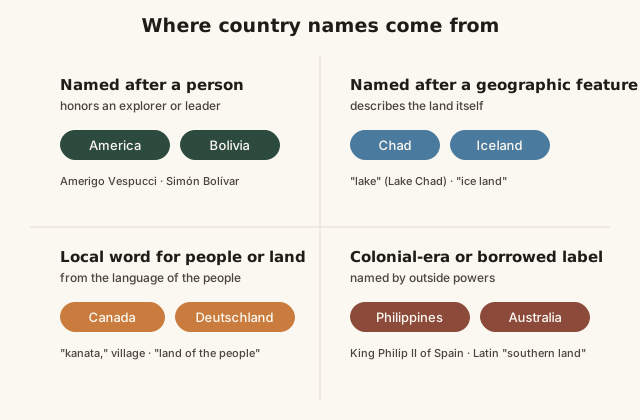
Most countries fit cleanly into one of these four quadrants, though a handful straddle two — the Philippines, for instance, is both a colonial-era name (after King Philip II) and, since it was assigned rather than locally originated, an exonym at the time of naming that has since become the country's own accepted endonym through centuries of continuous use. That drift — a name starting as an outsider's label and eventually becoming the accepted local name — is itself a common pattern worth watching for.
Common mistakes
Common Mistakes
Assuming a country's name has stayed fixed and untouched since its founding.
→ Names are actively renamed for political and cultural reasons well into the modern era — Burkina Faso (1984) and Eswatini (2018) are recent, deliberate examples, not ancient history.
Assuming a country's name always describes something true about its geography or climate today.
→ Iceland and Greenland show that names can reflect a namer's motive (attracting or discouraging settlers) rather than an accurate physical description, then simply persist for centuries regardless of accuracy.
Treating 'the country's official name' and 'the name most commonly used internationally' as always identical.
→ Distinguish endonyms from exonyms — Germans call their country Deutschland (the endonym), while 'Germany' is simply the English exonym; both are correct in their own context.
Common misconception
“A country's name has a single, fixed meaning that has stayed the same since it was first coined.”
Country names routinely shift in spelling, meaning, and even ownership over centuries — and sometimes get replaced outright. "America" began as a mapmaker's label honoring one explorer's first name and later broadened to describe an entire hemisphere, then narrowed again in everyday English usage to often mean just the United States. Names imposed during colonial rule have been formally replaced by newly or long-independent governments choosing names rooted in local languages instead — Ceylon became Sri Lanka in 1972, Upper Volta became Burkina Faso in 1984, and Swaziland became Eswatini in 2018. A country's name is a living, occasionally political choice, not a permanently fixed label handed down unchanged from its origin.
Someone claims 'a country's name, once established, never officially changes.' Which real example directly contradicts this?
What to do next
What to do next
- Pick five countries you know well and try to guess which naming category each falls into — person, geographic feature, local word for 'people/land,' or colonial-era label — before looking it up.
- Next time you hear about a country renaming itself in the news, check whether it's replacing a colonial-era name with a locally rooted one, which is a common and recurring pattern.
- Compare a country's endonym (its own name for itself) to the English exonym you're used to using — Deutschland vs. Germany, or Nihon vs. Japan, are good starting points.
- Read the related entry on Countries That No Longer Exist to see how renaming differs legally from a country actually dissolving.