Loanwords in English (words borrowed from other languages)
A loanword is a word one language adopts from another and gradually makes its own — and English has borrowed so extensively, from French and Latin to Hindi, Arabic, Japanese, and Indigenous American languages, that loanwords make up the majority of the English vocabulary rather than a small foreign minority within it.
Reading time
— 5 min
Updated
— Aug 16, 2026
Fact-reviewed
— Aug 16, 2026
Key Takeaways
Key Takeaways
1English has borrowed words from more than 350 languages — loanwords aren't a minor exception in English vocabulary, they're the majority of it, alongside a smaller core of native Old English words.
2The borrowing goes far beyond French and Latin: everyday English words come from Hindi/Urdu ('shampoo,' 'jungle'), Arabic ('algebra,' 'coffee'), Japanese ('tycoon,' 'emoji'), and Indigenous American languages ('hurricane,' 'moccasin').
3Most loanwords get fully naturalized over time, adapting to English spelling, pronunciation, and grammar rules until they stop feeling 'foreign' at all — like 'kindergarten,' which pluralizes the English way ('kindergartens'), not the German way.
The concept
A loanword is a word one language takes from another and, over time, makes its own. English is one of the most heavily borrowing languages in the world — according to Encyclopaedia Britannica, English has taken in words from more than 350 languages across its history. That includes the well-known sources, like French and Latin, but also words from Hindi, Arabic, Japanese, Yiddish, and dozens of Indigenous languages across the Americas. Most of these words don't feel "foreign" anymore because they've been fully absorbed into English spelling and pronunciation — you'd probably never guess "jungle," "algebra," and "tycoon" all started as words in three completely different, unrelated languages.
That kind of accidental resemblance is part of why tracing a word's actual origin — rather than guessing from how it sounds — is the only reliable way to know where it really came from.
Quick check
Roughly what share of English vocabulary, by a widely cited etymological analysis of the dictionary, is native Old English/Germanic in origin rather than borrowed?
Worked examples
Example 1: French and Latin — the largest borrowed sources (baseline case)
Most of English's law, government, and administrative vocabulary comes from French, arriving through Norman rule after 1066: "jury," "verdict," "parliament," "court." Latin arrived in several separate waves — through the early Christian church, through scholarship and science, and through French itself (since French descended from Latin) — giving English words like "agenda," "alibi," and most scientific and medical vocabulary ("thermometer," combining Greek and Latin roots). Together, French and Latin make up more than half of the words in a full English dictionary, by most etymological counts.
Example 2: Beyond Europe — Hindi/Urdu, Arabic, and Japanese loanwords (variation / exception case)
"Shampoo" comes from Hindi "champo," the imperative form of a verb meaning "to press or knead" (as in massage) — it entered English in the 1700s and only later came to mean washing hair. "Jungle" comes from Hindi/Sanskrit "jangal." "Bungalow" comes from a Gujarati/Hindi word meaning "of Bengal," describing a Bengali-style house. From Arabic: "algebra" comes from "al-jabr" ("reunion of broken parts"), part of the title of a 9th-century mathematics text by the Baghdad scholar al-Khwarizmi; "coffee" traces to Arabic "qahwa." From Japanese: "tycoon" comes from "taikun" ("great lord"), a diplomatic title for the shogun, borrowed into English in the 1850s and only later applied to powerful businessmen; "emoji," "karaoke," and "tsunami" are all direct, relatively recent Japanese borrowings.
Example 3: Indigenous American languages and words still entering English today (real-world / applied case)
"Hurricane" comes from the Taino (an Indigenous Caribbean language) word "hurakán," borrowed into English via Spanish. "Moccasin" and "tomahawk" both come from Algonquian languages of the Northeastern United States, as does "raccoon." "Squash" (the vegetable) comes from Narragansett. This kind of borrowing hasn't stopped — English continues absorbing loanwords today through food and pop culture, like "kimchi" (Korean), "sriracha" (Thai, from the coastal town of Si Racha), and "anime" (Japanese) — all recent enough that most English speakers can still name the source language, unlike centuries-old borrowings like "jungle" or "algebra," which now feel fully "English."
Quick check
What do 'shampoo' (Hindi), 'algebra' (Arabic), and 'tycoon' (Japanese) have in common, beyond all being loanwords?
How it works (visual)
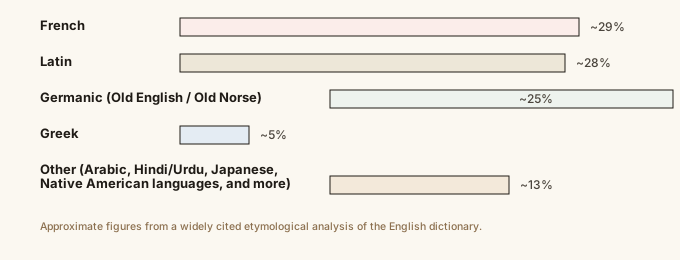
Rough share of English vocabulary by language of origin
The "other languages" slice looks small on a chart like this, but it's doing a lot of quiet work in everyday vocabulary — words like "jungle," "coffee," and "hurricane" are used constantly without most speakers ever thinking about which of those dozens of source languages they came from.
Common mistakes
Common Mistakes
✕
Assuming English borrowing is mostly limited to French, Latin, and Greek.
→ English has borrowed from more than 350 languages, including major contributions from Hindi/Urdu, Arabic, Japanese, Yiddish, and many Indigenous American languages.
✕
Assuming a word's sound tells you its true origin (like 'emoji' sounding like 'emotion').
→ Check the actual etymology rather than guessing from resemblance — apparent connections between words are sometimes coincidental, not a shared history.
✕
Treating naturalized loanwords like 'kindergarten' or 'jungle' as still 'foreign' or needing special treatment (like italics) in everyday writing.
→ Fully naturalized loanwords follow standard English spelling, pronunciation, and grammar, and should be treated as ordinary English words in regular writing.
Common misconception
“Loanwords are a small, exotic exception in English — most everyday words are 'originally English.'”
The opposite is closer to the truth. Widely cited etymological analyses of the English dictionary put native Old English/Germanic-origin words at roughly a quarter of the total vocabulary, with French, Latin, Greek, and dozens of other languages making up the rest. Native Old English words do dominate the handful of most frequently used words in everyday speech (like "the," "and," "water"), which is likely why borrowing feels like the exception — but across the full vocabulary, loanwords are the norm, not a rare special case.
Quick check
Why might English speakers underestimate how much of their vocabulary is actually borrowed?
What to do next
What to do next
Next time you use a word like 'jungle,' 'algebra,' or 'tycoon,' try to recall which language it actually came from.
When a word's sound suggests a connection to another English word (like 'emoji' and 'emotion'), check the real etymology before assuming they're related.
Notice new loanwords entering English right now through food and pop culture, and watch how quickly they start feeling 'normal.'
Read the entry on the History of the English Language next to see how borrowing connects to the bigger shifts — like the Norman Conquest — that shaped English over time.
FAQ
FAQ
Related terms
Related terms
Loanword
A word one language adopts from another, usually becoming fully naturalized in spelling and pronunciation over time — English has taken loanwords from more than 350 languages.
Calque
A special type of borrowing where a phrase is translated piece-by-piece into another language rather than the foreign word itself being adopted — for example, 'flea market' calques the French 'marché aux puces.'
Naturalization (linguistic)
The process by which a borrowed word is gradually absorbed into a language's normal spelling, pronunciation, and grammar rules, until it no longer feels 'foreign' to speakers (e.g. 'kindergarten' is fully naturalized and pluralizes as 'kindergartens,' not the German 'Kindergärten').
This entry was researched from public sources and drafted with AI-assisted tools, then edited — errors are still possible. Spot one, or want a topic covered? Read our disclaimer.
 KnowThis