The world's major religions cluster in distinct geographic patterns shaped by history, migration, and trade — Christianity is the most globally dispersed major religion, Islam and Hinduism are each heavily concentrated in specific regions, and religiously unaffiliated populations form a large and growing share of several countries, according to demographic research from Pew Research Center and other sources.
Reading time
— 6 min
Updated
— Aug 16, 2026
Fact-reviewed
— Aug 16, 2026
Key Takeaways
Key Takeaways
1According to Pew Research Center's Global Religious Landscape study, Christianity (roughly 31% of the world's population) and Islam (roughly 24%) are the two largest religious groups, followed by the religiously unaffiliated, Hinduism, and Buddhism.
2Religions cluster geographically for identifiable historical reasons — trade routes, empire and migration patterns, and colonial history — not randomly: Hinduism is concentrated in South Asia, Buddhism in East and Southeast Asia, and Islam across the Middle East, North Africa, and large parts of South and Southeast Asia.
3The country with the largest Muslim population in the world is Indonesia, not a Middle Eastern country — a fact that surprises many people and is a useful check against assuming religious geography follows regional stereotypes.
The concept
Religions aren't distributed evenly around the world — they cluster into regions shaped by where they originated and how they historically spread through migration, trade, and empire. Religious demography is the field that studies these patterns using census data and large-scale surveys, and it shows clear geographic concentrations: Hinduism is heavily concentrated in South Asia, Buddhism in East and Southeast Asia, and Christianity and Islam are each spread across large, geographically distant regions on multiple continents. This entry presents that geographic distribution factually, based on demographic research, without taking a position on any religion's truth or merit.
That Indonesia fact is a genuinely useful check on assumption — the next item tests whether that pattern actually sticks.
Quick check
Which country has the largest total Muslim population in the world?
Worked examples
Example 1: Christianity's global dispersal pattern (baseline case)
Christianity, while the largest religious group worldwide by Pew Research Center's estimates, is also unusually spread out geographically compared to most other major religions. Large Christian populations exist across the Americas (a legacy of European colonization and missionary activity beginning in the 15th and 16th centuries), across most of Europe, across large parts of sub-Saharan Africa (where Christianity has grown rapidly over the past century, particularly in countries like Nigeria and the Democratic Republic of the Congo), and in significant minority populations across parts of Asia and Oceania. This wide dispersal is itself demographically notable — most other major world religions remain much more concentrated in the specific region where they originated and historically spread, whereas Christianity's growth has been comparatively less geographically bounded, especially over the last two centuries.
Example 2: China's large religiously unaffiliated population (edge case / variation)
China stands out in global religious demography for having one of the largest religiously unaffiliated populations of any country, alongside a long history of Buddhist, Taoist, Confucian, and folk religious practice that continues in various forms, sometimes blended together in ways demographers call syncretism. Multiple factors are cited by researchers, including decades of state-promoted secularism following 1949 and the specific ways Chinese census and survey categories capture (or fail to fully capture) religious and folk-practice identity, which differs from how religious affiliation is typically measured and reported in many other countries. This is a genuine edge case in religious demography: "unaffiliated" in survey data doesn't necessarily mean a total absence of religious or spiritual practice — it often reflects how a specific survey question was asked and how respondents chose to answer it, which is why demographers treat cross-country unaffiliated comparisons with particular care.
Quick check
Survey data often shows China with one of the largest religiously unaffiliated populations of any country. What's the most accurate interpretation of this figure?
Example 3: Reading a "religion by country" map responsibly (real-world / applied case)
A world map shaded by each country's majority religion is a common way to visualize this topic, but reading it accurately requires a few checks: first, a country's majority religion doesn't mean uniformity — India is majority Hindu but also home to the world's third-largest Muslim population by raw numbers, alongside significant Christian, Sikh, Buddhist, and Jain populations. Second, "majority" figures come from surveys and censuses that vary in methodology and recency between countries, so cross-country comparisons carry some built-in uncertainty. Third, religious affiliation and religious practice are not the same thing — someone can identify with a religion on a census without regularly practicing it, and vice versa. A responsible geographic overview states the demographic data as reported by a named, credible source (Pew Research Center, national census bureaus) rather than presenting a single number as an unqualified, precise fact.
How it works (visual)
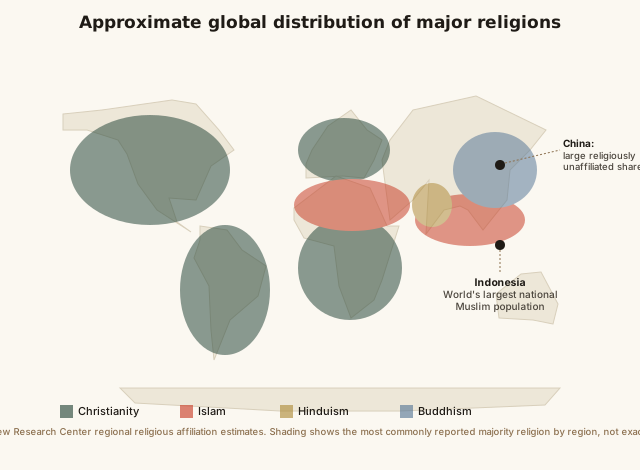
Approximate global distribution of major religions by region
The map is a simplified regional snapshot, not a precise country-by-country breakdown — most countries, especially large and populous ones, contain significant religious minorities alongside their majority group, and the boundaries of "regional" religious concentration are gradual rather than sharp. Its main value is showing the broad historical pattern: religions with a longer, more geographically bounded history of spread (Hinduism, Buddhism) remain more regionally concentrated, while religions with extensive histories of long-distance trade, migration, and missionary or colonial-era expansion (Christianity, Islam) show up across far more of the map.
Common mistakes
Common Mistakes
✕
Assuming Islam's population centers are located primarily in the Middle East.
→ Indonesia, in Southeast Asia, has the largest national Muslim population in the world — well over 200 million people — with major Muslim populations also concentrated across South Asia (Pakistan, India, Bangladesh).
✕
Treating a country's 'majority religion' label as if the entire population shares that religion.
→ Majority-religion figures describe the largest single group, not the whole population — India, for example, is majority Hindu but also home to the world's third-largest Muslim population by raw numbers, alongside sizable Christian, Sikh, Buddhist, and Jain communities.
✕
Treating global religious demographic percentages as precise, universally agreed figures.
→ Figures like Pew Research Center's Global Religious Landscape estimates are based on the best available census and survey data, but methodology, recency, and how 'unaffiliated' or blended practices are categorized vary by country — always check the source and year behind any specific percentage.
Common misconception
“Each world region has always been religiously homogeneous, following just one dominant faith throughout its history.”
Actual religious geography is far more layered than that. India, majority Hindu today, is also home to the world's third-largest Muslim population by raw numbers and significant Christian, Sikh, Buddhist, and Jain communities, alongside a long history of religious pluralism. Indonesia, the country with the world's largest Muslim population, also has substantial Christian and Hindu populations, particularly on the islands of Bali (majority Hindu) and parts of eastern Indonesia. Regions frequently described in shorthand as belonging to "one religion" almost always contain long-standing religious minority populations, often numbering in the tens or hundreds of millions — a fact regularly obscured by simplified, single-color world maps.
Quick check
A map shows a country shaded as 'majority Hindu.' What does that shading actually tell you about the country's religious makeup?
What to do next
What to do next
Look up your own country's religious demographic breakdown from a named source like Pew Research Center or your national census bureau, and note the largest minority religious groups alongside the majority.
Next time you see a single-color 'religion by country' map, remind yourself it shows majority group only, not the full religious makeup of that country's population.
Compare Indonesia's and Saudi Arabia's Muslim population totals directly to see how population size, not regional stereotype, drives which country actually has the largest Muslim population.
Read the entry on Languages by Region to see how a similar geography-driven clustering pattern shows up with world languages, shaped by many of the same historical migration and trade forces.
FAQ
FAQ
Related terms
Related terms
Religious demography
The statistical study of the size, distribution, and characteristics of religious populations.
Religiously unaffiliated
A demographic category for people who identify with no particular religion, including atheists, agnostics, and those with no specific religious identity — distinct from actively opposing religion.
Diaspora
A population that has spread from an original geographic homeland to live in other regions, often while retaining religious or cultural practices from that homeland.
Majority-religion country
A country in which more than half of the population identifies with a single religion, based on census or survey data.
Syncretism
The blending of practices or beliefs from two or more religious traditions into a combined form, common in regions with long histories of cultural contact.
This entry was researched from public sources and drafted with AI-assisted tools, then edited — errors are still possible. Spot one, or want a topic covered? Read our disclaimer.
 KnowThis