A territory or dependency is an area under the sovereignty of another country without being fully independent itself, while a disputed region is a territory whose sovereignty is actively contested by two or more parties — this entry presents the recognized facts and multiple positions on each, citing the United Nations and other neutral authorities rather than endorsing any single claim.
Reading time
— 6 min
Updated
— Aug 16, 2026
Fact-reviewed
— Aug 16, 2026
Key Takeaways
Key Takeaways
1A territory or dependency (Greenland, Puerto Rico, French Guiana) is governed under another sovereign country without being fully independent itself — the degree of self-rule varies enormously from case to case.
2The United Nations currently lists 17 Non-Self-Governing Territories, places whose people have not yet attained a full measure of self-government, tracked by its Special Committee on Decolonization.
3A disputed region has its sovereignty actively contested by two or more parties, and the honest, source-backed approach is to state who administers it, who else claims it, and what neutral bodies like the UN have said — not to declare a winner.
The concept
Not every place with its own flag, government, or well-known name is a fully independent country. A territory or dependency is administered by another country — Greenland is governed by Denmark, Puerto Rico by the United States, French Guiana by France — with varying degrees of local self-rule. A disputed region is different again: it's a place where two or more parties each claim rightful control, and the international community doesn't fully agree on which claim is correct. Both categories sit outside the tidy "195 countries" list covered in the countries and capitals overview.
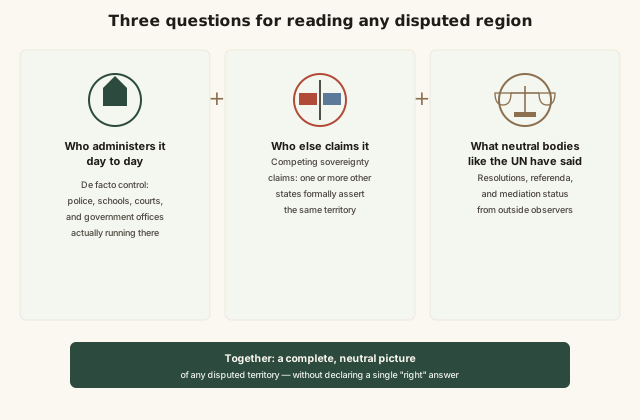
Reading a disputed region accurately means separating three distinct questions: who legally holds sovereignty according to which body, who exercises de facto administrative control on the ground, and what a neutral international body like the UN has actually said about it — the next examples work through real cases using exactly that framework.
Quick check
What is the most accurate, source-backed way to describe a territory where sovereignty is actively disputed by two or more parties?
Worked examples
Example 1: Greenland, a self-governing Danish territory (baseline case)
Greenland is an autonomous territory within the Kingdom of Denmark. Following a 2008 referendum, Greenland's home rule government gained authority over most domestic matters, including natural resources, while Denmark continues to handle foreign affairs, defense, and monetary policy, and provides an annual block grant that funds a substantial share of Greenland's public budget. Greenland is not a UN member state and is not on the UN's Non-Self-Governing Territories list, since its arrangement with Denmark is a recognized form of self-government rather than colonial administration. This is a comparatively uncontested case: no other country disputes Denmark's sovereignty over Greenland, and the primary open question — raised periodically by Greenlandic politicians and, at times, by U.S. officials — is whether Greenland might eventually pursue full independence, not who currently holds legitimate authority over it.
Example 2: Kashmir, a long-running multi-party dispute (edge case / variation)
The Kashmir region has been divided along a militarized Line of Control since a 1948–49 ceasefire, with India administering the largest share (Jammu and Kashmir, and Ladakh), Pakistan administering a portion (Azad Kashmir and Gilgit-Baltistan), and China administering a smaller area (Aksai Chin). India and Pakistan have each fought multiple wars partly over the region, and China separately disputes its own boundary with India in the area. Early UN Security Council resolutions in 1948 called for a plebiscite to let Kashmiris decide the territory's status, but that vote was never held, and the dispute remains formally unresolved. Presented factually: all three governments administer the portions they control as their own territory, all three maintain competing legal claims to some or all of the wider region, and no UN-recognized final settlement has been reached — a neutral geography reference states these facts and the relevant UN history without endorsing any one government's claim.
Quick check
The Kashmir region is currently administered in separate parts by India, Pakistan, and China. What does this fact alone tell you about who holds legitimate sovereignty over the whole region?
Example 3: How to responsibly report on the Falkland Islands / Islas Malvinas dispute (real-world / applied case)
The Falkland Islands (called Islas Malvinas by Argentina) are administered by the United Kingdom as a British Overseas Territory with its own local government, a status Argentina has disputed since the 19th century and which led to the 1982 Falklands War between the two countries. The UN's Special Committee on Decolonization lists the territory among its Non-Self-Governing Territories and has repeatedly called on the UK and Argentina to negotiate a resolution, without itself declaring which country holds rightful sovereignty. A 2013 referendum among Falkland Islands residents recorded overwhelming support for remaining a British Overseas Territory, a result the UK cites as evidence of local self-determination and Argentina does not recognize as resolving its sovereignty claim. The accurate, neutral way to state this: the UK administers the islands, Argentina disputes that sovereignty and refers to them as the Islas Malvinas, the UN has called for negotiation without ruling on sovereignty, and residents voted strongly to remain British — all of which can be reported as fact without a reference source declaring which government is "right."
How it works (visual)
Three separate questions for reading any disputed region
Most confusion about disputed regions comes from collapsing these three separate questions into one. A government administering a territory doesn't automatically settle who holds recognized sovereignty over it; a claim being disputed doesn't mean administration is unclear; and a UN statement calling for negotiation is not the same as a UN ruling on ownership. Keeping the three questions separate is what allows a factual, source-backed answer even when the underlying dispute itself remains unresolved.
Common mistakes
Common Mistakes
✕
Assuming whichever country currently administers a disputed territory automatically holds settled, universally recognized sovereignty over it.
→ De facto control and internationally recognized sovereignty are separate facts — a territory can be actively administered by one government while its sovereignty remains formally disputed by another, as with Kashmir and the Falklands/Malvinas.
✕
Treating 'territory,' 'dependency,' and 'disputed region' as interchangeable terms.
→ A territory or dependency (like Greenland or Puerto Rico) has an uncontested governing country even if its degree of self-rule varies; a disputed region (like Kashmir) has sovereignty actively contested by two or more parties — they're different categories.
✕
Declaring a personal or editorial opinion on which side is 'right' in an active sovereignty dispute.
→ Report the same facts a neutral source like the UN would: who administers it, who else claims it, and what relevant resolutions or referenda exist — state the facts, cite the authority, and let readers draw their own conclusions.
Common misconception
“A territory's status is always clearly settled — it's either fully part of a country or it's fully independent, with nothing in between.”
In reality, self-governance sits on a wide spectrum. French Guiana is fully legally integrated into France; Greenland runs most of its own domestic affairs while Denmark retains foreign policy and defense; Puerto Rico's residents are U.S. citizens who cannot vote in U.S. presidential elections; and the UN's own Non-Self-Governing Territories list currently includes 17 places whose long-term status remains formally unresolved. Sovereignty disputes add yet another layer entirely, where even the basic question of "whose territory is this" doesn't have one universally agreed answer. Treating every territory as either fully sovereign or fully absorbed misses most of the real cases on the map.
Quick check
Which of these best reflects how self-governance actually works across the world's territories and dependencies?
What to do next
What to do next
Look up the UN's current list of 17 Non-Self-Governing Territories and note how many you can locate on a map without checking first — most people know fewer than they expect.
Next time a disputed region comes up in the news, try separating the three questions covered here — de facto control, competing claims, and what a neutral body like the UN has said — before forming a view.
Compare Greenland's, Puerto Rico's, and French Guiana's degrees of self-governance side by side to see how differently 'dependency' status can actually work in practice.
Read the entry on the United Nations & Global Political Bodies to understand the specific UN mechanisms, like the Special Committee on Decolonization, that formally track territories like these.
FAQ
FAQ
Related terms
Related terms
Territory
An area of land under the sovereignty or administration of a country but not treated as a full, integral part of that country's core national territory.
Dependency
A territory that depends on another sovereign state for its governance, defense, or foreign affairs, without being fully independent — also called a dependent territory.
Disputed region
A territory whose sovereignty or control is actively claimed by two or more parties, without full international consensus on which claim is valid.
Non-Self-Governing Territory
A UN classification for a territory whose people have not yet attained a full measure of self-government, tracked by the UN's Special Committee on Decolonization.
De facto control
Actual, on-the-ground administrative control of a territory, which may or may not match who holds recognized legal sovereignty over it.
Self-determination
The principle, recognized in the UN Charter, that a people has the right to freely determine its own political status and form of government.
This entry was researched from public sources and drafted with AI-assisted tools, then edited — errors are still possible. Spot one, or want a topic covered? Read our disclaimer.
 KnowThis