A landlocked country is a sovereign state entirely enclosed by land, with no direct access to an ocean coastline, which forces it to depend on neighboring countries' ports and transit routes for maritime trade.
Reading time
— 5 min
Updated
— Aug 16, 2026
Fact-reviewed
— Aug 16, 2026
Key Takeaways
Key Takeaways
1Around 44 of the world's roughly 195 countries are landlocked, meaning they have no coastline on an ocean or an ocean-connected sea, according to the CIA World Factbook.
2Being landlocked isn't just a geographic curiosity — it forces a country to depend on neighboring countries' ports and transit infrastructure, which the United Nations formally recognizes as a structural trade disadvantage for many landlocked developing countries.
3Landlocked countries can still maintain a navy — several do, operating on inland rivers and lakes instead of the open ocean, including Bolivia, which keeps a lake-based navy decades after losing its Pacific coastline.
The concept
A landlocked country is one that doesn't touch an ocean anywhere along its borders — every neighboring territory is another country's land. Bolivia, Switzerland, Mongolia, and Chad are all landlocked, for example. This matters more than it might sound: without a coastline, a country can't build its own seaport, so it has to rely on roads, railways, or rivers running through a neighbor's territory just to get goods to and from the world's shipping lanes.
The economic disadvantage of being landlocked is well documented — but the most commonly misunderstood part of this topic is what a landlocked country can and can't do about its lack of a coastline, which is exactly where the next example goes.
Quick check
Kazakhstan borders the Caspian Sea along a long stretch of its territory. Does this give Kazakhstan direct access to global ocean shipping routes?
Worked examples
Example 1: Switzerland's transit dependence (baseline case)
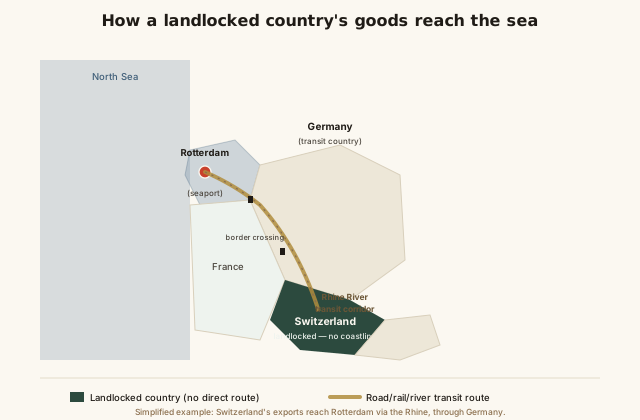
Switzerland, one of the world's wealthiest landlocked countries, moves the large majority of its seaborne trade through the port of Rotterdam in the Netherlands, reaching it via the Rhine River and connecting rail and road networks that cross through Germany and France. This isn't a special arrangement unique to Switzerland — it's the standard pattern for landlocked countries generally: goods travel by rail, road, or river through one or more neighboring countries before ever reaching a seaport. Switzerland's case works comparatively smoothly because of stable, well-developed neighboring infrastructure and long-standing trade agreements — a baseline example of the arrangement working close to as well as it can.
Example 2: Bolivia's lost coastline and its navy (edge case / variation)
Bolivia had a Pacific coastline until the War of the Pacific (1879–1884), after which Chile gained the disputed territory, leaving Bolivia landlocked. Bolivia has continued to press the issue diplomatically for decades; in 2018 the International Court of Justice ruled that while Chile had at times engaged in talks about sea access, it held no binding legal obligation to negotiate Bolivian sovereign access to the coast. Despite having no coastline since the 1880s, Bolivia still maintains a navy — the Bolivian Naval Force — operating on Lake Titicaca and the country's river systems, and it marks a national holiday, Día del Mar (Day of the Sea), each March 23rd. This is a genuine edge case showing that losing a coastline doesn't necessarily end a country's naval tradition or its ongoing diplomatic pursuit of the sea access it once had.
Quick check
Bolivia has had no ocean coastline since the 1880s, yet it still maintains an active navy. How is that possible?
Example 3: Why landlocked status is a tracked development category (real-world / applied case)
UNCTAD and the UN's broader development framework formally classify a subset of landlocked countries as "landlocked developing countries" (LLDCs), a category currently covering 32 countries, because the added cost and unpredictability of relying on a neighbor's transit infrastructure is a measurable, structural drag on trade competitiveness — extra border crossings, transit fees, customs delays, and dependence on a neighbor's road and rail investment all raise the effective cost of every import and export. This is why international development programs specifically target LLDCs with transit-corridor infrastructure investment and simplified cross-border customs agreements — it's treated as a distinct, well-defined policy problem, not simply an unlucky quirk of geography.
How it works (visual)
How a landlocked country's goods reach the sea
The diagram traces the physical path a landlocked country's export has to travel: from origin, across at least one additional international border, through a neighbor's road, rail, or river network, to a seaport that isn't under the exporting country's own control. Every one of those extra steps is a point where cost, delay, or political friction with the transit country can be added — which is the concrete, physical reason landlocked status shows up as a measurable economic disadvantage rather than just a line on a map.
Common mistakes
Common Mistakes
✕
Assuming a country bordering any body of water automatically isn't landlocked.
→ Bordering an enclosed sea with no outlet to the open ocean, like the Caspian Sea, doesn't count — Kazakhstan, Turkmenistan, and Azerbaijan all border the Caspian and are still classified as landlocked.
✕
Assuming landlocked countries can't have any kind of navy.
→ Landlocked countries can and do maintain navies on inland lakes and rivers — Bolivia (Lake Titicaca), Paraguay, and Switzerland (on the Rhine, for logistics) are documented examples.
✕
Treating 'landlocked' as a minor geographic footnote rather than a real economic factor.
→ UNCTAD and the UN formally track landlocked developing countries as a distinct policy category precisely because dependence on a neighbor's ports and transit infrastructure is a measurable, structural trade cost, not just trivia.
Common misconception
“Landlocked countries can't have a navy since they have no coastline.”
Nothing about being landlocked prevents a country from maintaining a navy — it simply means that navy operates on inland waters rather than the open ocean. Bolivia maintains a navy that patrols Lake Titicaca and Bolivian river systems despite losing its Pacific coastline in the 1880s, partly as an active symbol of its long-running diplomatic pursuit of sea access. Paraguay and Switzerland similarly maintain small riverine forces. The presence or absence of a coastline determines where a country's navy can operate, not whether it's allowed to have one at all.
Quick check
Which statement most accurately reflects the relationship between being landlocked and having a navy?
What to do next
What to do next
Find Liechtenstein and Uzbekistan on a map and trace the two national borders each would have to cross to reach any coastline — the only two 'doubly landlocked' countries in the world.
Next time you see a country bordering the Caspian Sea described as having 'coastal access,' check whether that access actually connects to the open ocean before assuming it does.
Look up which seaport your own country's landlocked trading partners (if any) rely on for shipping — it's often a specific, well-documented transit corridor.
Read the entry on Borders & How They're Defined to see how the shape of a country's borders, not just its size, determines whether it ends up landlocked.
FAQ
FAQ
Related terms
Related terms
Landlocked country
A sovereign state with no coastline on an ocean or a sea with direct ocean access, entirely surrounded by other countries' land territory.
Doubly landlocked country
A landlocked country that is itself surrounded only by other landlocked countries, requiring goods to cross at least two international borders to reach any coastline.
Transit route
A route through a neighboring country's territory that a landlocked country depends on to move goods to and from a seaport.
Riverine navy
A naval force operating on inland rivers or lakes rather than the open ocean, which some landlocked countries maintain despite having no coastline.
Enclosed sea
A body of water, such as the Caspian Sea, that is surrounded by land and not directly connected to the open ocean, meaning bordering it does not count as having ocean access.
This entry was researched from public sources and drafted with AI-assisted tools, then edited — errors are still possible. Spot one, or want a topic covered? Read our disclaimer.
 KnowThis