The Great Depression was a severe worldwide economic downturn that began in 1929 and lasted through most of the 1930s, marked by mass unemployment, widespread bank failures, and a collapse in industrial production and trade, driven not by the 1929 stock market crash alone but by a combination of banking crises, poor monetary policy, and contracting global trade.
Reading time
— 5 min
Updated
— Aug 16, 2026
Fact-reviewed
— Aug 16, 2026
Key Takeaways
Key Takeaways
1The October 1929 stock market crash was a trigger, not the sole cause — a wave of bank failures, a shrinking money supply, and countries clinging to the gold standard turned a market crash into a decade-long global depression.
2U.S. unemployment peaked at roughly 25% in 1933, and industrial production, international trade, and prices all collapsed sharply worldwide — the Depression was a genuinely global crisis, not limited to the United States.
3President Franklin D. Roosevelt's New Deal (from 1933) introduced major financial reforms and public works programs that reshaped the U.S. government's economic role permanently, though most economic historians agree it was ultimately World War II's wartime production, not the New Deal alone, that ended the Depression.
The concept
The Great Depression was the worst economic downturn in modern history, starting in 1929 and lasting through most of the 1930s. It's often remembered as starting with the stock market crash of October 1929, when U.S. stock prices collapsed in a matter of days. But the crash itself didn't directly cause mass unemployment and business failures — what followed it did. Banks failed in waves as panicked customers rushed to withdraw savings, businesses couldn't get loans, factories cut production and laid off workers, and the resulting hardship spread internationally as countries cut back on trade with each other, making the downturn worse and longer for almost everyone.
That gap between "a stock market crashed" and "a quarter of the workforce lost their jobs" is exactly where the real explanatory work of the Great Depression lives — and it's why historians and economists still study its mechanics closely today.
Quick check
Did the October 1929 stock market crash by itself directly cause the Great Depression's mass unemployment and business failures?
Worked examples
The 1929 crash and the wave of U.S. bank failures (baseline case)
Following the October 1929 crash, U.S. banks began failing in waves — first from bad loans tied to the crash, then increasingly from self-fulfilling bank runs as depositors, fearing collapse, rushed to withdraw funds all at once. With no deposit insurance, even fundamentally sound banks could be forced to close if enough customers demanded their money simultaneously. Roughly 9,000 U.S. banks failed between 1930 and 1933, wiping out savings and sharply shrinking the amount of money circulating in the economy, which choked off credit for businesses and consumers alike.
The Dust Bowl — an environmental crisis compounding an economic one (variation / regional case)
In the U.S. Great Plains, the Depression collided with a severe, multi-year drought and decades of soil-depleting farming practices, producing the "Dust Bowl" of the mid-to-late 1930s — massive dust storms that destroyed farmland across states like Oklahoma, Kansas, and Texas. Hundreds of thousands of families, already squeezed by collapsing crop prices, were forced to migrate, most famously westward to California, a mass displacement documented by photographers like Dorothea Lange and fictionalized in John Steinbeck's "The Grapes of Wrath." This case shows the Depression wasn't a purely financial event — in some regions, it combined directly with an ecological disaster to devastate entire communities.
The New Deal and the lasting expansion of government's economic role (real-world / applied case)
Franklin D. Roosevelt's New Deal, launched in 1933, introduced Social Security, the FDIC's bank deposit insurance, securities regulation (the SEC), and large public works programs employing millions. Economic historians generally agree these programs eased hardship and reduced unemployment somewhat, and several of its institutions — including Social Security and the FDIC — remain foundational parts of U.S. government and finance today. However, most economic historians also agree the Depression didn't fully end until the massive industrial mobilization of World War II from 1939-1941 drove unemployment down and production sharply upward, meaning the New Deal alone, while significant and lasting, didn't single-handedly end the Depression.
Quick check
What ultimately ended the Great Depression, according to most economic historians?
How it works (visual)
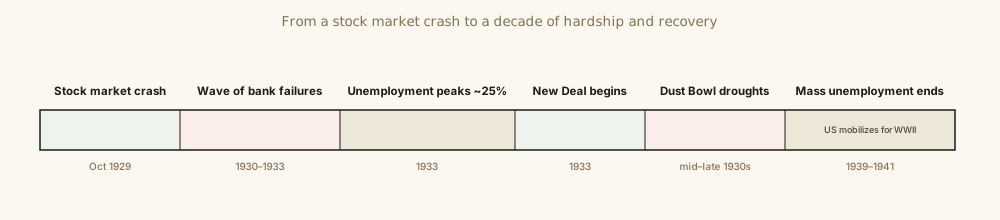
Timeline: the Great Depression, from crash to recovery, 1929-1941
The nearly four-year gap between the 1929 crash and unemployment's 1933 peak is worth sitting with — the worst human impact of the Depression didn't arrive all at once with the crash, but built gradually as bank failures and shrinking credit spread through the wider economy over several years.
Common mistakes
Common Mistakes
✕
Treating the 1929 stock market crash as the sole, complete cause of the Great Depression.
→ The crash was a serious trigger, but bank failures, a shrinking money supply, adherence to the gold standard, and contracting global trade were what turned it into a sustained, decade-long global depression.
✕
Assuming the Great Depression was limited to the United States.
→ It was a genuinely global crisis — industrial production, trade, and employment collapsed across much of Europe, Latin America, and beyond, worsened by countries' commitment to the gold standard and rising trade barriers.
✕
Believing the New Deal single-handedly ended the Depression.
→ Most economic historians credit the New Deal with easing hardship and leaving a lasting institutional legacy (like Social Security and the FDIC), but view World War II's industrial mobilization from 1939-1941 as what actually ended mass unemployment.
Common misconception
“The Great Depression was caused solely by the 1929 stock market crash.”
The October 1929 crash was a real and significant trigger, but on its own it wouldn't have produced a decade-long global depression. Economic historians point to a chain of compounding factors: a wave of roughly 9,000 U.S. bank failures between 1930 and 1933 (worsened by the absence of deposit insurance at the time), a resulting sharp contraction in the money supply and available credit, many countries' rigid adherence to the gold standard limiting their policy responses, and a collapse in international trade worsened by retaliatory tariffs following the U.S. Smoot-Hawley Tariff Act of 1930. The crash started the crisis; these compounding failures are what turned it into the Great Depression.
Quick check
Besides the 1929 stock market crash, what is one major factor economic historians cite as deepening the Great Depression?
What to do next
What to do next
Next time someone says "the stock market crash caused the Great Depression," add the bank failures, shrinking money supply, and global trade collapse that actually turned it into a decade-long crisis.
Notice which New Deal-era institutions are still part of everyday financial life today, like FDIC deposit insurance and Social Security, next time you see either mentioned.
When you read about the Dust Bowl, remember it was an environmental disaster compounding, not causing, the broader economic Depression happening at the same time.
Read the related entry on World War I to see how that war's economic aftermath (including reparations and war debts) fed into the international financial fragility the Depression later exposed.
FAQ
FAQ
Related terms
Related terms
Stock market crash
A sudden, sharp drop in stock prices; the October 1929 Wall Street crash saw major U.S. stock indices lose roughly 25% of their value in under a week.
Bank run
A situation where large numbers of depositors withdraw funds simultaneously, fearing a bank's collapse — which can itself cause the bank to fail even if it was otherwise solvent.
New Deal
A series of U.S. federal programs, public works projects, and financial reforms enacted under President Franklin D. Roosevelt starting in 1933 to combat the Great Depression.
Gold standard
A monetary system where a currency's value is directly linked to a fixed quantity of gold; many economists cite adherence to the gold standard as worsening the Depression's international spread.
This entry was researched from public sources and drafted with AI-assisted tools, then edited — errors are still possible. Spot one, or want a topic covered? Read our disclaimer.
 KnowThis