 KnowThis
Key Takeaways
Key Takeaways
- 1A standard essay has three structural jobs: an introduction that states a clear thesis, body paragraphs that each support that thesis with one point and evidence, and a conclusion that ties it together.
- 2The "five-paragraph essay" is a teaching scaffold for beginners, not a fixed rule — real essays can have as many body paragraphs as the argument genuinely needs.
- 3A strong essay is defined by how well-organized and well-supported its argument is, not by its word count — padding a thin argument with extra words weakens it rather than strengthening it.
The concept
With the thesis as the anchor and each paragraph's job clearly defined, essay structure becomes a matter of checking whether every part is actually doing its job — not a fixed word-count or paragraph-count target to hit.
An essay states its topic — 'Renewable energy is important' — as its opening thesis. What's the main problem with this thesis statement?
Worked examples
Example 1: A standard five-paragraph outline (baseline case)
Example 2: A longer essay that outgrows the five-paragraph shape (variation / exception)
Example 3: The same structure at work outside school essays (real-world / applied case)
A body paragraph presents a strong statistic but never explains how it supports the essay's thesis. What's missing?
How it works (visual)
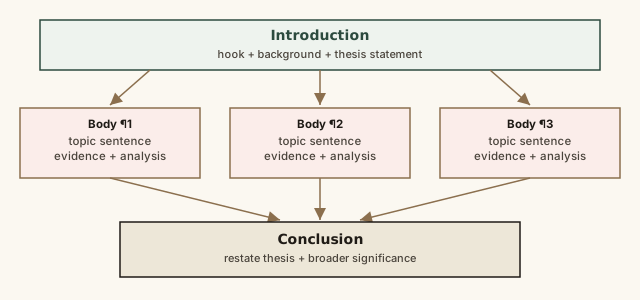
Notice that every body paragraph connects independently back up to the introduction's thesis and down into the conclusion — that's the actual structural test for whether a paragraph belongs in the essay, regardless of how many body paragraphs there end up being.
Common mistakes
Common Mistakes
Writing a vague, unarguable thesis statement that only names a topic.
→ Make the thesis a specific, debatable claim — something a reasonable reader could disagree with — not just a subject announcement.
Padding an essay with extra words or repeated points to reach a length or word-count requirement.
→ Add genuine new evidence, analysis, or a counterargument instead — length should come from real development, not restating the same point differently.
Presenting evidence in a body paragraph without explaining how it supports the thesis.
→ Follow every piece of evidence with a sentence or two of analysis connecting it explicitly back to the argument.
Common misconception
“A good essay is defined mainly by its length — longer essays are automatically stronger or better-graded.”
Essay quality comes from how clearly the thesis is argued and how well each paragraph supports it — not from word count. A tightly argued, well-organized short essay routinely outperforms a long one padded with repetition, vague generalities, or evidence that's never actually connected back to the thesis. Most grading rubrics and style guides explicitly reward clarity and support over sheer length, and padding a thin argument usually makes its weaknesses more visible, not less.
A writer, told their essay needs "more development," responds by adding several sentences that restate the thesis in slightly different words throughout the essay. Does this address the feedback?
What to do next
What to do next
- Before drafting body paragraphs, write your thesis as a single, specific, arguable sentence and check it isn't just naming a topic.
- For each body paragraph you write, confirm it has a topic sentence, evidence, and analysis connecting the evidence back to the thesis — not just evidence alone.
- If you're tempted to add length, add a counterargument paragraph or new evidence instead of restating an existing point.
- Read the related entry on Paragraph Writing Basics for how to build the individual paragraphs an essay is made of.