 KnowThis
Key Takeaways
Key Takeaways
- 1Battery percentage isn't measured directly like water in a tank — it's an estimate calculated from voltage and current, translated through a calibrated curve specific to the battery's chemistry.
- 2A lithium-ion cell's voltage stays nearly flat through most of the charge range and only drops sharply near empty, which is exactly why the percentage can seem to sit steady for a long time and then fall fast near the end.
- 3Two devices both showing '50% battery' aren't reporting a directly comparable physical quantity — each is an estimate calibrated to that specific battery's own capacity and discharge curve.
The concept
The flat-then-steep shape of the voltage curve is easiest to see by comparing how much charge is actually consumed over an equal percentage drop at two different points in the range.
Why can a phone appear to sit at a stable percentage for a long stretch and then drop from a low number to shutdown surprisingly quickly?
Worked examples
Example 1: The drop from 100% to 80% feels slower than 20% to 0% (baseline case)
Why does the same 20-percentage-point drop (100% to 80%, versus 20% to 0%) often represent very different amounts of real usage time?
Example 2: A sudden shutdown on an aging battery (edge case / variation)
Why might an aging battery occasionally shut a device down at a percentage that still looks moderate?
Example 3: Comparing "50% battery" across two different devices (real-world / applied case)
Two different devices both showing 50% battery aren't necessarily offering the same amount of remaining usable time, because each percentage is an estimate calibrated against that specific device's own battery capacity, chemistry, and discharge curve — not a universal, directly comparable unit of stored energy. A larger battery at 50% can hold far more actual charge than a smaller one at the same percentage, and even two similarly sized batteries can behave differently as one ages faster than the other. Judging remaining time by a device's own history and behavior is a more reliable read than comparing raw percentages across different devices.
How it works (visual)
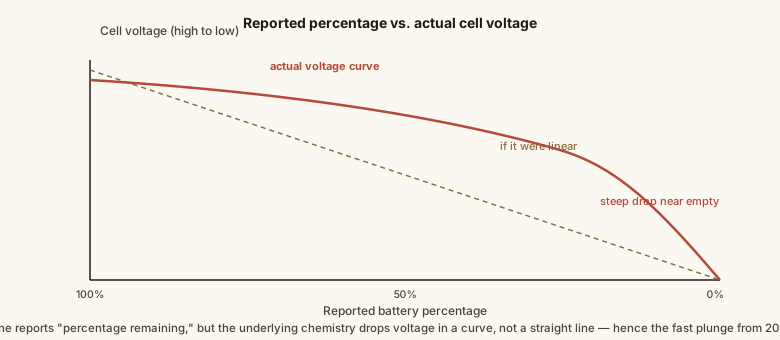
The gap between the real curve and the dashed straight-line reference is exactly why the reported percentage doesn't behave like a simple, evenly ticking countdown.
Common mistakes
Common Mistakes
Assuming 50% battery means exactly half the total charge in a strict straight-line sense.
→ Battery percentage is an estimate derived from a non-linear voltage curve, not a direct linear measurement of remaining energy.
Panicking when a battery drops rapidly near the low end.
→ Fast percentage drops near empty are expected behavior for lithium-ion cells, whose voltage falls steeply in that range — not necessarily a sign of a failing battery.
Comparing battery percentage across two different devices as if it were a directly comparable unit of energy.
→ Each device's percentage is calibrated to its own battery's capacity and discharge curve, so the same number doesn't guarantee the same remaining usable time on a different device.
Assuming charging speed is constant across the whole percentage range.
→ Charging is typically fastest through the middle of the range and deliberately slows near full during the constant-voltage phase, another non-linear pattern related to the same battery chemistry.
Common misconception
“Battery percentage is a direct, straight-line measurement — 50% is exactly half the real charge, just like a fuel gauge float.”
Battery percentage is an estimate, calculated from the battery's voltage and current and translated through a calibrated reference curve — not a direct physical measurement. A lithium-ion cell's voltage stays nearly flat through most of the charge range and only drops sharply near empty, so the percentage mirrors that same non-linear shape rather than counting down in even, equal-sized steps.
What to do next
What to do next
- Don't be alarmed by rapid percentage drops near very low battery — that's expected voltage-curve behavior, not necessarily a fault.
- If percentage readings seem to be drifting or jumping unexpectedly, let the battery run through an occasional full charge cycle to help it recalibrate.
- Judge remaining usable time by your own device's history rather than comparing raw percentage numbers across different devices.
- Treat a sudden shutdown at a moderate-looking percentage on an older battery as a sign of gauge drift or wear, not an immediate emergency.