The Solar System & Planets: Order, Sizes, and What Makes Each One Different
The solar system is the Sun plus everything gravitationally bound to it — 8 planets, their moons, dwarf planets, asteroids, and comets — with the Sun alone holding about 99.8% of the total mass.
Reading time
— 9 min
Updated
— Sep 24, 2026
Fact-reviewed
— Aug 19, 2026
Key Takeaways
Key Takeaways
1The solar system has 8 official planets since 2006 — the inner four (Mercury, Venus, Earth, Mars) are small, dense, and rocky; the outer four (Jupiter, Saturn, Uranus, Neptune) are large, low-density gas or ice giants with no solid surface.
2The Sun holds about 99.8% of the entire solar system's mass — every planet, moon, asteroid, and comet combined makes up roughly the remaining 0.2%.
3A planet's distance from the Sun and its orbital period are mathematically linked by Kepler's third law: farther planets don't just travel a longer path, they also move slower, so their 'year' grows much faster than their distance does.
The concept
The solar system is the Sun and everything that orbits it: 8 planets, their moons, dwarf planets like Pluto, and countless smaller rocky and icy bodies. Going outward from the Sun, the order is Mercury, Venus, Earth, Mars, Jupiter, Saturn, Uranus, Neptune. The first four are small and rocky with solid ground you could (in theory) stand on. The last four are enormous balls of gas and ice with no solid surface at all — Jupiter alone is more than 1,300 times Earth's volume.
That formation story explains why the planets look the way they do. The next useful step is putting real numbers on it — distance, orbital period, and gravity — because those numbers are what let you calculate things like a planet's year length or how much you'd weigh standing on it. That same gravity is also why the Moon always shows Earth the same face — its rotation and orbit have been locked together for billions of years.
Quick check
Why are Mercury, Venus, Earth, and Mars small and rocky, while Jupiter, Saturn, Uranus, and Neptune are enormous gas or ice giants?
Worked examples
Example 1: How much would you weigh on Mars? (baseline case)
Mars has a surface gravity about 0.38 times Earth's — meaning its gravitational pull is roughly 38% as strong. A person who weighs 70 kg on Earth would weigh 70 × 0.38 = 26.6 kg on Mars, even though their actual mass (the amount of matter in their body) hasn't changed at all. Weight is a force that depends on local gravity; mass is a fixed property of the object. This is why an astronaut who could barely lift a heavy toolbox on Earth could hoist it with far less effort on the Martian surface.
Example 2: Weight on Jupiter — a planet with no solid surface (edge case / variation)
Jupiter's surface gravity is about 2.53 times Earth's — the same 70 kg person would weigh 70 × 2.53 ≈ 177 kg there. But "surface" is doing unusual work in that sentence: Jupiter is a gas giant with no solid ground to stand on at all. Its atmosphere just gets denser and hotter with depth until it blends into a fluid metallic hydrogen interior. Planetary scientists define Jupiter's "surface gravity" at the altitude where atmospheric pressure equals 1 bar (roughly Earth's sea-level pressure) — a reference point in the clouds, not a place anyone could stand. It's also a genuine edge case worth noting that Saturn, despite being even larger than Jupiter, has a lower average density than water (about 0.687 g/cm³ versus water's 1.0 g/cm³) — a Saturn-sized bathtub could theoretically float it.
Quick check
Jupiter is often described as having a 'surface gravity' 2.53 times Earth's — but what does 'surface' actually mean for Jupiter?
Example 3: Using Kepler's third law to find Mars's orbital period (real-world / applied case)
Mars orbits the Sun at a semi-major axis of about 1.52 AU. Kepler's third law, simplified for objects orbiting the Sun, states T = a^1.5, where T is the orbital period in Earth years and a is the distance in AU. Plugging in Mars: T = 1.52^1.5 ≈ 1.87 years — which matches the real, independently measured value of about 687 Earth days (≈1.88 years) almost exactly. This same relationship is what let 17th-century astronomers predict planetary positions accurately centuries before anyone understood why gravity produced that pattern — Newton wouldn't explain the underlying physics until decades after Kepler published the law.
Quick check
Mars (1.52 AU from the Sun) takes about 1.87 Earth years to complete one orbit — roughly 1.88 times Earth's orbital period. Why isn't the ratio closer to 1.52, matching the distance ratio?
How it works (visual)
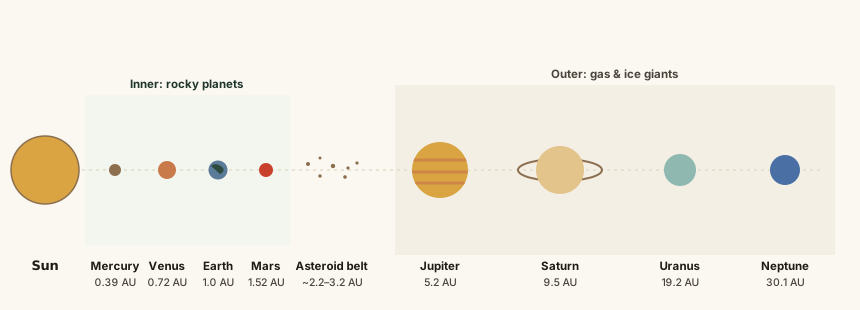
The solar system: planet order, relative sizes, and inner vs. outer split
Notice the jump in scale between Mars and Jupiter — that gap is the asteroid belt, and it also marks roughly where the "frost line" sat during the solar system's formation. Everything to the left of that gap is small and rocky; everything to the right is large and gas- or ice-dominated. The distances aren't evenly spaced either: each planet sits roughly (though not exactly) further from the Sun than a simple multiple of the one before it, which is part of why outer planets have such dramatically longer years.
The eight planets, one by one
Category and formation physics explain the general pattern, but each planet also has its own specific, well-documented quirks — the kind of facts that actually distinguish "Saturn" from "a gas giant" in general.
Mercury is the smallest planet and the fastest orbiter (an 88-day year), but its most extreme trait is temperature swing: with almost no atmosphere to trap or spread heat, its sunlit side reaches roughly 430°C while the night side drops to about -180°C — a wider single-planet temperature range than anywhere else in the solar system.
Venus, not Mercury, is the solar system's hottest planet — surface temperature averages around 465°C, hot enough to melt lead — because its thick carbon dioxide atmosphere traps heat through a runaway greenhouse effect far more powerful than distance from the Sun alone would produce. Venus also spins backward in retrograde rotation, and does so so slowly that a single Venusian day (243 Earth days) is longer than its entire year (225 Earth days).
Earth is the only known planet with stable liquid water on its surface and the only one confirmed to host life, both of which trace back to sitting inside the Sun's "habitable zone" and having a molten iron core that generates a protective magnetic field, deflecting most solar wind that would otherwise strip away the atmosphere over time (the likely fate of Mars, which lost its own magnetic field billions of years ago).
Mars gets its red color from iron oxide — literally rust — coating its dusty surface. It carries polar ice caps of frozen water and carbon dioxide, hosts the largest known volcano in the solar system (Olympus Mons, roughly 2.5 times the height of Mount Everest), and shows dry riverbeds and mineral deposits that only form in flowing water — strong evidence Mars once had a thicker atmosphere and liquid water on its surface, before losing both.
Jupiter, the largest planet, is dominated by the Great Red Spot — a storm wider than Earth that has been observed continuously for at least 190 years. Jupiter's powerful magnetic field and more than 90 known moons include the four Galilean moons (Io, Europa, Ganymede, Callisto), one of which, Europa, is considered a leading candidate for a subsurface liquid-water ocean elsewhere in the solar system.
Saturn is best known for its ring system — billions of ice and rock particles, most no bigger than a house, spread into a disk so thin relative to its width that it would be nearly invisible edge-on. Saturn is also the only planet in the solar system less dense than water (about 0.687 g/cm³): a Saturn-sized bathtub could, in principle, float it.
Uranus has an axial tilt of roughly 98°, meaning it essentially orbits the Sun on its side, likely the result of a massive ancient collision — this produces extreme, decades-long seasons where one pole faces the Sun continuously while the other sits in darkness. Its pale blue-green color comes from methane in its atmosphere absorbing red light and reflecting blue-green back.
Neptune, the outermost planet, has the strongest sustained winds ever measured in the solar system — gusts recorded up to roughly 2,100 km/h. It's also the only planet discovered through mathematics before anyone saw it: 19th-century astronomers noticed Uranus's orbit had unexplained irregularities, calculated where an unseen planet's gravity would have to be to cause them, and pointed a telescope at that exact predicted spot in 1846 — Neptune was there.
Common misconception
“Mercury must be the hottest planet, since it's closest to the Sun.”
Venus is hotter — averaging around 465°C versus Mercury's daytime peak of about 430°C — despite orbiting nearly twice as far from the Sun. Mercury has almost no atmosphere to trap heat, so its dayside gets scorching but its nightside plunges to about -180°C. Venus's thick carbon dioxide atmosphere traps heat so effectively through a runaway greenhouse effect that its surface stays blazing hot around the clock, on both the day and night side, with barely any temperature swing at all.
Common mistakes
Common Mistakes
✕
Thinking Pluto was removed from the solar system entirely when it 'stopped being a planet.'
→ Pluto is still very much part of the solar system — it was reclassified as a dwarf planet in 2006 because it hasn't gravitationally cleared its orbital neighborhood, not because it was ejected or disproven to exist.
✕
Assuming a planet's weight and mass are the same thing, and that weight is a fixed property of an object.
→ Mass (amount of matter) stays the same everywhere; weight (a force) changes with local gravity — the same person has one mass but a different weight on every planet.
✕
Picturing the asteroid belt as densely packed rocks you'd have to dodge, like in movie spaceship scenes.
→ The asteroid belt is mostly empty space — the average distance between known asteroids is roughly a million kilometers, which is why multiple spacecraft have crossed it without any special maneuvering.
Common misconception
“The asteroid belt is so densely packed with rocks that a spacecraft flying through it has to dodge collisions constantly, the way it's often shown in movies.”
The asteroid belt, sitting roughly between Mars and Jupiter, does contain millions of rocky bodies — but they're spread across a vast volume of space. The average distance between known asteroids is on the order of a million kilometers, far enough apart that several NASA spacecraft, including Pioneer 10, Voyager 1 and 2, and New Horizons, have flown straight through the belt without any evasive maneuvers or even a close encounter with an asteroid. The total mass of everything in the belt combined is only about 3% of the Moon's mass, with roughly a third of that concentrated in the dwarf planet Ceres alone.
Quick check
Several NASA spacecraft have flown straight through the asteroid belt on their way to the outer planets without hitting anything or needing to dodge debris. Why is this possible?
Try it yourself
Weight on another planet (from Earth weight and surface gravity ratio)
Approximate weight there (kg)26.6
Orbital period from distance (Kepler's third law, T = a^1.5)
Orbital period1.9 years
What to do next
What to do next
Try the weight calculator above with Jupiter's gravity ratio (2.53) and Mercury's (0.38) to see just how much your weight would swing across the solar system while your mass never changes.
Use the orbital period calculator with Neptune's distance (30.1 AU) to see how dramatically Kepler's third law stretches out the years of the outer planets.
Next time a movie shows a ship weaving between asteroids, remember the real belt is mostly empty space — several real spacecraft have crossed it in a straight line.
Read the related entry on Space, Stars & the Universe to see how the same distance-scale reasoning applies once you leave the solar system entirely.
FAQ
FAQ
Related terms
Related terms
Astronomical unit (AU)
The average distance from Earth to the Sun, about 149.6 million kilometers — used as a convenient yardstick for solar system distances.
Terrestrial planet
A small, dense, rocky planet with a solid surface — Mercury, Venus, Earth, and Mars.
Gas giant
A large planet made mostly of hydrogen and helium with no solid surface — Jupiter and Saturn.
Ice giant
A large planet made mostly of heavier volatile compounds like water, ammonia, and methane surrounding a rocky core — Uranus and Neptune.
Semi-major axis
Half the longest diameter of an elliptical orbit; commonly used as a planet's average distance from the Sun.
Orbital period
The time a planet takes to complete one full orbit around the Sun.
Surface gravity
The gravitational acceleration experienced at a planet's surface (or, for gas giants, at a defined reference altitude), often expressed relative to Earth's.
Dwarf planet
A body that orbits the Sun and is round from its own gravity but has not cleared other objects from its orbital path — Pluto is the best-known example.
Asteroid belt
A region between Mars and Jupiter, roughly 2.2 to 3.2 AU from the Sun, containing millions of rocky bodies left over from the solar system's formation.
Runaway greenhouse effect
A self-reinforcing warming process where a thick atmosphere traps so much heat that surface temperature climbs far beyond what distance from the Sun alone would predict — the reason Venus, not Mercury, is the solar system's hottest planet.
Retrograde rotation
Spinning in the opposite direction to most other bodies in the solar system (east to west instead of west to east) — Venus and Uranus both do this, likely from ancient collisions.
Axial tilt
The angle between a planet's spin axis and its orbital plane; Earth's 23.4° tilt drives our seasons, while Uranus's extreme 98° tilt means it essentially orbits on its side.
Galilean moons
Jupiter's four largest moons — Io, Europa, Ganymede, and Callisto — first observed by Galileo in 1610, the earliest evidence that not everything in the sky orbits Earth.
This entry was researched from public sources and drafted with AI-assisted tools, then edited — errors are still possible. Spot one, or want a topic covered? Read our disclaimer.
 KnowThis