 KnowThis
Key Takeaways
Key Takeaways
- 1Population density is calculated as total population divided by land area — it measures how crowded a place is, not how many people live there in total.
- 2Monaco is generally cited as the most densely populated sovereign country on Earth, at roughly 18,000-26,000 people per km² depending on the exact land area used, while Mongolia is among the least dense at around 2 people per km².
- 3A country can have a huge total population and still be sparsely populated (like Canada or Russia, both vast in land area), while a country with a comparatively small total population can be extremely dense (like Bangladesh) — the two measurements are independent of each other.
The concept
That gap between "how many people" and "how crowded" is where most confusion about population statistics comes from, and it's easiest to see clearly with real numbers side by side.
Country A has 40 million people and a land area of 9.9 million km². Country B has 20 million people and a land area of 150,000 km². Which has the higher population density?
Worked examples
Example 1: Calculating density for a mid-size example (baseline case)
Example 2: Same population, wildly different density (edge case / variation)
Someone claims that Canada, with roughly 39-40 million people, must be a 'crowded' country because that's a large total population. Is this reasoning sound?
Example 3: Bangladesh vs. Canada — a real-world contrast (real-world / applied case)
Bangladesh has a total population of roughly 170 million people — well under half of Canada's neighbor, the United States — living in a land area of about 148,000 km², producing a population density around 1,150 people per km², among the highest of any large country in the world. Canada, by contrast, has a smaller total population (roughly 39-40 million) but a vastly larger land area of nearly 9.98 million km², putting its density at around 4 people per km² — one of the lowest of any populous country. Both countries have populations in the tens of millions, but their density figures differ by roughly 285-fold, driven entirely by the difference in land area rather than population size.
How it works (visual)
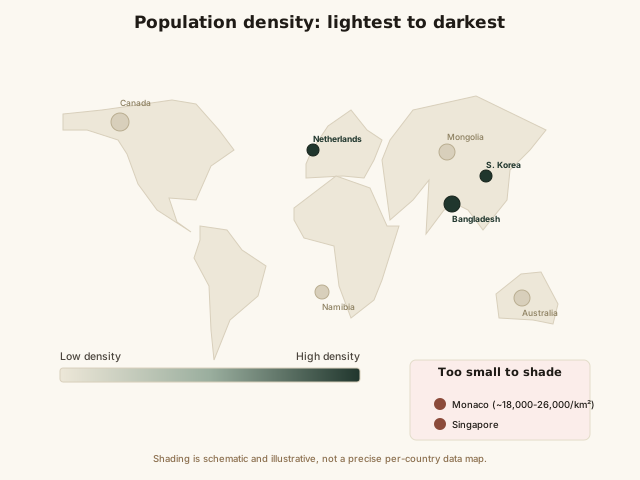
Notice that the darkest-shaded countries aren't necessarily the ones with the largest total populations — Bangladesh is far darker than Russia on this map despite Russia having a slightly larger total population, purely because Bangladesh's land area is a small fraction of Russia's. Large, lightly shaded countries like Canada, Australia, and Russia all have substantial total populations but rank among the lowest in density.
Common mistakes
Common Mistakes
Assuming a country with a large total population must be densely populated.
→ Density depends on land area too. Russia, the US, and Canada all have large total populations but rank among the lower-density major countries because their land areas are enormous.
Comparing population density figures without checking whether they use total land area or only habitable land.
→ A country with large uninhabitable regions (deserts, ice, mountains) can have a much higher 'density on habitable land' figure than its raw total-land-area density suggests — always check the methodology before comparing sources.
Assuming density rankings and total population rankings will roughly match.
→ They frequently don't. Monaco tops density rankings with a total population of about 38,000, while India and China, the top two total-population countries, don't even crack the top 20 in density due to their large land areas.
Common misconception
“Population density means the same thing as total population size — a country with 'more people' is automatically 'more crowded.'”
These are two separate measurements that often point in opposite directions. Total population is a headcount; population density is that headcount divided by land area, which measures crowding. Russia has the world's largest total land area and a sizable population (around 144 million), yet ranks among the least densely populated major countries at roughly 9 people per km² because that population is spread across such an enormous territory. Meanwhile, Bangladesh, with a much smaller total population than Russia, is one of the most densely populated large countries on Earth, at over 1,000 people per km², because its population occupies a comparatively tiny land area. A country can rank near the top for total population and near the bottom for density at the same time — India (roughly 480/km²) and especially China (roughly 150/km², since China's vast interior is sparsely populated) both have densities far below far smaller but more tightly packed nations like Bangladesh or the Netherlands.
India has one of the largest total populations of any country in the world. Does this mean India also has one of the highest population densities in the world?
Try it yourself
What to do next
What to do next
- Try the calculator above with Bangladesh's approximate figures (population 170,000,000, area 148,000 km²) and then with Canada's (population 39,000,000, area 9,980,000 km²) to see the contrast directly.
- Next time you see a 'most populous countries' list, check whether it's ranking total population or density — they're usually very different lists.
- Look up your own country's or city's population density and compare it to a place you consider 'crowded' or 'empty' to test your intuition against the real numbers.
- Read the related entry on Urbanization Trends to see how density plays out specifically within cities rather than across whole countries.