 KnowThis
Key Takeaways
Key Takeaways
- 1More than half of the world's population has lived in urban areas since around 2007-2008 — a first in human history — and the UN projects that share will reach roughly 68% by 2050.
- 2Urbanization rates vary hugely by region: North America and Latin America are already roughly 80% urban, while Africa remains under half urban, even though Africa and Asia are currently urbanizing the fastest in relative terms.
- 3Urban growth isn't universal — while cities overall are gaining population faster than rural areas globally, some wealthier countries see stable or even shrinking urban cores alongside growing suburbs, exurbs, or rural areas, a pattern called counterurbanization.
The concept
That regional unevenness — and the fact that "urban" itself is a moving target defined differently country to country — matters a lot once you start comparing specific places or projecting trends forward.
Roughly what share of the world's population currently lives in urban areas, and when did that share first cross 50%?
Worked examples
Example 1: Projecting the global urban share forward (baseline case)
Example 2: How the definition of "urban" itself changes the numbers (edge case / variation)
Country A reports 70% urbanization and Country B reports 45%. Does this necessarily mean Country A's population is genuinely more concentrated in cities than Country B's?
Example 3: The rise of megacities (real-world / applied case)
In 1950, only a couple of urban areas worldwide — New York and Tokyo — approached what's now defined as megacity scale (over 10 million people). By the late 2010s, the UN counted more than 30 megacities globally, including Tokyo (the world's largest urban agglomeration, with over 37 million people in its greater metropolitan area), Delhi, Shanghai, São Paulo, and Mexico City, with further growth projected. This surge reflects the combined effect of rural-to-urban migration for economic opportunity, natural population growth within existing cities, and the physical expansion of city boundaries absorbing previously separate towns — the same underlying forces driving global urbanization, concentrated at an extreme scale in a relatively small number of places.
How it works (visual)
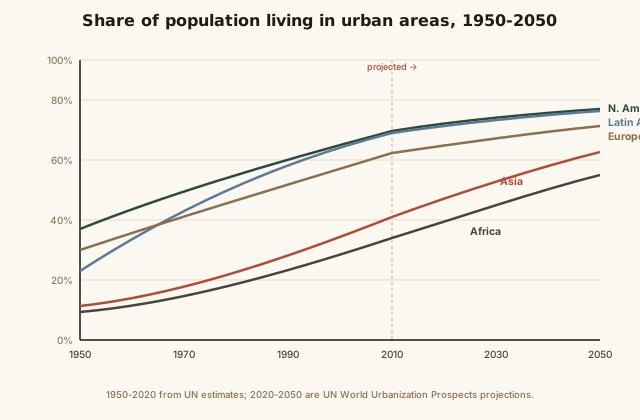
Notice that North America and Latin America's lines are already high and relatively flat by 2020 — most of their urbanization happened decades ago. Africa's line, by contrast, is still climbing steeply through the projected period, which is why Africa is often described as urbanizing "fastest" even though its overall urban share remains the lowest of the five regions shown.
Common mistakes
Common Mistakes
Assuming every region of the world is urbanizing at roughly the same pace.
→ Rates vary hugely — North America and Latin America are already 80%+ urban and growing slowly, while Africa and Asia, starting from a lower base, are adding urban population much faster in relative terms.
Comparing 'percent urban' figures across countries without checking how each defines 'urban.'
→ Definitions of urban range from roughly 200 people (some Nordic countries) to 50,000 (Japan) — always check methodology before treating cross-country comparisons as precise.
Treating a megacity's population as fixed, rather than as an ongoing, changing metric.
→ Megacity rankings shift over time as cities grow, boundaries expand, and new cities cross the 10-million threshold — the specific list of the world's largest urban areas changes with each UN revision.
Common misconception
“Cities are always growing faster than rural areas, everywhere in the world.”
Globally, urban areas are gaining population faster than rural ones on average — that broad trend is real and well documented. But it isn't universal. In several higher-income countries, a pattern called counterurbanization has been observed, where growth shifts away from dense city centers toward suburbs, exurbs, or smaller towns, sometimes driven by housing costs, quality-of-life preferences, or (more recently) the rise of remote work reducing the need to live near a city center. Some rural areas in wealthy countries have also seen population growth from retirement migration or lifestyle relocation even while nearby urban cores stagnate. The global average trend toward urbanization is genuinely dominant, but treating it as an exceptionless law that applies identically to every country and every year overstates what the data actually shows.
A specific wealthy country's official statistics show its urban core population declining slightly while its surrounding suburbs and small towns grow. Does this contradict global urbanization data?
Try it yourself
What to do next
What to do next
- Try the calculator above with Africa's approximate current urban share (around 44%) and a higher annual increase (around 0.9 points/year) to see how a lower-starting, faster-growing region catches up over time.
- Next time you see an 'urbanization ranking' of countries, check what population threshold each country uses to define 'urban' before comparing them directly.
- Look up your own country's urban vs. rural population trend over the last 20 years on the World Bank's urban development data to see where it fits the global pattern.
- Read the related entry on World Population Facts to see how overall population growth and urbanization interact.