 KnowThis
Key Takeaways
Key Takeaways
- 1The Black Death (1347-1351) is estimated to have killed around 25 million people in Europe alone — roughly a third of the continent's population — in just four years.
- 2The disease was plague, caused by the bacterium Yersinia pestis, and its main historical transmission cycle involved infected fleas, commonly carried by rodents, biting humans — not rodents alone, and not through casual person-to-person contact as the primary route for its most common form.
- 3The mass labor shortage that followed the pandemic measurably shifted power toward surviving peasants and workers, contributing to the decline of medieval serfdom across much of Western Europe in the generations afterward.
The concept
That transmission detail — fleas as the primary carrier, not rats by themselves — matters for understanding both the disease's actual history and a persistent modern misconception about how it spread, which is worth addressing directly.
Roughly what share of Europe's population is estimated to have died during the Black Death (1347-1351)?
Worked examples
Example 1: The 1347 arrival in Sicily (baseline case)
Example 2: Uneven regional impact and later recurring waves (variation / exception)
Example 3: How the labor shortage reshaped medieval Europe (real-world / applied case)
How did the Black Death's death toll affect labor and social structure in the decades that followed?
How it works (visual)
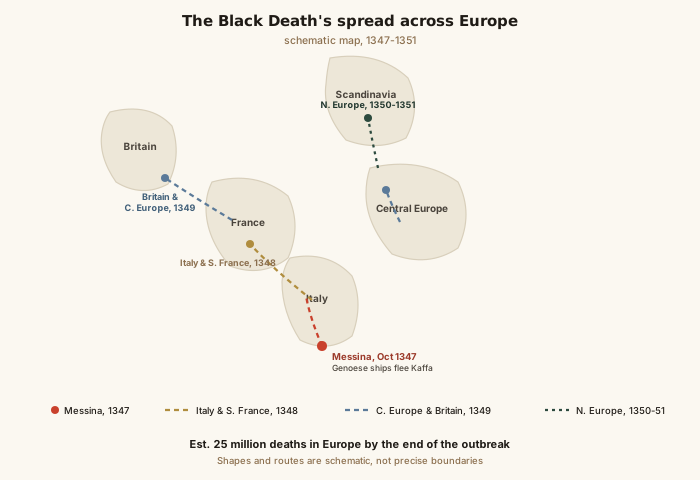
The spread pattern traces existing trade routes almost exactly — port cities and major trade hubs were hit earliest and often hardest, while more isolated inland or rural areas were sometimes affected later or less severely.
Common mistakes
Common Mistakes
Assuming the Black Death was a single isolated outbreak that never recurred.
→ Plague returned to Europe in periodic waves for centuries after 1351, including a notable recurrence in London in 1665 — the 1347-1351 outbreak was the deadliest, not the only one.
Thinking the Black Death had no lasting effects beyond the immediate death toll.
→ The resulting labor shortage measurably shifted economic power toward peasants and workers, contributing to the decline of serfdom across much of Western Europe over the following century.
Assuming every region of Europe was affected equally by the initial 1347-1351 outbreak.
→ Mortality varied significantly by region and city — some areas, like much of Poland, are generally documented as experiencing comparatively lower mortality than hard-hit regions of Western and Southern Europe.
Common misconception
“The Black Death was caused and spread by rats alone, with no real role for fleas or trade networks.”
Rats are part of the story, but they weren't spreading the disease directly — the actual transmission mechanism, according to the U.S. Centers for Disease Control and Prevention, is a flea bite: fleas become infected with the bacterium Yersinia pestis after feeding on an infected rodent, and then bite and infect a human host. Some historians studying the pandemic's unusually rapid European spread have also proposed that human fleas and body lice may have contributed to person-to-person transmission during the medieval outbreak, an active area of academic research. Separately, none of this would have reached Europe at all without the era's Mediterranean trade networks — the disease arrived specifically via Genoese trading ships fleeing a siege at Kaffa, following the same commercial routes as ordinary goods. Reducing the Black Death's spread to "rats" alone leaves out both the actual biological transmission mechanism and the trade-network context that let it reach Europe in the first place.
What is the main mechanism by which bubonic plague, including the Black Death, historically spread to humans?
Try it yourself
What to do next
What to do next
- Next time rats get blamed for the Black Death on their own, mentally correct it to fleas as the actual biting, disease-transmitting link.
- When you hear the Black Death described as a single one-off event, remember plague recurred in periodic waves for centuries afterward, including in 1665 London.
- Notice the trade-route connection next time the pandemic's spread comes up — it followed Mediterranean shipping lanes almost exactly.
- If serfdom's decline comes up in a European history context, connect it back to the post-plague labor shortage as a major contributing factor.