The Silk Road was a network of overland and maritime trade routes connecting China, Central Asia, the Middle East, and Europe from roughly the 2nd century BCE to the 15th–16th century CE, carrying goods, technologies, religions, and diseases across Eurasia.
Reading time
— 5 min
Updated
— Aug 16, 2026
Fact-reviewed
— Aug 16, 2026
Key Takeaways
Key Takeaways
1"The Silk Road" was never a single physical road — it was a shifting network of overland and maritime trade routes across Eurasia, in active use from roughly the 2nd century BCE to the 15th-16th century CE.
2Far more than silk moved along these routes — paper-making technology, gunpowder, religious ideas (Buddhism, Islam, Christianity), and diseases, most notably the pathogen behind the Black Death, all traveled the same corridors as trade goods.
3The Mongol Empire's 13th-century "Pax Mongolica" made the overland route unusually safe for about a century, the exact era when the Venetian merchant Marco Polo traveled it and reached the court of Kublai Khan.
The concept
The Silk Road was a network of trade routes, not one continuous road, linking China to the Mediterranean world through Central Asia, Persia, and the Middle East. It carried silk from China westward and, in return, brought goods like wool, gold, and silver eastward, but goods were only part of what traveled — ideas, religions, and technologies moved along the same routes over roughly 1,500 years of active use.
That disease connection is a useful check on any picture of the Silk Road as simply a prosperous trade highway — it was also one of history's clearest examples of how connectivity itself can be a vector, for better and worse.
Quick check
What does the term "Silk Road" actually refer to?
Worked examples
Example 1: Zhang Qian and the Han dynasty's westward opening (baseline case)
Around 138 BCE, the Han Chinese emperor sent the envoy Zhang Qian west, initially to seek military allies against a rival nomadic confederation. Zhang Qian didn't secure the alliance he was sent for, but he returned over a decade later with detailed reports on the kingdoms of Central Asia, information that helped open formal, sustained trade contact between Han China and the wider region. This mission is commonly cited as the starting point historians use to date the Silk Road's formal opening, even though informal exchange networks likely existed earlier.
Example 2: The Pax Mongolica and Marco Polo's journey (variation / peak activity)
For much of its history, the Silk Road was dangerous — caravans faced banditry and unstable, fragmented political control across Central Asia. That changed dramatically in the 13th century once the Mongol Empire unified territory from China to Eastern Europe under a single, if brutal, political order, making overland travel unusually safe for about a century. It was during this window, 1271-1295, that the Venetian merchant Marco Polo traveled the route with his father and uncle, reaching the court of Kublai Khan and remaining in China for roughly 17 years before returning home — his account of the journey, later written down with the help of a fellow prisoner, Rustichello, became one of medieval Europe's most influential descriptions of Asia.
Example 3: Paper, gunpowder, and religion — what actually traveled (real-world / applied case)
Silk moved west, but the exchange ran both ways and covered far more than fabric. Papermaking technology spread from China westward, reaching the Islamic world by the 8th century and Europe centuries later, fundamentally changing how information could be recorded and shared. Gunpowder technology followed a similar westward path from China. Religions spread in multiple directions along the same routes — Buddhism moved from India into Central Asia and China, while Nestorian Christianity and later Islam spread eastward into Central Asia. This is the clearest evidence that the Silk Road's real historical significance goes well beyond silk itself — it was a channel for technological and cultural exchange on a scale that reshaped multiple civilizations.
Quick check
What made the 13th century an unusually active and safe period for overland Silk Road travel?
How it works (visual)
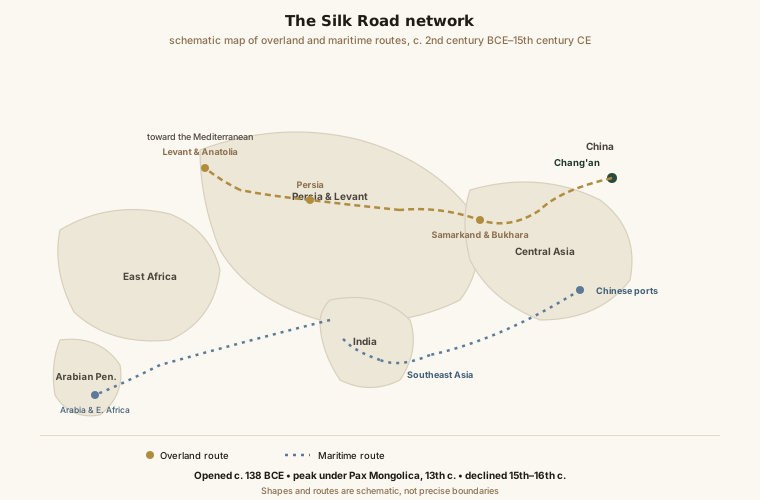
The Silk Road network: overland and maritime routes, c. 2nd century BCE–15th century CE
Notice the two separate systems on the map — an overland network through Central Asia's mountains and deserts, and a maritime network across the Indian Ocean — that operated in parallel for centuries, with trade shifting more toward the sea routes as overland political stability declined after the Mongol Empire fragmented.
Common mistakes
Common Mistakes
✕
Picturing the Silk Road as one continuous, clearly marked road merchants traveled start to finish.
→ It was a shifting network of many overland and maritime routes — most merchants traveled only a segment of it, trading goods onward through a relay of local markets, not end to end.
✕
Assuming silk was the only significant good exchanged.
→ Paper, gunpowder technology, religious ideas, and diseases all spread along the same routes — silk gave the network its name, but wasn't close to the only thing that mattered.
✕
Thinking the Silk Road was equally active and safe throughout its entire ~1,500-year history.
→ Safety and trade volume varied enormously by era — the 13th-century Pax Mongolica was an unusually stable peak, not the norm across the route's whole history.
Common misconception
“The Silk Road was a single, continuous physical road connecting China to Europe.”
There was no single road — the Silk Road was a network of multiple overland routes through Central Asia, supplemented by an equally important Maritime Silk Road connecting China to Southeast Asia, India, and beyond by sea. Which specific routes were most active shifted over the centuries depending on political stability, with the 13th-century Mongol-controlled Pax Mongolica marking an unusually safe and active period for overland travel. Even the name "Silk Road" is a 19th-century invention by geographer Ferdinand von Richthofen — people living along these routes at the time had no single name for the whole network, because they experienced it as a patchwork of connected regional trade relationships, not one road.
Quick check
Why is "the Silk Road was a single continuous road" considered a misconception?
What to do next
What to do next
Next time you see a map with a single line labeled "the Silk Road," remember it represents a simplified sketch of a much wider, shifting network of routes.
When silk trade comes up, mentally add paper, gunpowder, and religious exchange to the list of what actually moved along these routes.
Notice the Pax Mongolica connection next time Marco Polo comes up — his journey happened during an unusually safe, specific historical window, not a Silk Road norm.
If you read about the Black Death's origins, connect it back to this same trade network — the same connectivity that carried goods also carried disease.
FAQ
FAQ
Related terms
Related terms
Silk Road
A modern name (coined in the 19th century by geographer Ferdinand von Richthofen) for the historical network of trade routes connecting China to the Mediterranean world across Central Asia.
Pax Mongolica
"Mongol Peace" — the roughly century-long period of relative stability across the Mongol Empire's territories in the 13th and 14th centuries, which made long-distance overland trade unusually safe.
Caravanserai
A roadside inn along trade routes like the Silk Road where merchant caravans could rest and resupply, common across Central Asia and the Middle East.
Maritime Silk Road
The network of sea trade routes connecting China to Southeast Asia, India, the Middle East, and East Africa, which operated alongside the overland Silk Road.
This entry was researched from public sources and drafted with AI-assisted tools, then edited — errors are still possible. Spot one, or want a topic covered? Read our disclaimer.
 KnowThis