 KnowThis
Key Takeaways
Key Takeaways
- 1Feudal Japan ran from 1185, when Minamoto no Yoritomo established the Kamakura shogunate, to 1868, when the Meiji Restoration formally ended shogunal rule — nearly 700 years, not one uniform stretch.
- 2Japan's emperor never stopped being the formal head of state during this period — real political and military power sat with the shogun and, later, powerful regional lords called daimyo, while the emperor's role became largely ceremonial.
- 3Japanese feudalism developed independently of European feudalism and worked by different rules — different inheritance customs, a differently structured warrior class, and no equivalent single religious institution playing the Church's unifying role.
The concept
That gap between "shogunate abolished" (1868) and "samurai class legally ended" (1876) is a useful reminder that feudal Japan didn't end on a single clean date — it unwound in stages, much like it built up in stages centuries earlier.
During feudal Japan, who held the country's real political and military power?
Worked examples
Example 1: The Kamakura shogunate's founding (baseline case)
Example 2: The Sengoku period — when central authority broke down (variation / exception)
Example 3: Himeji Castle and bushido's modern legacy (real-world / applied case)
What does the Sengoku ('Warring States') period, roughly 1467-1600, show about feudal Japan?
How it works (visual)
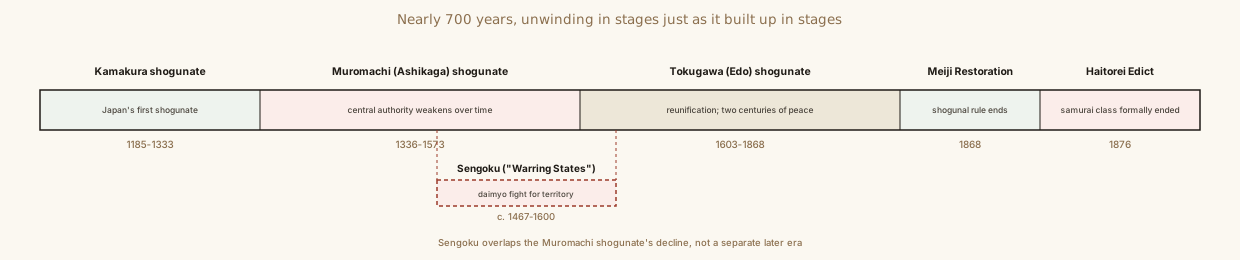
The Sengoku period's overlap with the end of the Muromachi shogunate is the key thing to notice — it wasn't a separate era so much as the Muromachi shogunate's authority visibly failing in real time, resolved only by force over more than a century.
Common mistakes
Common Mistakes
Assuming the Japanese emperor had no role at all during feudal Japan.
→ The emperor remained the formal head of state throughout — even shoguns needed imperial appointment to legitimize their rule, even as real power sat elsewhere.
Treating Japanese feudalism as a direct copy of European feudalism.
→ They developed independently, with different inheritance customs, a different warrior class structure, and no equivalent single religious institution playing the unifying role the Christian Church played in Europe.
Assuming bushido was a fixed, ancient code that all samurai followed literally for the entire feudal period.
→ Bushido was formalized in writing mostly during the peaceful Edo period, after most large-scale samurai warfare had ended — treat it as an evolving ideal, not a fixed rulebook followed identically across all 700 years.
Common misconception
“Feudal Japan's samurai-and-shogun system worked essentially the same way as European feudalism, just with different names for the same roles.”
The two systems share a broad family resemblance — land-holding lords, warrior retainers, hierarchical loyalty — but they developed independently and differ in real structural ways. European feudalism was closely bound up with the Catholic Church, which held its own land, sanctioned oaths, and shaped legal and moral authority across the whole system; feudal Japan had no equivalent single religious institution playing that unifying role. Inheritance customs, the legal status of the warrior class, and the relationship between local lords and central authority also differed significantly between the two systems. Historians generally treat "feudalism" as a useful comparative label for both, not evidence that they were the same system in two different places.
Why do historians caution against treating feudal Japan and medieval European feudalism as essentially identical systems?
What to do next
What to do next
- Next time you see "feudal Japan" compared directly to medieval Europe, notice which specific structures are actually being compared — the label "feudal" covers real differences underneath.
- When bushido comes up in a movie, book, or business context, remember it was formalized mostly during peacetime, after most samurai warfare had ended.
- Notice the gap between 1868 (shogunate ends) and 1876 (samurai class formally abolished) next time "the end of the samurai era" comes up — it wasn't one single date.
- If you visit or see photos of Himeji Castle, place it at the transition out of the Sengoku period into over two centuries of Tokugawa peace.