The Islamic Golden Age was a period of roughly the 8th through the 13th century, centered on the Abbasid Caliphate and its capital Baghdad, during which scholars translated, preserved, and substantially expanded on Greek, Persian, and Indian knowledge in mathematics, astronomy, medicine, and optics.
Reading time
— 5 min
Updated
— Aug 16, 2026
Fact-reviewed
— Aug 16, 2026
Key Takeaways
Key Takeaways
1The Islamic Golden Age (roughly 8th–13th century CE) was centered on Baghdad's House of Wisdom, but it wasn't just one library in one city — Cordoba, in Islamic Spain, ran a parallel and independently significant scholarly tradition at the same time.
2Scholars didn't just translate Greek, Persian, and Indian texts into Arabic — they corrected, extended, and built genuinely new fields on top of them, most famously algebra, developed as a systematic discipline by al-Khwarizmi around 820 CE.
3The period's conventional end point is the Mongol destruction of Baghdad in 1258, though scholarship continued well past that in Cairo, Islamic Spain, and Central Asia — the 1258 date marks Baghdad's fall, not the end of Islamic scholarship itself.
The concept
The Islamic Golden Age refers to a period of roughly the 8th through the 13th century when cities across the Islamic world, especially Baghdad under the Abbasid Caliphate, became major centers of learning. Scholars translated Greek, Persian, and Indian works into Arabic, preserving knowledge that might otherwise have been lost after the fall of Rome, while also making substantial original contributions of their own in mathematics, medicine, astronomy, and optics. Baghdad's House of Wisdom is the best-known institution from this era, but it was one hub among several across a very large and connected Islamic world.
That multi-city, multi-faith picture matters for the question people usually ask next: did this era actually produce new knowledge, or was it mostly a holding pattern that just passed Greek ideas along to Europe untouched?
Quick check
Which of these best describes the House of Wisdom in Baghdad?
Worked examples
Example 1: Al-Khwarizmi and the founding of algebra (baseline case)
Muhammad ibn Musa al-Khwarizmi (c. 780–850 CE) worked at the House of Wisdom under al-Ma'mun. His book Al-Kitab al-mukhtasar fi hisab al-jabr wa'l-muqabala ("The Compendious Book on Calculation by Completion and Balancing") systematized methods for solving linear and quadratic equations — the word "al-jabr" in its title is the direct root of the English word algebra. This wasn't a translation of an existing Greek algebra text; algebra as a distinct, systematic discipline is credited to al-Khwarizmi's own synthesis. He also wrote a separate book explaining the Hindu-Arabic numeral system and how to calculate with it, which is where the word "algorithm" — a Latinization of his own name — eventually comes from once his work reached medieval Europe.
Example 2: Cordoba as a second, independent center (regional variation)
While Baghdad flourished under the Abbasids, Cordoba in Islamic Spain developed its own scholarly culture under a separate, rival Umayyad dynasty that had fled Abbasid rule in the 8th century. Cordoba built one of the largest libraries in the medieval world and later produced figures like Ibn Rushd (Averroes, 1126–1198), whose detailed commentaries on Aristotle became central texts in European universities once translated into Latin. This is a genuine exception to any picture of one unified center: Baghdad and Cordoba were politically rival capitals, not part of the same administration, yet both produced major scholarship in the same centuries.
Example 3: Ibn al-Haytham's optics and the scientific method (real-world / applied case)
Ibn al-Haytham (c. 965–1040 CE, known in Latin as Alhazen) wrote the Book of Optics (Kitab al-Manazir), which refuted the older Greek idea that the eye sends out visual rays to "see" objects, and instead correctly argued that vision works by light reflecting off objects into the eye. He backed this up with controlled experiments rather than argument alone — a methodical, evidence-based approach historians of science treat as an early and influential model for the modern scientific method. His work was translated into Latin by the 13th century and directly influenced the English scientist Roger Bacon. The underlying idea — that light travels from an object to your eye, not the other way around — is exactly the correct physical model still taught in science classrooms today.
Quick check
What did Ibn al-Haytham's Book of Optics establish?
How it works (visual)
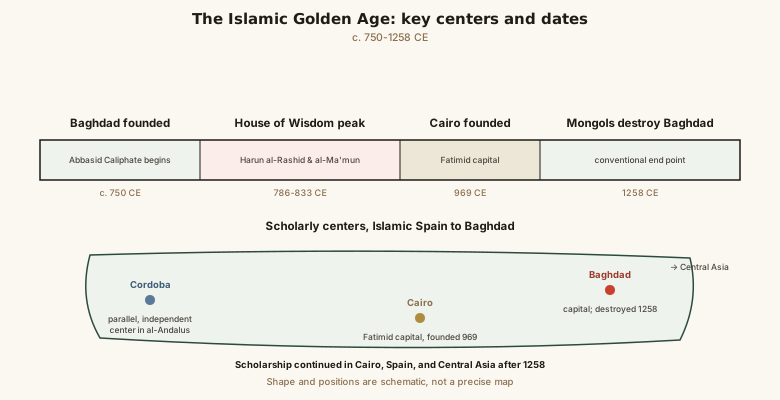
The Islamic Golden Age: key centers and dates, c. 750–1258 CE
Notice the geography: Baghdad, Cordoba, and Cairo sit at opposite ends of the Islamic world and were, for long stretches, ruled by rival dynasties — this was a broad, competitive network of scholarly centers, not a single institution radiating outward from one city.
Common mistakes
Common Mistakes
✕
Assuming the Islamic Golden Age was centered only in Baghdad.
→ Cordoba (Islamic Spain) and, later, Cairo were major, independent scholarly centers in the same broad period, not satellites of Baghdad.
✕
Treating the era's scholarship as purely translation work with no original contributions.
→ Al-Khwarizmi's systematic algebra and Ibn al-Haytham's experimental optics were new fields and methods, not translations of existing Greek texts.
✕
Assuming Islamic scholarship simply stopped in 1258 when Baghdad fell to the Mongols.
→ 1258 marks the destruction of Baghdad specifically — scholarship continued afterward in Cairo, Islamic Spain (for a time), and Central Asia.
Common misconception
“The Islamic Golden Age was mostly about translating and preserving Greek texts, not producing original science that mattered.”
Scholars in this period did preserve a great deal of Greek, Persian, and Indian knowledge that might otherwise have been lost — but they also produced substantial original work. Al-Khwarizmi's systematic algebra, Ibn al-Haytham's experimentally grounded optics, and Ibn Sina's (Avicenna's) Canon of Medicine, used as a standard medical textbook in European universities for roughly 600 years afterward, were new contributions built on top of earlier knowledge, not simple copies of it. Historians of science generally credit this period with real advances in mathematics, optics, and medicine, alongside its well-documented translation and preservation work.
Quick check
Which statement most accurately reflects historians' assessment of the Islamic Golden Age's scientific contribution?
What to do next
What to do next
Next time you hear the word "algebra" or "algorithm," remember both trace to al-Khwarizmi's work in 9th-century Baghdad.
When you see the Islamic Golden Age described as one city or one library, mentally add Cordoba and Cairo as separate, significant centers.
Notice how often historical accounts credit this era with only "preserving" knowledge — and weigh that against the original contributions in algebra, optics, and medicine described here.
If you come across Ibn Sina's Canon of Medicine or Ibn al-Haytham's optics referenced in a science history context, connect it to roughly 600 years of continued use in European universities.
FAQ
FAQ
Related terms
Related terms
Abbasid Caliphate
The Islamic empire (750–1258 CE) ruled by the Abbasid dynasty from its capital Baghdad, under which the Islamic Golden Age's major scholarly institutions flourished.
House of Wisdom (Bayt al-Hikmah)
A royal library and academy in Baghdad, most active under caliphs Harun al-Rashid and al-Ma'mun in the early 9th century, where scholars translated Greek, Persian, and Indian texts into Arabic.
Translation movement
The large-scale, centuries-long effort by scholars in the Islamic world — many of them Christian, Jewish, or Zoroastrian — to translate Greek, Persian, and Indian scientific and philosophical works into Arabic.
Algebra
From the Arabic al-jabr ("reunion of broken parts"), the branch of mathematics systematized by al-Khwarizmi in 9th-century Baghdad.
This entry was researched from public sources and drafted with AI-assisted tools, then edited — errors are still possible. Spot one, or want a topic covered? Read our disclaimer.
 KnowThis