Medieval India, roughly the 8th through early 16th century, was not a single unified state but a patchwork of major regional powers, including the Chola dynasty in the south, the Delhi Sultanate in the north, and the Vijayanagara Empire, whose rise and fall shaped the subcontinent until the Mughal Empire's founding in 1526.
Reading time
— 5 min
Updated
— Aug 16, 2026
Fact-reviewed
— Aug 16, 2026
Key Takeaways
Key Takeaways
1"Medieval India" was never a single kingdom — the Chola dynasty ruled much of the south by land and sea for centuries while the Delhi Sultanate, a succession of five Turkic-Persian Islamic dynasties, ruled the north starting in 1206, and the two regions had largely separate political histories for long stretches.
2The Delhi Sultanate (1206-1526) and the Mughal Empire (founded 1526) are two different, sequential states, not the same empire under different names — the Mughals conquered the last Delhi Sultanate dynasty in 1526.
3The Vijayanagara Empire (1336-1646) rose in the south partly as a direct response to the Delhi Sultanate's southward expansion, reaching a peak under Krishnadevaraya before its defeat at the Battle of Talikota in 1565.
The concept
Medieval India covers roughly the 8th through the early 16th century, a period with no single ruling power across the subcontinent. In the south, the Chola dynasty built a powerful kingdom known for temple architecture and a navy strong enough to reach Southeast Asia. In the north, after 1206, a succession of Turkic-Persian Islamic dynasties known collectively as the Delhi Sultanate controlled much of the region. Later, the Vijayanagara Empire rose in the south as a major Hindu kingdom that both traded and fought with the sultanates to its north.
That reused-material detail is a useful entry point into how medieval India actually worked — regional powers overlapped, conquered, traded, and physically built on top of each other far more than a single clean timeline suggests.
Quick check
Which statement most accurately describes the political landscape of medieval India?
Worked examples
Example 1: The Chola dynasty's naval reach (baseline case)
Under Rajaraja I and Rajendra I, the Chola dynasty built the Brihadishvara Temple at Thanjavur (completed around 1010) and extended Chola power well beyond south India, including a naval expedition that reached as far as Srivijaya in maritime Southeast Asia around 1025. Inscriptions from this period also document unusually detailed local self-governance through village assemblies, evidence historians use to argue Chola administration was more locally participatory than a simple top-down monarchy might suggest.
Example 2: The Delhi Sultanate's five dynasties (variation / political turnover)
The Delhi Sultanate wasn't one continuous royal family — it passed through five distinct dynasties over three centuries: the Mamluk dynasty (1206-1290), founded by former military slaves who rose to rule; the Khalji dynasty (1290-1320), which expanded sultanate territory into Gujarat and parts of the Deccan; the Tughlaq dynasty; the brief Sayyid dynasty; and finally the Lodi dynasty (1451-1526), an Afghan Pashtun dynasty that ruled until its defeat at Panipat in 1526. Each transition between dynasties happened through conquest, rebellion, or succession crisis, not peaceful inheritance within one family line.
Example 3: Hampi and the Vijayanagara Empire's legacy (real-world / applied case)
The ruins at Hampi, capital of the Vijayanagara Empire and now a UNESCO World Heritage Site, contain over 1,600 surviving structures — temples, royal complexes, and market streets — reflecting the empire's wealth at its peak under Krishnadevaraya in the early 16th century, when foreign travelers described it as one of the richest cities they had seen. After the empire's defeat at the Battle of Talikota in 1565 by an alliance of Deccan sultanates, Hampi was abandoned and largely left in ruins, making it today a rare, mostly undisturbed archaeological record of a major medieval south Indian capital — still studied for its temple architecture and urban planning.
Quick check
What happened to the Delhi Sultanate in 1526?
How it works (visual)
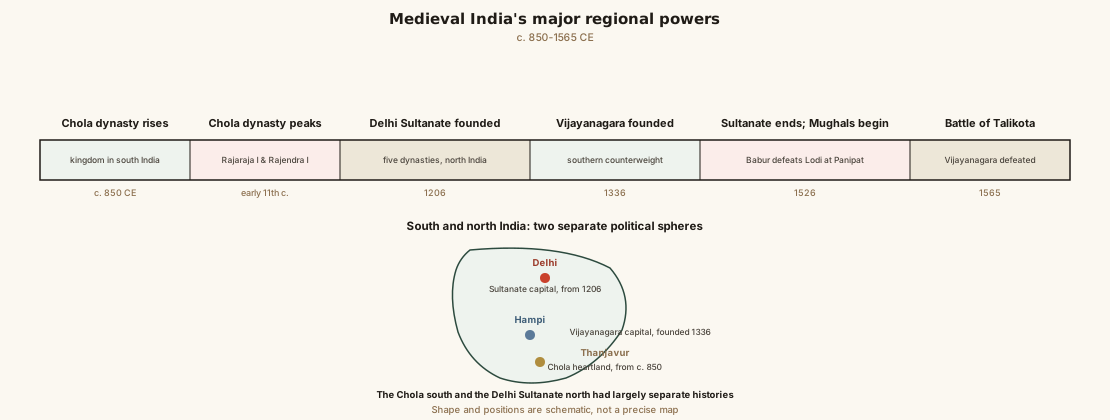
Medieval India's major regional powers, c. 850–1565 CE
Notice how the timelines overlap rather than run in sequence: the Chola dynasty and the early Delhi Sultanate coexisted for decades, and Vijayanagara and the Delhi Sultanate's successor states in the Deccan were contemporaries and frequent rivals for over two centuries.
Common mistakes
Common Mistakes
✕
Treating "medieval India" as one continuous empire with one ruling line.
→ It was a patchwork of regional powers — the Chola dynasty in the south and the Delhi Sultanate in the north operated largely independently for much of this period.
✕
Confusing the Delhi Sultanate with the Mughal Empire, or assuming one is just a renamed version of the other.
→ They are two separate, sequential empires — the Mughal Empire began in 1526 when Babur defeated the last Delhi Sultanate dynasty (Lodi) in battle.
✕
Assuming the Delhi Sultanate was one unbroken dynasty for three centuries.
→ It passed through five distinct dynasties (Mamluk, Khalji, Tughlaq, Sayyid, Lodi), each rising to power through conquest or succession crisis, not smooth hereditary continuity.
Common misconception
“Medieval India was a single, continuously unified empire from roughly 800 to 1500 CE.”
No single power controlled the entire subcontinent for this whole period. South India was dominated for centuries by the Chola dynasty and, later, the Vijayanagara Empire, while north India came under the Delhi Sultanate's five successive dynasties starting in 1206. These regions had largely separate political histories, their own wars, alliances, and periods of decline, and frequently fought each other across the Deccan frontier rather than existing as parts of one connected state. Historians generally describe medieval India as a shifting patchwork of regional powers, not a single continuous empire.
Quick check
Why is it inaccurate to describe medieval India as one continuously unified empire?
What to do next
What to do next
Next time "medieval India" comes up as a single label, mentally split it into at least the Chola south and the Delhi Sultanate north.
If someone conflates the Delhi Sultanate and the Mughal Empire, remember 1526 as the hinge — Babur's victory at Panipat ended one and founded the other.
When you see Hampi's ruins in photos or travel content, connect them to the Vijayanagara Empire's peak under Krishnadevaraya and its 1565 defeat at Talikota.
Notice how many of the Delhi Sultanate's five dynasties changed hands through conquest rather than peaceful succession — it's a useful check against assuming smooth dynastic continuity.
FAQ
FAQ
Related terms
Related terms
Sultanate
A state ruled by a sultan, a Muslim monarch; the Delhi Sultanate (1206-1526) was a succession of five such dynasties ruling much of north India.
Thalassocracy
A state whose power is based substantially on control of the sea and maritime trade — a term historians apply to the Chola dynasty's naval reach into Southeast Asia.
Deccan
The large plateau region of south-central India, historically a contested frontier zone between northern Islamic sultanates and southern Hindu kingdoms like Vijayanagara.
Vijayanagara Empire
A south Indian empire (1336-1646) founded partly as a bulwark against the Delhi Sultanate's southward expansion, centered on its capital at Hampi.
This entry was researched from public sources and drafted with AI-assisted tools, then edited — errors are still possible. Spot one, or want a topic covered? Read our disclaimer.
 KnowThis