 KnowThis
Key Takeaways
Key Takeaways
- 1Most classic math puzzles have a general counting formula hiding underneath them — the handshake problem's n(n-1)/2 is one of the most useful patterns in all of combinatorics.
- 2Brute-force listing (writing out every possible handshake, pairing, or arrangement) works for small puzzles but collapses fast as the numbers grow, which is exactly why finding the underlying rule matters.
- 3The pigeonhole principle — if you have more items than containers, at least one container must hold more than one item — solves an entire category of 'must be true' logic riddles without any counting at all.
The concept
The handshake formula is easiest to trust once you've confirmed it against a small case you can fully list out by hand, and then watched how badly brute-force listing scales once the group gets larger.
At a party of 6 people, everyone shakes hands with everyone else exactly once. How many total handshakes occur?
Worked examples
Example 1: The handshake problem at a small party (baseline case)
Example 2: A pigeonhole riddle (edge case / variation)
A drawer has socks in 4 different colors, unsorted. What is the minimum number of socks you must pull to guarantee a matching pair?
Example 3: Round-robin tournament scheduling (real-world / applied case)
A youth soccer league has 12 teams, and the schedule requires every team to play every other team exactly once during the regular season. How many total games need to be scheduled? This is the handshake problem wearing a different costume — teams instead of people, games instead of handshakes. Using n(n-1)/2 with n = 12: 12(11)/2 = 132/2 = 66 games. League organizers use exactly this formula (not a spreadsheet of every possible matchup written out by hand) to instantly know how many time slots and fields they need to book before a single match is scheduled — the same n(n-1)/2 pattern applies to tournament brackets, social network connection counts, and even the number of cables needed to directly connect every computer in a small office network to every other one.
How it works (visual)
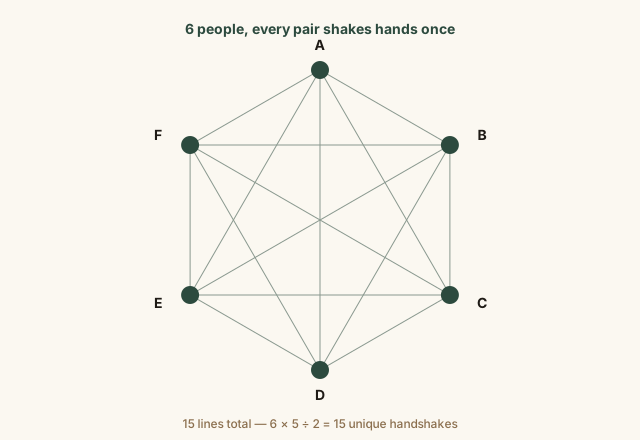
Every line in the diagram is one unique handshake, and every point (person) touches exactly 5 lines, since there are 5 other people to shake hands with. Counting "lines touching each point" and multiplying by the number of points (6 × 5 = 30) counts every line exactly twice, once from each end — which is precisely why the handshake formula divides by 2 at the end, turning a visual double-count into the correct single count of 15 unique connections.
Common mistakes
Common Mistakes
Forgetting to divide by 2 in the handshake formula, doubling the true count.
→ Remember that n(n-1) counts every handshake from both participants' perspectives — always divide by 2 as the final step to get the true, unique count.
Trying to brute-force list every possibility in a puzzle that's grown too large to track by hand.
→ Once a puzzle involves more than 5-6 items, stop and look for a counting formula or a general rule (like n(n-1)/2) instead of continuing to list cases individually — the pattern almost always generalizes cleanly.
Assuming a 'must be true' logic riddle requires calculating exact probabilities.
→ Check first whether the riddle is really a pigeonhole problem (a guarantee based on quantity, not chance) — these are solved by simple counting of categories versus items, with no probability involved at all.
Common misconception
“Solving a math puzzle or logic riddle is mostly about being naturally clever or getting a sudden flash of insight.”
Most classic puzzles are solved by systematic method, not sudden inspiration — recognizing which strategy applies (a counting formula, the pigeonhole principle, or elimination) and then applying it carefully. The handshake formula, n(n-1)/2, isn't a clever trick invented on the spot; it's a standard, learnable combinatorics pattern that solves an entire family of pairing puzzles once you recognize the shape of the problem. Puzzle-solving skill is built by learning to recognize these recurring structures across many puzzles, the same way a chess player recognizes recurring tactical patterns — not by waiting for a flash of pure genius each time.
Is the handshake formula, n(n-1)/2, a one-off trick that only works for literal handshakes at a party?
Try it yourself
What to do next
What to do next
- Verify the handshake formula yourself for n = 4 by listing every pair by hand, then check it matches n(n-1)/2.
- Use the calculator above to see how quickly the number of handshakes grows as the group size increases — try n = 10 versus n = 50.
- Next time you hit a 'must be true' riddle, check whether it's a disguised pigeonhole problem before trying to calculate a probability.
- Read the related entry on Math Illusions & Paradoxes for more places where a systematic method beats an intuitive first guess.