 KnowThis
Key Takeaways
Key Takeaways
- 1Million (10⁶), billion (10⁹), and trillion (10¹²) each jump by a factor of exactly 1,000 from the previous one — a trillion is one thousand billions, not just 'a bit more' than a billion.
- 2These same power-of-ten jumps are standardized as SI prefixes — mega- (million), giga- (billion), and tera- (trillion) — used identically across science, computing, and engineering worldwide.
- 3Most people's intuition badly compresses the gap between a million and a billion: counting to a million takes about 11.5 days at one number per second, while counting to a billion the same way takes over 31 years.
The concept
Reading "million," "billion," and "trillion" as a smooth, gradually-scaling sequence is exactly what makes their real size so easy to underestimate — the numbers below make the actual gap concrete.
Roughly how many millions are in one billion?
Worked examples
Example 1: Converting a large number to scientific notation (baseline case)
Example 2: How long it takes to count to a million versus a billion (edge case / variation)
Counting nonstop at 1 number per second, it takes about 11.6 days to reach a million. Roughly how long would it take to reach a trillion at the same pace?
Example 3: Reading a national budget figure correctly (real-world / applied case)
A government budget headline reports $2.3 trillion in annual spending. Written out fully, that's $2,300,000,000,000 — 2.3 followed by 12 zeros. To make that concrete: $2.3 trillion divided evenly among a population of about 330 million people works out to roughly $2.3 × 10¹² ÷ 3.3 × 10⁸ ≈ $6,970 per person. News coverage often quotes trillion-scale and billion-scale figures back to back in the same sentence (a $2.3 trillion budget funding a $50 billion program), and without tracking the exponents, it's easy to badly misjudge how large a share that $50 billion program actually represents — in this case, roughly 2.2% of the total budget, not the "large chunk" it might sound like when both numbers are just heard as "huge."
How it works (visual)
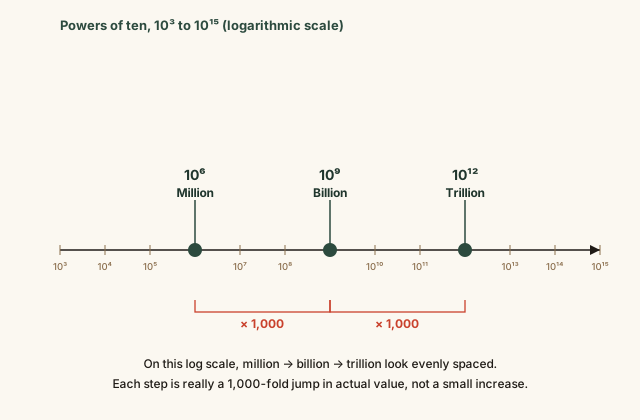
On this logarithmic scale, million, billion, and trillion look evenly spaced — which is exactly the illusion that makes people underestimate how much bigger each one really is. On an ordinary linear scale, a million would barely register as a dot next to a trillion; the log scale is a useful tool for comparing numbers across many orders of magnitude, but it also flattens out differences that are, in real linear terms, absolutely enormous.
Common mistakes
Common Mistakes
Assuming a billion is roughly 10 times a million, or some similarly modest multiple.
→ Anchor the rule firmly: each named big number (million, billion, trillion) is exactly 1,000 times the one before it, not 10 times — three more zeros, every step.
Miscounting zeros when writing out a large number by hand, especially past nine or ten digits.
→ Use scientific notation or grouped commas (1,000,000,000) instead of writing long unbroken strings of zeros — group in sets of three and count the groups to confirm the magnitude.
Treating 'trillion' as a vague synonym for 'billion' or 'astronomically large' rather than a specific value.
→ Keep the exact exponents in mind: million = 10⁶, billion = 10⁹, trillion = 10¹² — precise numbers, not interchangeable descriptions of 'a lot.'
Common misconception
“A trillion is basically just 'a really big billion' — a somewhat bigger version of the same idea.”
A trillion is one thousand billions — the same enormous 1,000-fold jump that separates a million from a billion. If a stack of $1 bills one billion dollars high would already reach roughly 63 miles into the sky (each bill is about 0.0043 inches thick), the equivalent trillion-dollar stack would reach about 63,000 miles — more than a quarter of the way to the Moon. "Trillion" is not a modest upgrade from "billion"; treating them as similar in scale badly understates just how much larger a trillion actually is.
A news report says a company's valuation grew from $900 million to $1.1 billion. How large is that jump, roughly?
Try it yourself
What to do next
What to do next
- Try the calculator above with 1,000,000, then 1,000,000,000, then 1,000,000,000,000, and compare how sharply the required counting time jumps each time.
- Next time a news article quotes a 'million' figure and a 'billion' figure in the same story, pause and convert both to scientific notation to compare their true scale.
- Practice writing out three large numbers you encounter (a company valuation, a population figure, a data storage size) in scientific notation.
- Read the related entry on Math Illusions & Paradoxes for more places where the human sense of scale gets fooled by numbers that look deceptively similar.