 KnowThis
Key Takeaways
Key Takeaways
- 1Solving an equation means finding the specific value of the variable that makes both sides equal — not guessing, but reversing the operations that were applied to it.
- 2Whatever operation you apply to one side of an equation, you must apply identically to the other side, or the two sides stop being equal — this is the balance-scale principle.
- 3Two-step equations undo operations in reverse order from how they were built: undo addition/subtraction first, then undo multiplication/division.
The concept
The balance-scale idea is simple to state, but it only becomes automatic once you've walked through the two-step process on real numbers a few times.
To solve the equation x - 8 = 15 for x, what should you do to both sides?
Worked examples
Example 1: A one-step equation (baseline case)
Example 2: A two-step equation with a negative result (edge case / variation)
Solve 2x - 9 = 7 for x. What are the correct two steps, in order?
Example 3: Finding a missing quantity in a shared restaurant bill (real-world / applied case)
Four friends split a restaurant bill evenly, and each person also chips in $3 for the tip on top of their even share. Each person ends up paying $18 total. As an equation with s standing for each person's share of the food bill: s + 3 = 18. Subtract 3 from both sides: s = $15 per person for food, meaning the total food bill was 4 × 15 = $60. This is the identical two-step pattern as the algebra examples above — a real constraint (each person's total payment) turned into an equation and solved by undoing the addition first.
How it works (visual)
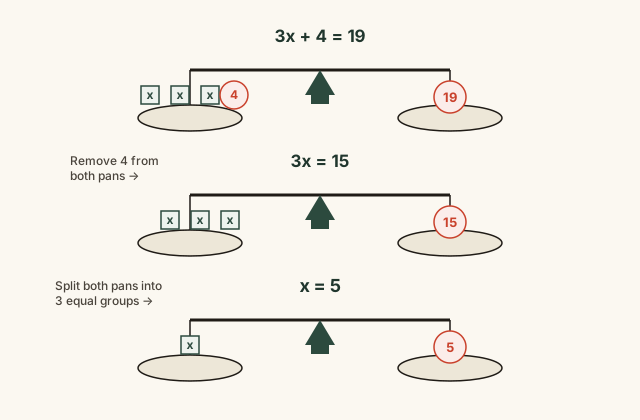
Each stage of the diagram is one legal move on the balance scale: remove the same weight from both pans, or split both pans into the same number of equal groups. Because the scale starts balanced and every move is applied identically to both sides, it stays balanced all the way through — which is exactly why the final reading, x = 5, is guaranteed to be the correct solution rather than a guess.
Common mistakes
Common Mistakes
Applying an operation to only one side of the equation instead of both.
→ Treat the equals sign as a strict balance point — any operation performed on the left side must be performed, in full, on the right side too, every single time.
Undoing multiplication/division before addition/subtraction in a two-step equation.
→ Undo operations in the reverse order they were applied — constants (addition/subtraction) first, coefficients (multiplication/division) last.
Skipping the final check of substituting the solution back into the original equation.
→ Always plug your answer back in before moving on — it takes seconds and catches almost every arithmetic error before it compounds into a wrong final answer.
Common misconception
“Solving an equation means 'moving' a term to the other side, and it magically flips its sign.”
Nothing actually teleports across the equals sign. "Moving a term and flipping its sign" is shorthand for applying an inverse operation to both sides — subtracting the same term from both sides of x + 5 = 12 gives x + 5 - 5 = 12 - 5, and the +5 on the left cancels to 0, leaving x = 12 - 5 = 7. The term didn't travel anywhere; it was canceled out on the left by an identical operation applied to both sides, which happens to look like "moving with a sign flip" as a shortcut.
A student solves x + 7 = 20 by writing 'move the 7 to the other side and flip its sign,' getting x = 20 - 7 = 13. Is the reasoning behind this shortcut actually correct?
Try it yourself
What to do next
What to do next
- Solve one one-step and one two-step equation by hand, then check both by substituting your answer back into the original equation.
- Try the calculator above with a negative constant (b) to practice equations that produce negative solutions.
- Next time you split a bill or calculate a per-item cost from a total, write it as a real equation instead of doing it by trial and error.
- Read the related entry on Linear Equations Explained to see how this same balance-scale idea extends to equations with two variables and graphs.