 KnowThis
Key Takeaways
Key Takeaways
- 1An inequality (using <, >, ≤, or ≥) describes a whole range of possible values, not one single exact answer the way a typical equation does.
- 2Adding or subtracting the same number from both sides of an inequality behaves exactly like it does for equations — the direction of the sign never changes.
- 3Multiplying or dividing both sides by a negative number flips the inequality's direction — this is the one rule that has no equation equivalent and is the single most common source of errors.
The concept
The addition and subtraction rules feel identical to equations right up until a negative multiplier enters the picture — that single exception is worth isolating and testing on its own before anything else.
If x < 7, is it still true that x + 4 < 11?
Worked examples
Example 1: A basic inequality with addition (baseline case)
Example 2: Dividing by a negative number, where the sign must flip (edge case / variation)
Solve -5x ≤ 20 for x. What is the correct solution?
Example 3: A budget constraint (real-world / applied case)
You have $60 to spend at an arcade, where each game token costs $2.50, and you also want to buy a $12.50 snack. If t is the number of tokens you can afford, the constraint is 2.50t + 12.50 ≤ 60 (you can spend up to, but not more than, $60). Subtract 12.50 from both sides: 2.50t ≤ 47.50. Divide both sides by 2.50 (a positive number, so no flip needed): t ≤ 19. Since you can't buy a fraction of a token, this means you can afford at most 19 tokens plus your snack and stay within budget — exactly the kind of "at most" or "at least" real-world constraint inequalities are built to describe, where an exact equation would be too rigid.
How it works (visual)
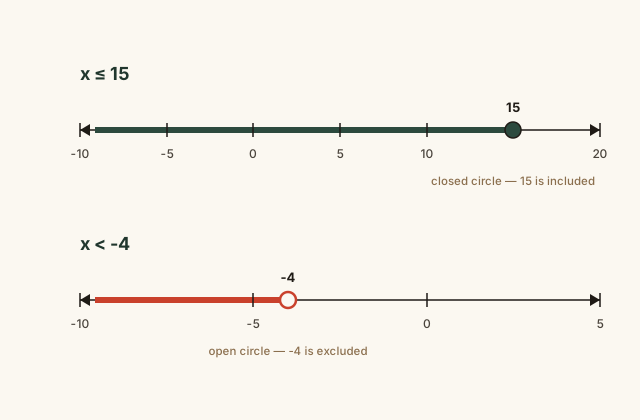
The circle style tells you whether the boundary number itself counts as a solution — filled in (closed) for ≤ and ≥, hollow (open) for strict < and > — and the shaded direction tells you which numbers satisfy the inequality. Reading a number line this way is often faster and less error-prone than re-checking the algebra, especially for confirming whether a sign-flip step was handled correctly.
Common mistakes
Common Mistakes
Forgetting to flip the inequality sign when multiplying or dividing both sides by a negative number.
→ Build a habit of pausing at every multiplication or division step to check the sign of what you're multiplying or dividing by — flip only for negatives, never for positives.
Using a closed circle on a number line for a strict inequality (< or >), or an open circle for ≤ or ≥.
→ Match the circle to the symbol: any inequality with 'or equal to' (≤, ≥) gets a closed, filled circle; strict inequalities (<, >) get an open, hollow circle.
Treating an inequality's solution as a single number instead of a whole range.
→ Remember an inequality describes every number satisfying the condition, not one value — x > 3 is true for infinitely many numbers, not just for 'the next number after 3.'
Common misconception
“The inequality sign flips whenever you feel like the numbers have gotten 'more negative,' or basically at random.”
The flip rule is precise, not a vague feeling: the inequality sign flips if, and only if, you multiply or divide both sides by a negative number. Adding or subtracting a negative number (e.g., subtracting -5, which is the same as adding 5) never triggers a flip — only multiplication or division by a negative does. The underlying reason is that multiplying by a negative number reverses the relative order of every number on the number line (5 > 3, but -5 < -3), so the inequality symbol has to reverse too, to keep describing a true statement.
Which of these steps requires flipping the inequality sign?
Try it yourself
What to do next
What to do next
- Solve one inequality that requires dividing by a negative number, and double-check your flipped sign by testing a value from your solution set in the original inequality.
- Sketch a number line for at least one inequality, choosing the correct open or closed circle based on whether the sign includes 'or equal to.'
- Write a real budget or time constraint you have as an inequality (a maximum spend, a minimum score) instead of an equation.
- Read the related entry on Solving Simple Equations to reinforce the core inverse-operation moves inequalities share with equations.