 KnowThis
Key Takeaways
Key Takeaways
- 1Algebra replaces unknown or changing numbers with letters (variables) so one general rule can cover infinitely many specific numeric cases at once.
- 2An expression like 3x + 5 has no equals sign and can be evaluated for any value of x; an equation like 3x + 5 = 20 makes a specific claim that's only true for particular values.
- 3Combining like terms and distributing a coefficient across parentheses are the two core moves for simplifying any algebraic expression, before you ever get to solving anything.
The concept
Knowing the vocabulary is one thing; actually evaluating an expression for a specific number is where it starts to feel like real math instead of definitions.
Which of the following is an expression rather than an equation?
Worked examples
Example 1: Evaluating a simple expression (baseline case)
Example 2: Evaluating with a negative coefficient and a negative value (edge case / variation)
What is the value of 4x + 9 when x = -2?
Example 3: A rideshare fare formula (real-world / applied case)
A rideshare app charges a flat $2.50 pickup fee plus $1.25 per mile driven. As an algebraic expression with m standing for miles, the fare is 2.50 + 1.25m. For a 12-mile trip, substitute m = 12: 2.50 + 1.25(12) = 2.50 + 15.00 = $17.50. For a much shorter 3-mile trip, the same expression gives 2.50 + 1.25(3) = 2.50 + 3.75 = $6.25. Every fare estimator, phone plan calculator, and shipping cost tool on the internet is running this exact pattern — one algebraic expression, evaluated with whatever number the user enters.
How it works (visual)
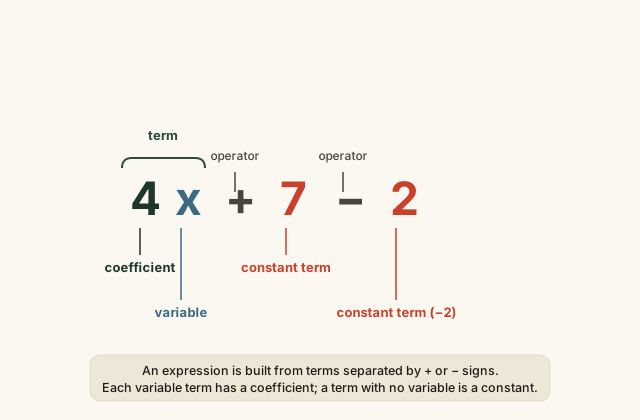
Every algebraic expression, no matter how long, breaks down into this same handful of labeled pieces — terms joined by operators, each term either a constant on its own or a coefficient attached to a variable. Once you can point to each piece by name, combining like terms is just a matter of finding terms with matching variable labels and adding their coefficients together.
Common mistakes
Common Mistakes
Forgetting to distribute a coefficient across every term inside parentheses, e.g. treating 3(x + 4) as 3x + 4 instead of 3x + 12.
→ Multiply the outside number by every single term inside the parentheses, one at a time — none of them are exempt just because they're further from the coefficient.
Combining unlike terms, such as adding 3x and 5x² as if they behaved the same way.
→ Only combine terms that share the identical variable raised to the identical power. 3x and 5x² are different kinds of quantities and cannot be added into a single term.
Dropping or flipping a sign when rearranging terms, e.g. treating -2x as +2x once it moves in the expression.
→ The sign directly in front of a term travels with that term permanently. Rewrite a - b as a + (-b) mentally if it helps keep the negative sign attached correctly.
Common misconception
“The variable in an algebra problem is always called x.”
Any letter or symbol can serve as a variable — x is simply the most common convention, traced back to French mathematician René Descartes's 17th-century notation. Physics problems commonly use t for time and v for velocity; economics uses P for price and Q for quantity; a spreadsheet formula uses a cell reference like A1 as its variable. The letter itself carries no mathematical meaning — it is only a placeholder for a number, and any unused symbol works exactly as well as x does.
A physics formula for distance traveled is written d = rt, using d, r, and t instead of x, y, and z. Is this valid algebra?
Try it yourself
What to do next
What to do next
- Pick any everyday cost that has a flat fee plus a per-unit charge (a phone plan, a taxi fare, a gym day-pass) and write it as an algebraic expression with a variable for the changing quantity.
- Practice simplifying one expression with like terms and one with a parenthesis to distribute, so both core moves feel automatic before moving on to equations.
- Try the calculator above with a negative value of x to build confidence handling signs correctly.
- Read the related entry on Solving Simple Equations to see what changes once an expression gets an equals sign attached to it.