The Maya, Aztec, and Inca were three distinct civilizations that developed independently in the Americas — the Maya across present-day Mexico and Central America from around 2000 BCE, the Aztec in central Mexico from the 14th century CE, and the Inca along the Andes from the 13th century CE — each with its own writing, engineering, and government systems, before European colonization.
Reading time
— 4 min
Updated
— Oct 9, 2026
Fact-reviewed
— Aug 16, 2026
Key Takeaways
Key Takeaways
1The Maya, Aztec, and Inca were three separate civilizations in different places and eras — the Maya are the oldest by far (from around 2000 BCE), while the Aztec and Inca empires both rose in the 14th-15th centuries CE, over three thousand years later.
2The Maya independently developed the mathematical concept of zero and a base-20 number system, centuries before it reached Europe from India via the Islamic world.
3The Inca ran a vast, well-organized empire — the largest in the pre-Columbian Americas — without a written alphabet, using knotted cords called quipu to record numbers and information instead.
The concept
The Maya, Aztec, and Inca are three different civilizations that developed independently of each other and of the Old World, in different parts of the Americas at different times. The Maya built city-states across present-day Mexico, Guatemala, Belize, and Honduras starting around 2000 BCE, with their most famous period (the Classic era) peaking between 250 and 900 CE. The Aztec built a powerful empire in central Mexico starting in the 1300s CE, ruling from their capital Tenochtitlan (built on an island in Lake Texcoco, where Mexico City now stands). The Inca, far to the south, built the largest empire in the pre-Columbian Americas along the Andes mountains, also starting in the 1300s CE.
Given how different these three civilizations actually were, it's worth looking at what each one specifically achieved — starting with the Maya's independent invention of a mathematical idea Europe didn't have yet.
Quick check
Did the Maya, Aztec, and Inca civilizations exist at the same time and interact with each other?
Case studies
Case 1: Maya mathematics and astronomy (baseline case)
Maya mathematicians used a base-20 (vigesimal) number system and independently developed the concept of zero as a placeholder — a genuinely rare mathematical breakthrough, also independently achieved in ancient India and by the Babylonians in a more limited form. Maya astronomers tracked the movements of Venus and the sun with remarkable precision without telescopes, encoding this knowledge into a complex calendar system involving multiple interlocking cycles, used to time agricultural activity and religious ceremonies.
Case 2: Tenochtitlan, the Aztec capital (variation / engineering case)
Built on an island in Lake Texcoco starting around 1325 CE, Tenochtitlan grew into one of the largest cities in the world at the time, with an estimated population of 200,000-300,000 — larger than most European capitals of the same era. The Aztec expanded their farmland using chinampas, artificial islands built from layered lake mud and vegetation, an intensive farming method productive enough to help feed the huge urban population, connected to the mainland by causeways and a sophisticated system of dikes and aqueducts for fresh water.
Case 3: The Inca road network and quipu record-keeping (real-world / applied case)
The Inca Empire, at its height stretching roughly 4,000 kilometers along the Andes from modern-day Ecuador to Chile, built and maintained a road network of over 30,000 kilometers connecting the empire, used by relay runners called chasquis who could carry messages across hundreds of kilometers in days. Remarkably, the Inca managed this vast, centrally administered empire — including detailed census and tax records — without a written alphabet, instead using quipu, knotted cords in which the type, position, and color of knots recorded numerical (and likely some narrative) information, a system scholars are still working to fully decode today.
Quick check
How did the Inca Empire keep detailed records like census and tax data without a written alphabet?
How it works (visual)
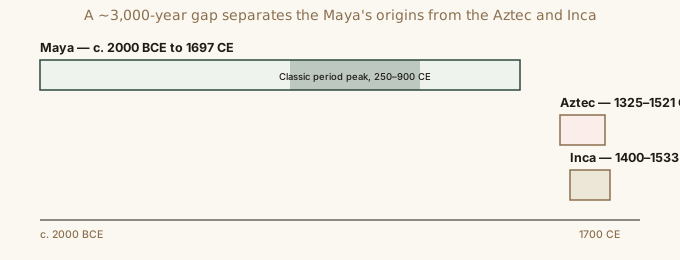
Maya, Aztec, and Inca civilizations: where and when, on the same timeline
The visual gap is the whole point: the Maya timeline bar stretches back thousands of years further than the Aztec or Inca bars even begin — three genuinely separate civilizations, not stages of one culture.
Common mistakes
Common Mistakes
✕
Treating "Maya, Aztec, and Inca" as interchangeable names for one ancient American culture.
→ They were three separate civilizations in different regions and eras — the Maya predate the other two by millennia and are a distinct language family and culture, not an early phase of the Aztec or Inca.
✕
Assuming the Maya civilization vanished or went extinct.
→ Millions of Maya people live in Mexico and Central America today, many speaking Mayan languages — what declined was the network of large Classic-era city-states, not the Maya people or culture themselves.
✕
Assuming these civilizations lacked writing or record-keeping without an alphabet.
→ The Maya had a sophisticated hieroglyphic writing system (largely deciphered since the late 20th century); the Inca used quipu instead of an alphabet but still maintained detailed administrative records — absence of an alphabet isn't absence of record-keeping.
Common misconception
“The Maya civilization mysteriously and completely collapsed or disappeared.”
What's usually called the "Maya collapse" refers specifically to the decline of many large Classic-period city-states in the southern lowlands between roughly 800-900 CE, likely driven by a combination of prolonged drought, warfare, and political strain — not the disappearance of the Maya people. Northern Maya cities like Chichen Itza continued to flourish for centuries afterward, and Maya civilization and language groups persisted, with the last independent Maya kingdom not falling to Spanish conquest until 1697 — and millions of Maya people and their descendants live in the region today.
What to do next
What to do next
Next time you see "Maya, Aztec, Inca" grouped together as one thing, mentally separate them by rough era: Maya ancient, Aztec and Inca both fairly late, right before European contact.
If you hear "the Maya disappeared," correct it mentally — millions of Maya people and their languages exist today.
Look up a photo of a quipu online — seeing an actual knotted-cord record makes the Inca's alphabet-free administration much more concrete.
FAQ
FAQ
Related terms
Related terms
Mesoamerica
A cultural region spanning central Mexico to Central America, home to the Maya, Aztec, and earlier civilizations like the Olmec.
Maya numeral system
A base-20 counting system used by the Maya that included the concept of zero, developed independently of Old World number systems.
Quipu
A system of knotted cords used by the Inca to record numerical information and possibly narrative records, without a written alphabet.
Chinampa
An Aztec farming technique using artificial islands built up from lake mud and vegetation, used to grow crops on Lake Texcoco.
This entry was researched from public sources and drafted with AI-assisted tools, then edited — errors are still possible. Spot one, or want a topic covered? Read our disclaimer.
 KnowThis