A passport is an official government document that certifies a person's identity and nationality for international travel; getting one generally means proving identity and citizenship with underlying documents, then having a government agency issue a booklet or card that other countries' border authorities agree to recognize.
Reading time
— 4 min
Updated
— Aug 26, 2026
Fact-reviewed
— Aug 26, 2026
Key Takeaways
Key Takeaways
1A passport certifies identity and nationality — it doesn't grant citizenship, it documents citizenship that already exists based on underlying proof like a birth certificate or naturalization certificate.
2Getting a passport for the first time generally means proving identity, proving citizenship, and providing a photo, submitted in person for first-time adult applicants in the U.S. system.
3Processing time varies significantly (routine vs. expedited service), and a passport nearing expiration can cause real problems abroad since many countries require six months of remaining validity to allow entry.
The concept
A passport is your government's official statement to the rest of the world that you are who you say you are and that you're a citizen or national of that country. To get one, you generally have to prove your identity and citizenship with documents you already have (like a birth certificate or existing ID), fill out an application, provide a photo, pay a fee, and wait for the passport agency to process and mail it. Countries recognize each other's passports as valid travel documents under long-standing international norms, which is why a booklet issued by one government works to cross another country's border.
The most common first-time-applicant mistake is treating the passport application like any other form — the identity/citizenship proof requirements exist specifically because a passport is a document other sovereign governments choose to trust, and that trust rests entirely on the rigor of the issuing process.
Quick check
Does getting a passport make someone a citizen of that country?
Worked examples
Example 1: A first-time adult applicant (baseline case)
Someone who has never had a passport gathers their original birth certificate, a driver's license, and a passport photo, then applies in person at an authorized post office or clerk's office using the routine service tier. They wait several weeks for processing before the passport book arrives by mail — a predictable, non-urgent timeline that assumes no errors in the application and no unusual document issues.
Example 2: A name change after marriage (edge case / variation)
Someone who married and legally changed their last name wants their new passport to reflect it. If their prior passport was issued relatively recently and meets renewal-by-mail eligibility, they can typically submit the renewal application along with an original or certified copy of the marriage certificate as legal proof of the name change, rather than needing to apply in person as if starting from scratch — though if the prior passport is too old or doesn't meet other renewal conditions, an in-person application may still be required.
Quick check
If a passport is close to expiring but someone has an international trip planned, what specifically causes the most common real-world problem?
Example 3: An urgent same-week international trip (real-world / applied case)
Someone learns they need to travel internationally in a matter of days for a genuine emergency but has no valid passport. Regional passport agencies generally offer in-person appointments for documented life-or-death emergencies or imminent, verifiable travel, requiring proof of the urgent need (such as a plane ticket and evidence of the emergency) in addition to the standard application materials — this is a real but narrowly available option, not a routine way to skip the ordinary timeline for planned travel.
How it works (visual)
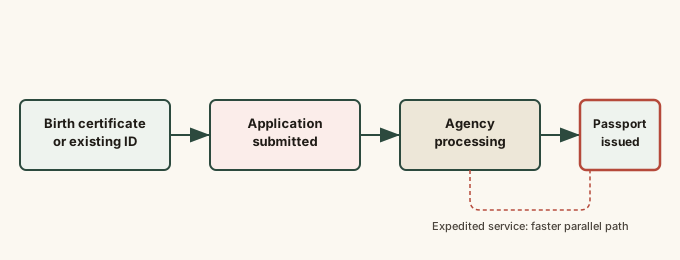
The general passport application pathway
The diagram's core point is that a passport sits at the end of a documentation chain — it can only be as trustworthy as the underlying proof of identity and citizenship that supported the application.
Common mistakes
Common Mistakes
✕
Waiting until close to a planned trip to apply or renew, then being surprised by routine processing timelines.
→ Apply well in advance of any planned travel, and check current processing times on the issuing agency's official site before booking non-refundable travel.
✕
Assuming a passport is valid for entry as long as it hasn't technically expired yet.
→ Check the specific destination country's minimum remaining-validity requirement (commonly six months) well before departure, not just the passport's printed expiration date.
✕
Submitting a passport photo that doesn't meet size, background, or recency requirements.
→ Use the issuing agency's official photo specifications, since a non-compliant photo is one of the most common reasons applications are rejected or delayed.
Common misconception
“A passport card works the same as a passport book for any kind of international travel.”
A passport card is generally valid only for land and sea travel to a limited set of neighboring countries and territories, and is not valid for international air travel. Anyone planning to fly internationally needs the passport book, not the card, regardless of how recently the card was issued.
What to do next
What to do next
Check your current passport's expiration date and compare it against your destination country's minimum remaining-validity rule before booking travel.
Gather original or certified copies of your citizenship proof (birth certificate or naturalization certificate) well before you need to apply.
Confirm whether you qualify for renewal by mail or need to apply in person, based on the age and condition of any prior passport.
If travel is genuinely urgent, contact a regional passport agency directly to ask about emergency appointment availability rather than assuming routine timelines will work.
FAQ
FAQ
Related terms
Related terms
Passport
A government-issued travel document that certifies the holder's identity and nationality, generally recognized by other countries for entry and exit under international travel agreements.
Passport book
The traditional booklet-form passport valid for both air and land/sea international travel.
Passport card
A wallet-sized identity card, issued by some countries (including the U.S.) as a lower-cost alternative to the passport book, generally valid only for land and sea travel to a limited set of neighboring countries — not for international air travel.
Apostille
A standardized certification, recognized under an international treaty (the Hague Apostille Convention), that authenticates a public document like a birth certificate for use in another treaty country — sometimes required when using such a document to support an identity application abroad.
This entry was researched from public sources and drafted with AI-assisted tools, then edited — errors are still possible. Spot one, or want a topic covered? Read our disclaimer.
 KnowThis