 KnowThis
Key Takeaways
Key Takeaways
- 1A birth certificate is generally the root document other identity documents (passports, driver's licenses, Social Security numbers) depend on as proof of identity, age, and citizenship.
- 2In the U.S., birth certificates are issued at the state (or sometimes county/city) level, not by the federal government, so replacement requests go to the specific state or jurisdiction where the birth occurred.
- 3Only a certified copy — bearing an official seal from the vital records office — generally satisfies legal requirements; an uncertified photocopy typically does not.
The concept
Because so many other documents point back to the birth certificate as their starting proof, losing it doesn't just mean losing one document — it means the entire chain of "prove who you are" temporarily gets harder until a certified replacement copy is obtained.
Does a decorative 'commemorative' birth certificate given out by a hospital count as legal proof of identity?
Worked examples
Example 1: A newborn's first identity documents (baseline case)
Example 2: Requesting a certified copy from a different state than where you now live (edge case / variation)
Someone was born in State A but now lives in State B and needs a replacement certified birth certificate. Which state's vital records office should they contact?
Example 3: Correcting an error on a birth certificate (real-world / applied case)
How it works (visual)
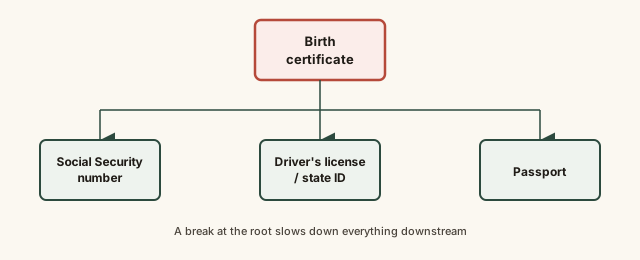
Every arrow in this diagram represents a real dependency, not a loose association — a break at the root (a lost or inaccessible birth certificate) can slow down every document downstream of it.
Common mistakes
Common Mistakes
Assuming a hospital-issued commemorative certificate can substitute for an official certified copy.
→ Keep the actual certified copy issued by the state or local vital records office; treat any hospital keepsake purely as a memento, not a legal document.
Requesting a birth certificate replacement from your current state of residence rather than the state where the birth occurred.
→ Identify the specific state (and sometimes county or city) where the birth was registered, and request the certified copy from that jurisdiction's vital records office.
Letting the only certified copy sit unprotected, then discovering it's lost right when it's urgently needed for another application.
→ Store the certified original securely and consider requesting an extra certified copy in advance to keep as a backup, since replacement can take time.
Common misconception
“Any copy of a birth certificate, including a photocopy, works the same as the original for legal purposes.”
Most government agencies specifically require a certified copy bearing an official seal from the issuing vital records office — a plain photocopy of even a genuine certified copy generally does not meet identity-proof requirements, since it can't independently verify the document's authenticity the way the seal does.
What to do next
What to do next
- Locate your certified birth certificate now, before you urgently need it for a passport or other application.
- If you don't have it, identify the specific state or jurisdiction where you were born and contact that vital records office directly.
- Consider requesting an extra certified copy to keep as a secure backup, since replacement requests take time to process.
- If your birth certificate has an error, file a formal correction request with the issuing vital records office rather than trying to informally fix a copy.