A driver's license is a state-issued document that legally authorizes someone to operate a motor vehicle, and — because states also design it to meet common photo-ID needs — it has become the de facto everyday identity document most U.S. adults use for tasks that have nothing to do with driving, from boarding flights to opening bank accounts.
Reading time
— 4 min
Updated
— Aug 26, 2026
Fact-reviewed
— Aug 26, 2026
Key Takeaways
Key Takeaways
1A driver's license serves two distinct functions at once: legal authorization to drive, and everyday photo identification — the second role developed as a practical side effect of the first.
2Driver's licenses are issued and administered by individual states, not the federal government, which is why requirements and appearance vary from state to state.
3New teen drivers in most states go through graduated licensing — a staged system of increasing privileges — rather than receiving full, unrestricted driving rights immediately.
The concept
A driver's license is issued by your state and legally permits you to drive. But because it already has a photo, your address, and your date of birth on it, businesses and other agencies started accepting it as general proof of identity too — which is why it ends up in your wallet for buying alcohol, boarding flights, or picking up a package, none of which have anything to do with driving.
The system works the way it does because a document originally designed to answer one narrow question — "is this person allowed to drive?" — happened to already contain the information needed to answer a much broader one, "who is this person?" — and businesses and agencies simply adopted it for that second purpose over time.
Quick check
If someone doesn't drive but needs a state-issued photo ID, what are their options?
Worked examples
Example 1: A new teen driver going through graduated licensing (baseline case)
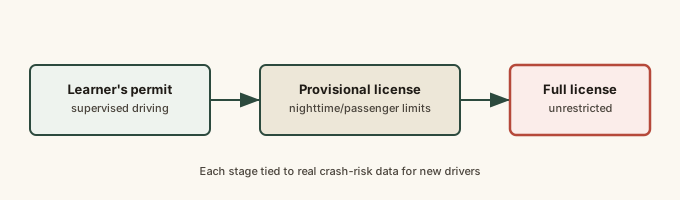
A 16-year-old obtains a learner's permit requiring supervised driving, then after a set period and passing a road test, moves to a provisional license with restrictions like limited nighttime driving, before eventually qualifying for a full unrestricted license at a set age. Each stage is a real legal boundary, not a formality — driving outside the current stage's restrictions (like driving alone at night on a provisional license, where restricted) is a genuine violation, not just a guideline.
Example 2: Moving to a new state (edge case / variation)
Someone relocating to a different state generally must surrender or replace their prior state's driver's license within a state-specific window (commonly a set number of days after establishing residency) and pass that new state's requirements, which can include a written test or vision screening even for an experienced driver — since licensing authority and requirements belong to the state, not to the individual as a portable, uniform national credential.
Quick check
Does a driver's license from one U.S. state automatically transfer with zero requirements when someone moves to a different state?
Example 3: A license suspension affecting non-driving uses (real-world / applied case)
Someone whose driver's license is suspended for a driving-related violation still needs valid photo ID for non-driving purposes like air travel or age verification. Depending on the state, a suspended license may still display as a physical card usable for identity purposes even though driving on it is illegal, or the person may need to apply for a separate state ID card — illustrating the practical friction that comes from a single document carrying both a legal driving authorization and an everyday identity function.
How it works (visual)
Graduated licensing stages for new drivers
Each stage exists as a genuine legal restriction tied to statistical crash-risk data for new drivers, not as an arbitrary waiting period.
Common mistakes
Common Mistakes
✕
Assuming a driver's license from one state works identically and indefinitely in a new state of residence.
→ Check the new state's specific requirements and timeline for new residents to obtain a local license, since requirements vary by state.
✕
Confusing REAL ID compliance with legal authorization to drive.
→ Understand these are separate: REAL ID affects acceptance for certain federal purposes like flying, not whether the license authorizes driving.
✕
Not realizing a state ID card exists as an option for non-drivers who need photo ID.
→ Apply for a state ID card through the same agency that issues driver's licenses if you need photo ID without driving privileges.
Common misconception
“A driver's license is fundamentally an identity document that also happens to permit driving.”
Legally, it's the reverse — a driver's license is fundamentally a state-issued authorization to operate a motor vehicle. Its widespread use as an identity document is a practical byproduct of it containing a photo and biographical details, not its original or primary legal purpose.
What to do next
What to do next
Check whether your current driver's license is REAL ID-compliant if you plan to fly domestically.
If you move to a new state, research that state's specific timeline and requirements for new residents obtaining a local license.
If you don't drive but need photo ID, apply for a state ID card through your state's motor vehicle agency.
If you're a parent of a new teen driver, understand your state's specific graduated licensing stages and restrictions before assuming your teen has full driving privileges.
FAQ
FAQ
Related terms
Related terms
Driver's license
A document issued by a state (or similar jurisdiction) that legally authorizes a person to operate a motor vehicle, and which also commonly serves as that person's primary everyday photo identification.
State ID card
A non-driving identity card issued by the same state agencies that issue driver's licenses, intended for people who need a state-issued photo ID but don't drive or hold a driver's license.
Graduated licensing
A staged licensing system, used for most new teen drivers in the U.S., that phases in full driving privileges over time (e.g. a learner's permit, then a provisional license with restrictions, then a full license) rather than granting unrestricted driving privileges immediately.
This entry was researched from public sources and drafted with AI-assisted tools, then edited — errors are still possible. Spot one, or want a topic covered? Read our disclaimer.
 KnowThis