An electronic signature is a broad legal category covering any electronic mark or process a person uses to signal intent to sign a document — typed names, click-to-sign buttons, and cursive-style images can all qualify — and it's legally recognized in the U.S. under federal and state law for most (though not all) types of documents; a digital ID is a related but separate concept referring to electronically verifiable proof of identity.
Reading time
— 4 min
Updated
— Aug 26, 2026
Fact-reviewed
— Aug 26, 2026
Key Takeaways
Key Takeaways
1An e-signature is legally defined broadly — a typed name, a click-to-sign action, or an image-based cursive signature can all qualify, since the law cares about intent to sign, not the visual style.
2The U.S. ESIGN Act generally gives electronic signatures the same legal weight as ink signatures, but specifically carves out exceptions — like wills and certain court documents — where it doesn't apply.
3A digital ID (electronically verifiable proof of identity) and an e-signature (evidence of intent to sign) are related but distinct concepts, often combined but not the same thing.
The concept
An e-signature is just any electronic way of showing you intend to sign something — typing your name at the bottom of an email, clicking "I Agree," or drawing your signature with a finger on a screen all count. Legally, in most cases, it works the same as signing on paper with a pen. A digital ID is a separate idea — it's about proving who you are electronically, like a mobile version of your driver's license, and it's often used alongside e-signatures but isn't the same thing.
The practical reason this matters is that assuming "e-signature" always means "casual and less binding" than a pen-and-paper signature can lead someone to sign something electronically without realizing it carries the same legal weight as if they'd signed it in ink.
Quick check
Does typing your name at the bottom of an electronic contract count as a valid signature under U.S. law?
Worked examples
Example 1: Signing a rental lease electronically (baseline case)
A tenant receives a lease through an e-signature platform, reviews it, and clicks to apply their electronic signature, which the platform records along with a timestamp and other verification metadata. This carries the same general legal weight as signing a printed lease with a pen, since a residential lease is a type of document electronic-signature law generally covers.
Example 2: Attempting to sign a will electronically (edge case / variation)
Someone tries to create a valid will using an e-signature platform, assuming it works the same as any other electronically signed document. In many jurisdictions, wills are specifically excluded from electronic-signature law and require traditional wet-ink signing, often with witnesses and sometimes notarization — meaning an e-signed will could later be challenged or found invalid precisely because this document type falls into one of the recognized carve-outs.
Quick check
Are all types of legal documents covered equally by U.S. electronic-signature law?
Example 3: Using a mobile driver's license for age verification (real-world / applied case)
Someone uses a state-issued mobile driver's license stored in a smartphone wallet app to verify their age at a store that accepts digital ID. The verification uses cryptographic methods designed to confirm the credential's authenticity without necessarily revealing the person's full physical ID or address, illustrating how digital ID technology can, in some cases, actually share less information than showing a physical card — a genuine privacy improvement over the traditional method, though acceptance still varies by business and jurisdiction.
How it works (visual)
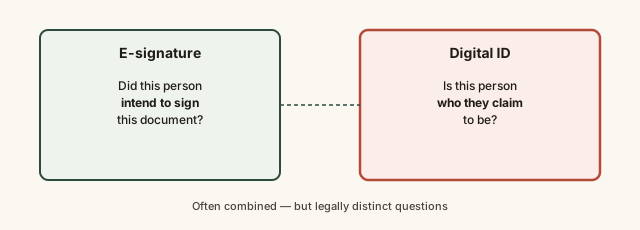
E-signature vs. digital ID: two related but separate concepts
Keeping these two questions separate — intent to sign versus proof of identity — clarifies why a platform can sometimes need both an e-signature and a separate identity-verification step for higher-stakes documents.
Common mistakes
Common Mistakes
✕
Assuming an e-signature is legally weaker or less binding than a handwritten one.
→ Recognize that U.S. law generally gives electronic signatures the same legal weight as ink signatures for most document types, based on intent and attribution, not visual style.
✕
Trying to sign a will or certain court documents using an ordinary e-signature platform.
→ Check whether the specific document type is one of the recognized carve-outs (like wills) that still require traditional wet-ink signing, often with witnesses or notarization.
✕
Confusing 'digital ID' and 'e-signature' as the same thing.
→ Remember an e-signature is about intent to sign, while a digital ID is about verifying who someone is — related concepts that are sometimes combined but answer different questions.
Common misconception
“An electronic signature has to look like a handwritten cursive signature to be legally valid.”
U.S. electronic-signature law defines a valid e-signature functionally, by demonstrated intent to sign and attribution to a specific person — not by visual appearance. A plainly typed name, made with clear intent to sign, can carry the same legal weight as an elaborate image-based signature.
What to do next
What to do next
Before signing anything electronically, confirm it isn't one of the document types (like a will) that's generally excluded from electronic-signature law in your jurisdiction.
Treat an e-signature request with the same seriousness as a physical signature request, since it generally carries the same legal weight.
Check whether your state offers a mobile driver's license or other digital ID option if you want a more privacy-preserving verification method.
For high-stakes documents (estate planning, court filings), consult a licensed attorney about whether electronic signing is appropriate before assuming it's valid.
FAQ
FAQ
Related terms
Related terms
Electronic signature (e-signature)
Any electronic sound, symbol, or process attached to or logically associated with a document, executed with the intent to sign it — a broad legal category that includes typed names, click-to-agree actions, and image-based signatures, not just a scanned handwritten mark.
ESIGN Act
A 2000 U.S. federal law establishing that electronic signatures and records generally carry the same legal weight as their paper, ink-signed equivalents, for most types of documents and transactions.
Digital ID
An electronically verifiable representation of a person's identity, which can range from a simple username/password account to a government-issued mobile driver's license or other cryptographically verifiable credential — a distinct concept from an e-signature, though the two are often used together.
This entry was researched from public sources and drafted with AI-assisted tools, then edited — errors are still possible. Spot one, or want a topic covered? Read our disclaimer.
 KnowThis