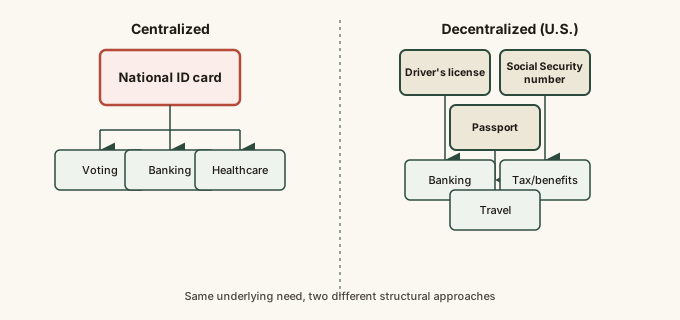
A national identity system is the set of documents and identifiers a government uses to let people prove who they are for legal, civic, and administrative purposes; some countries centralize this into a single mandatory ID card, while others — the U.S. among them — spread the function across state-level driver's licenses, Social Security numbers, and other overlapping identifiers.
Reading time
— 4 min
Updated
— Aug 26, 2026
Fact-reviewed
— Aug 26, 2026
Key Takeaways
Key Takeaways
1Countries differ sharply in whether they use a single mandatory national ID card or a decentralized combination of separate documents and numbers.
2The U.S. has no single mandatory national ID card — identity verification instead relies on a combination of state-issued driver's licenses/ID cards, the Social Security number, and (for travel) the passport.
3REAL ID is a U.S. federal minimum-security standard for state IDs, not a new national ID card — it changes what a state-issued license can be used for at the federal level, not who issues it.
The concept
A national ID system is just whatever combination of documents a country uses to answer the basic question "who is this person, legally?" Some countries hand every citizen a single centralized ID card used for essentially everything. The U.S. instead spreads that function across several separate pieces — a state-issued driver's license or ID card for everyday photo ID, a Social Security number for tax and benefits purposes, and a passport for international travel — with no single card that does all three jobs at once.
The practical upshot for someone living in the U.S. is that no single document does everything — knowing which document is needed for which purpose (voting, flying, opening a bank account, proving work eligibility) matters more than it would under a single centralized card system.
Quick check
Is REAL ID a new national ID card issued by the federal government?
Worked examples
Example 1: Opening a U.S. bank account (baseline case)
A bank typically requires a government-issued photo ID (a driver's license or state ID card) plus a Social Security number for tax-reporting purposes. Neither document alone satisfies the requirement — the photo ID proves who is physically present, while the SSN links the account to the correct taxpayer record, illustrating how the decentralized U.S. system routinely requires combining two separate documents to do what a single national ID card might do elsewhere.
Example 2: Flying domestically without a REAL ID-compliant license (edge case / variation)
Someone with an older, non-REAL-ID-compliant state driver's license attempts to board a domestic flight after the federal enforcement deadline. Depending on current federal enforcement policy, they may need to present an alternative acceptable ID (such as a passport) or undergo additional identity verification — a concrete example of how REAL ID compliance is a real, enforceable federal requirement layered on top of a state-issued document, not a symbolic distinction.
Quick check
Someone's driver's license is not REAL ID-compliant. Does this affect their ability to legally drive?
Example 3: Someone who moves to the U.S. from a country with a centralized national ID card (real-world / applied case)
A new resident accustomed to a single all-purpose national ID card has to instead assemble several separate U.S. documents over time — a Social Security number application, a state driver's license or ID card application, and potentially other identity documents depending on immigration status — since no single U.S. document replicates what their home country's card did. Understanding this structural difference up front generally saves considerable confusion compared to expecting one document to serve every purpose.
How it works (visual)
Centralized vs. decentralized identity systems
Neither approach is inherently more secure — they're different design choices for the same underlying problem, with different tradeoffs in convenience, privacy concentration, and administrative complexity.
Common mistakes
Common Mistakes
✕
Carrying a physical Social Security card routinely as if it were a general-purpose photo ID.
→ Keep the Social Security card in a secure location and use a state driver's license or state ID card for everyday identity verification instead.
✕
Assuming a driver's license is automatically valid for boarding a domestic flight regardless of its REAL ID status.
→ Check whether a specific license is REAL ID-compliant (often marked with a star) well before travel, and carry a passport as an alternative acceptable ID if unsure.
✕
Treating REAL ID as a new document to apply for separately.
→ Recognize REAL ID as a compliance standard applied to an existing state driver's license or ID card renewal, not a separate application process.
Common misconception
“The United States has an official national ID card that every citizen is required to carry, similar to systems used in many other countries.”
The U.S. has no single mandatory national ID card. Identity verification instead relies on a decentralized combination of state-issued driver's licenses or ID cards, the Social Security number, and — for international travel — the passport, each serving a different, narrower purpose.
What to do next
What to do next
Confirm whether your state driver's license or ID card is REAL ID-compliant before relying on it for domestic air travel.
Keep your Social Security card stored securely rather than carried daily, and know your number without needing the physical card for routine use.
Understand which document is required for which purpose (voting, banking, travel, employment eligibility) rather than assuming one document covers all of them.
If you're new to the U.S. system, prioritize obtaining a Social Security number and a state ID or driver's license early, since many other processes depend on having them.
FAQ
FAQ
Related terms
Related terms
National ID system
The overall set of documents, numbers, and processes a country uses to let individuals prove their identity for legal and administrative purposes — this can be a single centralized card or a decentralized combination of separate documents.
Social Security number (SSN)
A unique nine-digit number issued by the U.S. Social Security Administration, originally created to track earnings for retirement benefits but now widely used as a general identity and tax identifier — not itself a photo ID.
REAL ID
A set of minimum U.S. federal security standards for state-issued driver's licenses and ID cards, established after the REAL ID Act of 2005, that determines whether a state-issued ID can be used for certain federal purposes like boarding a domestic flight.
This entry was researched from public sources and drafted with AI-assisted tools, then edited — errors are still possible. Spot one, or want a topic covered? Read our disclaimer.
 KnowThis