Landlord Responsibilities Basics (Factual General Overview)
Landlord responsibilities are the legal obligations that generally accompany renting out a property to a tenant — most notably maintaining habitable conditions, complying with fair housing/anti-discrimination law, providing proper notice before entering a rented unit, and following the correct legal process for eviction — and while specific rules vary by jurisdiction, these categories of obligation recur widely across rental law systems.
Reading time
— 4 min
Updated
— Aug 26, 2026
Fact-reviewed
— Aug 26, 2026
Key Takeaways
Key Takeaways
1A landlord's core obligations generally include maintaining habitable conditions, complying with fair housing law, giving proper notice before entering the unit, and following the legal eviction process.
2Fair housing rules apply throughout the rental relationship — in advertising, screening applicants, and day-to-day treatment of tenants — not just at the point of signing a lease.
3A landlord's obligations exist independently of a tenant's own behavior — a tenant being late on rent doesn't suspend the landlord's separate habitability or notice-to-enter obligations.
The concept
Being a landlord comes with a set of legal duties that exist whether or not the lease spells them out. The main ones: keep the unit in livable condition, don't discriminate against applicants or tenants based on protected characteristics, give advance notice before entering the unit for non-emergencies, and follow the proper legal process to remove a tenant rather than acting unilaterally. These obligations run alongside whatever specific terms are in the lease.
Because these obligations exist independently of the tenant's own conduct, a landlord can't treat a tenant's late rent payment as a reason to skip notice-to-enter requirements or delay urgent habitability repairs.
Quick check
A tenant is two months behind on rent. Does this change the landlord's obligation to give proper notice before entering the unit for a routine, non-emergency inspection?
Worked examples
Example 1: Giving proper notice before a routine inspection (baseline case)
A landlord wants to inspect a unit's smoke detectors annually. Following typical notice requirements, they send written notice 48 hours in advance, stating the date, approximate time window, and purpose of the visit. This is the standard, compliant way to exercise a landlord's legitimate right to access the property for a non-emergency purpose.
Example 2: A genuine emergency entry without advance notice (edge case)
A neighboring unit reports water leaking through a shared ceiling, suggesting a burst pipe. The landlord enters the affected unit immediately, without the usual 24-48 hour notice, to address the active emergency. Most jurisdictions recognize a genuine emergency exception to standard notice requirements — the key distinguishing factor is whether the situation actually poses an immediate risk of harm or serious property damage, not merely landlord convenience.
Example 3: A long-ignored repair request escalating into a legal dispute (real-world / applied case)
A tenant reports a broken heating system in a cold-climate rental in October and follows up repeatedly through January without the landlord making repairs. Depending on the jurisdiction and how severe the loss of heat is, this pattern could potentially support a habitability complaint, a rent-withholding remedy (where legally recognized), or, in more extreme and sustained cases, a constructive eviction claim — which specific remedy applies, and under what conditions, depends heavily on local law, making this exactly the kind of situation where consulting a local tenant rights organization or attorney (from the tenant's side) is more reliable than assuming a generic outcome.
Quick check
Can a landlord refuse to rent to an applicant because of their religion?
How it works (visual)
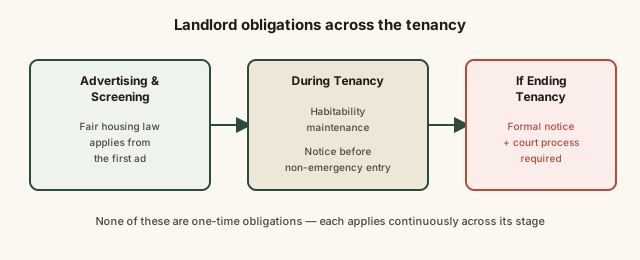
Core landlord obligations over the life of a tenancy
Fair housing obligations start before a lease is even signed, and habitability/notice obligations continue throughout the tenancy — none of these are one-time boxes to check.
Common mistakes
Common Mistakes
✕
Assuming fair housing rules only apply once a lease is signed, not during advertising or screening.
→ Apply fair housing standards consistently from the advertising and applicant-screening stage onward, not just during an active tenancy.
✕
Entering a rented unit without proper advance notice for non-emergency reasons.
→ Provide the required advance written notice (commonly 24-48 hours, check local rules) except in genuine emergencies.
✕
Treating a tenant's late rent as justification for skipping the landlord's own separate legal obligations.
→ Keep habitability maintenance and notice-to-enter obligations current regardless of a tenant's payment status — pursue rent issues through the proper legal channel instead.
Common misconception
“A landlord can enter a rental unit at any time, since they own the property.”
Ownership of a property doesn't override a tenant's legal right to quiet enjoyment and advance notice during an active tenancy. Most jurisdictions require a landlord to give advance written notice before non-emergency entry, with only genuine emergencies (like an active fire or serious leak) typically treated as an exception.
What to do next
What to do next
Review the fair housing protected characteristics that apply in your jurisdiction, since the list often extends beyond national minimums at the state or city level.
Confirm the required advance notice period for entering a rented unit for non-emergency purposes.
Address habitability-related repair requests promptly and document the timeline of requests and responses.
If facing an eviction decision, follow the legally required notice-and-court process rather than acting unilaterally.
For an unfamiliar or high-stakes situation, consult a local landlord-tenant attorney or housing authority.
FAQ
FAQ
Related terms
Related terms
Fair housing law
Legal rules prohibiting discrimination in renting or selling housing based on protected characteristics such as race, religion, national origin, sex, familial status, or disability, among others depending on jurisdiction.
Notice to enter
A required advance notification a landlord generally must give a tenant before entering a rented unit for non-emergency purposes, with the required notice period varying by jurisdiction.
Constructive eviction
A situation where a landlord's failure to maintain habitable conditions is severe enough that a tenant can treat the lease as effectively ended and move out, even without a formal eviction — recognized in some jurisdictions under specific conditions.
A tenant signs a 12-month lease. Three months in, the landlord wants to raise the rent because a neighboring unit is renting for more. Can the landlord do this mid-lease?
This entry was researched from public sources and drafted with AI-assisted tools, then edited — errors are still possible. Spot one, or want a topic covered? Read our disclaimer.
 KnowThis