 KnowThis
Key Takeaways
Key Takeaways
- 1A contract doesn't need to be a formal printed document to be enforceable — many verbal and even implied agreements can be legally binding, though written contracts are far easier to prove and enforce in a dispute.
- 2A notary verifies who signed a document and that they signed willingly — a notary does not verify that the document's contents are true, fair, or legally sound.
- 3Dying without a will doesn't mean your belongings default to the government in most cases — it means a jurisdiction's standard intestate succession rules decide who inherits, which usually favors close relatives but may not match what the deceased actually wanted.
The concept
Three myths recur across very different document types: how binding a verbal agreement actually is, what a notary is actually certifying, and what happens to someone's belongings when they die without a will.
What does a notary's stamp on a document actually certify?
Worked examples
Example 1: A verbal agreement to do freelance work (baseline case)
Example 2: Assuming a notarized document is automatically "legal" (edge case / variation)
Example 3: Dying without a will (real-world / applied case)
If someone dies without a will, what generally happens to their belongings?
How it works (visual)
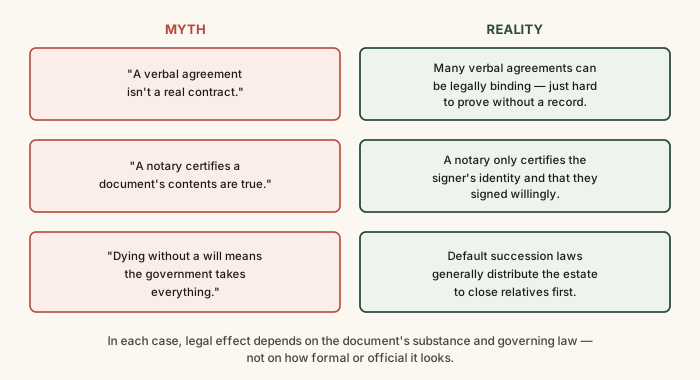
In each case, the myth assumes a document's formality and its actual legal effect move together — while the reality is that each type of document has a specific, narrower scope than intuition suggests.
Common mistakes
Common Mistakes
Treating a verbal agreement as informal and therefore not real or enforceable.
→ Recognize that many verbal agreements can be legally binding — the real weakness is proof in a dispute, not enforceability itself, which is exactly why important agreements should be put in writing regardless.
Assuming a notarized document has been legally reviewed or approved.
→ Understand notarization as an identity/willingness check only — have an actual attorney review a document's substance if that's what you need.
Assuming that without a will, an estate automatically goes to the government.
→ Understand that intestate succession laws generally prioritize close relatives first — government ownership is a rare fallback, not the default outcome.
Common misconception
“If it's not a formal, printed, and signed document, it doesn't count legally.”
Legal weight and physical formality are related but not the same thing. Many verbal and informal agreements carry real legal force, while some formal-looking documents (like a notarized but poorly drafted contract) can still contain unenforceable or one-sided terms. What actually determines a document's legal effect is its substance and the law governing that type of agreement — not how official it looks.
What to do next
What to do next
- Put important agreements in writing even when a verbal agreement might technically be enforceable — it removes the proof problem entirely.
- Don't mistake a notary stamp for legal review — have an attorney check a document's actual terms if that's the protection you need.
- If you don't have a will, treat that as an active decision to accept your jurisdiction's default succession rules rather than choosing your own — write one if that default doesn't match your wishes.
- When in doubt about whether a specific document or agreement is legally binding or protective, consult a licensed attorney rather than relying on general assumptions.