 KnowThis
Key Takeaways
Key Takeaways
- 1Legal document scams almost always combine three ingredients: manufactured urgency, an unusual or untraceable payment method, and a request for sensitive documents or information before you can verify anything.
- 2Real legal processes — court service, notarization, government filings — follow predictable, verifiable procedures; a scammer's version usually skips or shortcuts a step a real process would never skip.
- 3The fastest way to check a document's legitimacy is to independently look up the sender (court clerk's office, notary registry, government agency phone number) rather than using contact information provided in the suspicious document itself.
The concept
Three scam patterns account for a large share of legal-document fraud: fake notarization or document-preparation services, fake process-server or court-notice scams, and fraudulent rental or lease documents. Each follows the same underlying structure with different props.
What is the single most reliable way to check whether a legal document or notice is genuine?
Worked examples
Example 1: The fake notarization / document-prep scam (baseline case)
Example 2: The fake process-server / court-notice scam (edge case / variation)
Example 3: The fraudulent rental listing / lease document (real-world / applied case)
Why is a demand for payment via gift card or wire transfer a major red flag in a legal-document scam?
How it works (visual)
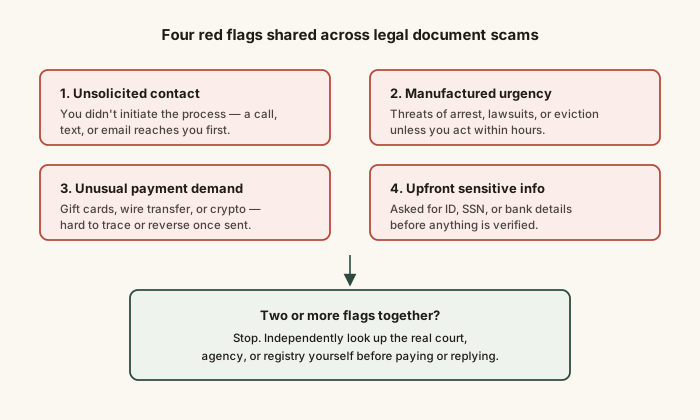
No single red flag proves a scam by itself, but a document or message combining two or more of these should be independently verified before any payment or personal information is provided.
Common mistakes
Common Mistakes
Using contact information printed on the suspicious document itself to 'verify' it.
→ Independently look up the court, agency, notary registry, or company through an official website or phone directory — never the number or link the document provides.
Assuming official-looking letterhead, legal jargon, or a case number proves a document is genuine.
→ Treat visual polish and legal-sounding language as neutral — scammers can and do replicate them convincingly. Verification requires an independent check, not a visual inspection.
Acting immediately because a message threatens arrest, a lawsuit, or an urgent deadline within hours.
→ Real legal processes almost always provide a real, verifiable timeline of days or weeks, not hours — extreme urgency is itself a manipulation tactic, not a normal feature of legitimate legal processes.
Common misconception
“Scammers only target people who are careless or unfamiliar with legal processes.”
Legal document scams are specifically designed to look convincing to careful, attentive people — they mimic real processes closely and often target moments of genuine urgency (an actual pending legal matter, a real apartment search) precisely because that's when a target is most likely to act quickly. Recognizing the pattern (unsolicited contact, urgency, unusual payment, upfront sensitive information) matters more than general caution alone.
What to do next
What to do next
- If a document or message demands payment via gift card, wire transfer, or cryptocurrency, treat that alone as a strong warning sign and stop before proceeding.
- Independently look up the issuing court, agency, notary registry, or company through an official website or phone directory — never the contact details the document itself provides.
- Never wire money or provide sensitive documents (ID, Social Security number, bank details) before independently verifying the other party's identity and legitimacy.
- Report a suspected scam at reportfraud.ftc.gov, and if in doubt about a genuine legal matter, contact a licensed attorney or your local court clerk's office directly.