 KnowThis
Key Takeaways
Key Takeaways
- 1A class action allows a small number of representative plaintiffs to sue on behalf of a larger group who suffered similar harm, once a court formally certifies the class.
- 2Class members are typically included automatically after being notified, unless they take an affirmative step to opt out and pursue their own separate claim instead.
- 3Any settlement fund is generally divided among the remaining class members according to a distribution plan, which can be an equal split or weighted by factors like the size of each person's claimed harm.
The concept
A few concrete scenarios show how certification, notice, and distribution actually play out for the people involved.
What generally happens to someone who is part of a certified class action but does nothing after receiving notice?
Worked examples
Example 1: A straightforward consumer class action settlement (baseline case)
Example 2: A class member who opts out to pursue an individual claim (edge case / variation)
Example 3: A settlement distributed by a weighted formula rather than an equal split (real-world / applied case)
Why might a class action settlement's distribution plan not divide the fund equally among all claimants?
How it works (visual)
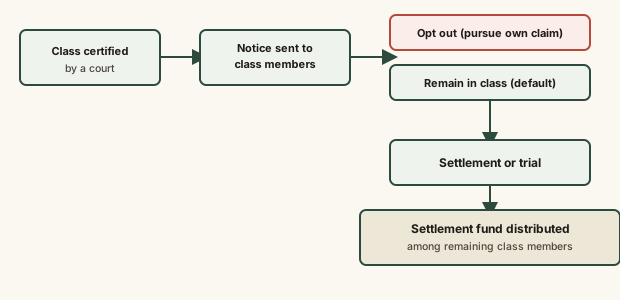
The opt-out decision point is the one moment class members have direct control over — everything before and after generally happens on the case's own timeline.
Common mistakes
Common Mistakes
Ignoring a class action notice, assuming it doesn't matter if you do nothing.
→ Read any class action notice carefully — doing nothing typically keeps you in the class and bound by the outcome, which may or may not be what you want.
Assuming a reported settlement total translates directly into a large individual payout.
→ Recognize that attorneys' fees, administrative costs, and the number of claimants all reduce the actual amount any individual class member receives.
Missing the opt-out deadline after deciding you'd rather pursue an individual claim.
→ Act within the specific window stated in the class notice — opt-out rights are generally time-limited and can't be exercised after the deadline passes.
Common misconception
“Everyone affected by the same issue automatically gets an equal, meaningful payout from a class action.”
Distribution formulas vary by case and are subject to court approval — some settlements split funds equally, others weight payouts by documented harm, and after legal fees and administrative costs are deducted, individual payouts are often far smaller than the total settlement figure reported in headlines.
Try it yourself
Illustrates a simple equal-share distribution of a settlement fund among claimants. Real settlements often use a weighted formula instead — this is a simplified illustration, not a prediction of any actual payout.
This is a simplified illustration assuming an equal split with no deductions for legal fees or administrative costs, which real settlements almost always include. It is not a projection of any actual class action payout.
What to do next
What to do next
- Read any class action notice you receive carefully, and note both the opt-out deadline and the claims-filing deadline, which are often different dates.
- Decide whether remaining in the class or opting out to pursue an individual claim better fits your situation, especially if your individual harm may be unusually large.
- Keep documentation (receipts, records) that could support a larger weighted share if the distribution plan isn't a flat equal split.
- Consult a licensed attorney if you're considering opting out, since pursuing an individual claim carries its own costs and is not guaranteed to produce a better outcome.