 KnowThis
Key Takeaways
Key Takeaways
- 1An exponent is shorthand for repeated multiplication, not multiplication by the exponent: 2³ means 2 × 2 × 2 = 8, not 2 × 3 = 6.
- 2The core exponent rules — multiplying same-base powers adds exponents, raising a power to a power multiplies exponents, any base to the power of 0 equals 1 — all fall directly out of consistently counting multiplications, not arbitrary conventions.
- 3A negative exponent means 'take the reciprocal,' not 'make the result negative': 2⁻³ = 1/2³ = 1/8, a small positive fraction, never -8.
The concept
What is 2³?
Worked examples
Example 1: Computing 2⁵ directly (baseline case)
Example 2: Zero and negative exponents (edge case / variation)
Simplify 3⁴ × 3².
Example 3: Bacterial growth doubling every 20 minutes (real-world / applied case)
A bacterial culture starts with 1 cell and doubles every 20 minutes under ideal lab conditions. After 3 hours (180 minutes), the culture has doubled 180 ÷ 20 = 9 times. The population after n doublings is 2ⁿ, so after 9 doublings the population is 2⁹ = 512 cells — from a single starting cell to 512 in just three hours. This is exactly why exponential growth catches people off guard: for the first several doublings the numbers stay small and unremarkable (1, 2, 4, 8...), but the exponent, not the base, is what's driving the growth, and a handful more doublings pushes the total into the thousands and beyond very quickly.
How it works (visual)
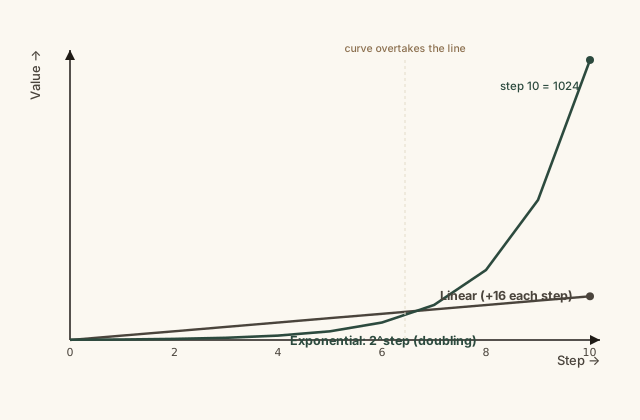
For the first few steps, the exponential curve (doubling: 2, 4, 8, 16) looks unremarkable next to the steadily climbing linear line. Past roughly the halfway point, the exponential curve bends sharply upward and overtakes the linear one permanently — this crossover is the visual signature of exponential growth, and it's exactly why early-stage exponential processes (population growth, compounding, viral spread) are so easy to underestimate: the "boring" early steps and the "explosive" later steps are the same formula, just evaluated at different points along the same curve.
Common mistakes
Common Mistakes
Treating the exponent as a multiplier instead of a repetition count (computing 2³ as 2 × 3 = 6).
→ An exponent tells you how many times to multiply the base by itself. 2³ means 2 × 2 × 2 = 8, not 2 × 3.
Assuming a negative exponent makes the whole result negative (thinking 2⁻³ = -8).
→ A negative exponent means take the reciprocal: 2⁻³ = 1/2³ = 1/8, a positive fraction, never negative.
Applying the product rule (add the exponents) to powers with different bases, like treating 2³ × 3² as 6⁵.
→ The add-the-exponents shortcut only applies when the bases match. With different bases, compute each power separately first (2³ = 8, 3² = 9) and then multiply the results (8 × 9 = 72).
Common misconception
“A negative exponent means the result is a negative number.”
A negative exponent controls position relative to 1, not sign. b^-n is defined as 1/b^n — a reciprocal — and since b^n is positive whenever b is positive, 1/b^n is positive too. 10⁻³ = 1/1000 = 0.001, a small positive number, not -1000 or -0.001. The confusion comes from negative numbers showing up everywhere else in math as "make it negative" — but in an exponent, a minus sign specifically means "flip to the reciprocal," a completely different operation from negating a value.
Is 5⁻² a positive number or a negative number?
Try it yourself
What to do next
What to do next
- Practice writing out an exponent as repeated multiplication (2⁵ = 2×2×2×2×2) before computing it, until the difference between b^n and b×n feels automatic.
- Next time you see a negative exponent, immediately rewrite it as 1 over the positive power before doing anything else — that single rewrite prevents almost every negative-exponent mistake.
- Try doubling a starting value (like $1, or 1 bacterium) ten times in a row by hand, and notice exactly where the growth stops feeling 'small' — that's exponential growth's characteristic late acceleration.
- Read the related entry on Squares, Cubes & Roots to see the two most common exponents, 2 and 3, and their inverse root operations in more depth.