 KnowThis
Key Takeaways
Key Takeaways
- 1A subscription billing system tracks one core piece of state — active or not active — and re-checks it on a fixed recurring cycle, not a rolling window that resets from whenever you happen to log in.
- 2The only charge that's ever partial is the very first one, used to align an arbitrary sign-up date to the service's fixed billing date; every renewal after that is a full-price charge for a full cycle.
- 3Cancellation timing and refund timing are two different mechanisms — cancelling stops future charges from that point forward, but it doesn't automatically mean the current, already-paid-for period is refunded.
The concept
Every billing quirk people notice — a smaller-than-expected first charge, a full-price renewal every month after that regardless of usage, or access continuing briefly after a card issue — comes from this same underlying loop: track one state, resync it to a fixed schedule, prorate only at the seam where a variable sign-up date meets that fixed schedule.
Why is the very first charge on a new subscription sometimes smaller than the advertised monthly price?
Worked examples
Example 1: Signing up mid-cycle and the first prorated charge (baseline case)
After the first prorated charge, why does every subsequent charge become the full monthly price?
Example 2: Cancelling mid-cycle and what actually happens to the current period (edge case / variation)
A subscriber cancels on day 10 of a 30-day cycle they already paid for in full. What should they expect by default?
Example 3: A failed payment and the grace period before suspension (real-world / applied case)
A subscriber's card expires the day before a scheduled renewal charge. The charge fails, but the subscriber doesn't lose access immediately — the billing system flags the account and begins a dunning process, retrying the charge over the following days and sending notifications, while access continues during that grace period. Only if the retries keep failing and the grace period ends does the account's state actually flip to suspended. This is the same state-tracking loop as the sign-up case, just running in the failure direction: the system doesn't assume "payment failed" means "access should end instantly."
Why might someone keep streaming access for a few days after their card on file expires and a renewal charge fails?
How it works (visual)
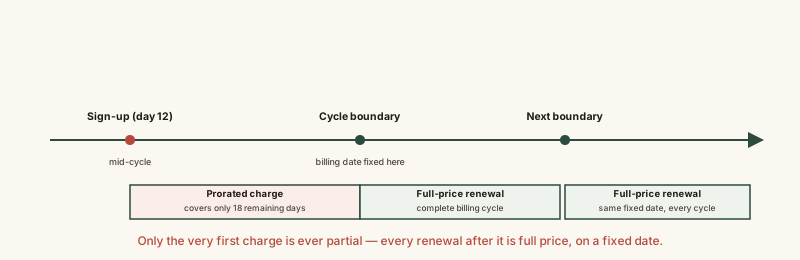
Notice that proration only ever appears once, at the seam between an arbitrary sign-up date and the service's fixed billing date — after that, the timeline is just full-price charges repeating on a schedule.
Try it yourself
Enter a monthly price, the length of the billing cycle in days, and how many days remain until the fixed billing date to estimate that first partial charge.
Illustrative estimate only — actual providers may prorate by exact day counts, calendar months, or round differently; check a specific service's own billing terms for the exact method used.
Common mistakes
Common Mistakes
Assuming every partial-looking charge on a subscription statement is a billing error.
→ Check whether it lines up with a mid-cycle sign-up or plan change first — proration produces a legitimately smaller charge by design, not by mistake.
Believing cancelling a subscription automatically refunds the unused portion of the current period.
→ Treat cancellation and refunds as separate mechanisms — cancelling stops future renewal charges, but a refund for the current already-paid period is a distinct request, not automatic by default.
Assuming a failed card charge means access ends that exact instant.
→ Expect a short grace period with automatic retry attempts (dunning) before an account is actually suspended — update the payment method promptly rather than assuming access is already gone.
Common misconception
“Streaming subscriptions always bill the same way regardless of when you signed up.”
The billing date is fixed by the service, not by the day you joined — which is exactly why a first charge is often prorated to a smaller, partial amount. Two people who joined the same plan on different days of the month can have completely different first-charge amounts and different fixed renewal dates, even though their ongoing full-price charge ends up identical once their own cycle stabilizes.
What to do next
What to do next
- If a first subscription charge looks smaller than expected, check the sign-up date against the billing cycle before assuming it's an error — it's likely proration.
- When cancelling, don't assume a refund for the current period is automatic — check the service's specific refund policy if you want the unused portion back.
- Update an expiring payment method before the renewal date rather than after — grace periods exist, but they aren't unlimited.
- Read How Online Payments Actually Get Processed next to see what happens technically each time a recurring charge is submitted for approval.