 KnowThis
Key Takeaways
Key Takeaways
- 1An online payment passes through a chain of separate parties — merchant, payment processor, card network, issuing bank — and only the issuing bank at the far end actually decides whether to approve or decline it.
- 2The merchant's website never sees your full card details in the clear for longer than the initial capture; that data is encrypted and typically tokenized so the real number isn't repeatedly exposed as it moves down the chain.
- 3A 'declined' payment can mean several different things happening at different links in the chain — insufficient funds, a fraud flag, or an expired card each produce the same visible message but different underlying causes.
The concept
Every behavior a shopper notices — a checkout that finishes in a couple of seconds, a decline with no clear reason given, or a receipt that shows only the last four digits of a card — comes from this same structure: a chain of separate parties, each only able to relay and verify, with the real decision made at just one link.
Why can't the checkout page on a merchant's website approve a card payment by itself?
Worked examples
Example 1: A normal approved checkout (baseline case)
In a normal successful online payment, which party actually makes the decision to approve the charge?
Example 2: A decline with no visible reason given (edge case / variation)
Why does a declined online payment often show only a generic message instead of the specific reason?
Example 3: Why a receipt shows a tokenized card number, not the real one (real-world / applied case)
A customer checks a saved payment method on a merchant's site and sees only the last four digits alongside a card type, rather than the full number. Behind that display, the merchant's systems are very likely storing a token — a substitute value generated during tokenization — rather than the real card number at all. When that saved method is used again, the merchant sends the token, and the payment processor (which holds the mapping between the token and the real card) is the one that translates it back for the authorization request. This limits how much of the payment chain ever handles the actual card number directly, which is central to what PCI DSS requirements are designed to reduce.
When a merchant's site shows a saved card as only the last four digits, what does that suggest about how the merchant is storing that payment method?
How it works (visual)
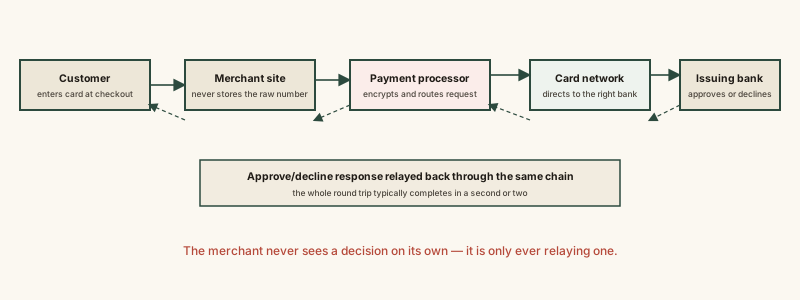
Follow the arrows in both directions: the request travels one way to reach the only party that can actually decide, and the decision travels back the same path in reverse — nothing in the middle makes an independent call.
Common mistakes
Common Mistakes
Assuming a merchant's website decides whether a payment is approved or declined.
→ Recognize the merchant only relays the request and displays the result — the actual decision is made by the customer's issuing bank, several links down the chain.
Treating every decline as the same kind of problem (usually assumed to be insufficient funds).
→ Remember a generic decline can hide several different causes — an expired card, a fraud flag, or a temporary hold can all produce an identical-looking decline message.
Believing a saved card number on a merchant's site means the merchant is storing your full card number.
→ Understand that a masked, last-four-digits display commonly reflects a stored token, not the actual card number, precisely because handling less real card data reduces both risk and compliance burden.
Common misconception
“Online payments are approved instantly by the website you're buying from, based on your entered card details alone.”
A checkout page has no authority to approve a payment on its own. The request is relayed through a payment processor and a card network to the customer's actual issuing bank, which is the only party able to check the account and make a real decision. The "instant" feeling comes from how fast that multi-party round trip completes — typically a second or two — not from the merchant deciding anything itself.
What to do next
What to do next
- If a payment declines with no clear reason, contact your card's issuing bank directly rather than assuming the merchant's site is at fault — the bank is the party that actually made the decision.
- Look for a masked card display (like last-four digits) as a reasonable sign that a merchant is using tokenization rather than storing your full card number.
- Check that a checkout page uses an encrypted connection before entering card details — that encryption is what protects the first leg of the chain, from your browser to the payment gateway.
- Read How Streaming Subscriptions Actually Bill You next to see how this same authorization chain gets reused for every automatic recurring charge, not just one-time purchases.