 KnowThis
Key Takeaways
Key Takeaways
- 1Uptime is a measured percentage of time a service actually works, not a promise that nothing will ever fail — the number describes an outcome, achieved through redundancy.
- 2The gap between uptime percentages is much larger in practice than the numbers suggest: 99% uptime allows for roughly 3.65 days of downtime a year, while 99.99% allows for only about 52 minutes.
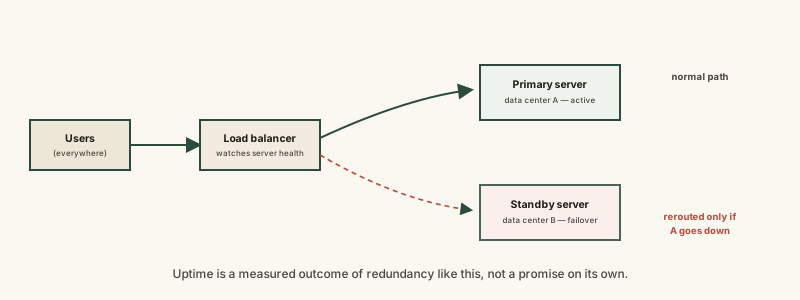
- 3High uptime is typically achieved with redundant servers and automatic failover, not by making one server that simply never breaks — individual machines fail regularly, and the system is designed around that fact.
The concept
Once uptime is understood as a designed outcome of redundancy rather than an assumption that nothing ever breaks, the size of the gap between different uptime percentages — and why providers charge more for higher guarantees — makes a lot more sense.
A hosting provider advertises '99.9% uptime.' What does this actually guarantee?
Worked examples
Example 1: Comparing 99% and 99.9% uptime over a year (baseline case)
Two services advertise 99% and 99.9% uptime. Written side by side, the numbers look almost the same. How different is the actual allowed downtime per year?
Example 2: A server failing during a failover system's test (edge case / variation)
A primary server fails, but users barely notice any disruption because a backup server took over within seconds. What does this demonstrate?
Example 3: Reading a service-level agreement's uptime clause (real-world / applied case)
A business evaluating a cloud provider for a critical application reads the provider's service-level agreement (SLA) and finds it guarantees 99.95% uptime, with defined compensation (typically service credits) if that threshold isn't met in a given month. Rather than treating "99.95%" as an abstract marketing number, the business calculates what it actually means in practice: roughly 21.9 minutes of allowed downtime per month. This kind of concrete translation — converting a percentage into real minutes or hours — is exactly how uptime figures should be evaluated when choosing a provider for something where downtime has real business consequences.
A business reads a cloud provider's SLA promising 99.95% uptime. Why does the business bother converting that percentage into actual minutes of allowed downtime per month?
How it works (visual)
Common mistakes
Common Mistakes
Treating 99% and 99.9% uptime as nearly the same because the numbers look close.
→ Convert the percentage into actual downtime minutes or hours over a year — the real-world gap between adjacent 'nines' is roughly tenfold, not marginal.
Assuming high uptime means a provider's hardware never fails.
→ High uptime is typically achieved through redundancy and automatic failover despite regular individual hardware failures, not by preventing failure altogether.
Assuming a service counted as 'up' is necessarily working correctly and at full speed.
→ Some uptime definitions only measure whether a service responds at all, not whether it's performing normally — check an SLA's exact definition of 'available' for anything business-critical.
Common misconception
“99% uptime is basically the same as 100% — close enough not to worry about.”
99% uptime allows for roughly 3.65 days of downtime across a year — noticeably more than a rounding error. By comparison, 99.99% uptime allows only about 52 minutes a year. The percentages look close written next to each other, but converting them into actual downtime reveals a difference of days versus minutes, which is exactly why providers charge meaningfully more for each additional "nine" of guaranteed uptime.
Try it yourself
See how many minutes of downtime per year a given uptime percentage actually allows.
Assumes a full calendar year (525,600 minutes) — some SLAs measure and prorate downtime monthly instead.
What to do next
What to do next
- Convert any advertised uptime percentage into actual downtime minutes or hours before judging whether it's meaningful for your use case.
- When choosing a provider for something critical, read the SLA's exact definition of 'available,' not just the headline percentage.
- Understand that high uptime comes from redundancy and failover design, not a promise that hardware won't fail.
- Read What a Server Actually Is next if the client/server mechanics behind an individual server failing and being replaced aren't yet clear.